
Employee Onboarding and Background Verification Software in Dubai (2026): Real AED Costs and the 5-Day Work Bundle
The UAE ran 253,000 qualification checks by September 2026 and MoHRE cut onboarding from 30 days to 5. Real AED costs for Dubai onboarding and screening software.
- PUBLISHED
- 31 OCT 2026
- READ TIME
- 12 MIN
- AUTHOR
- AQUARIUS · DUBAI
- UNIT
- REV 2026.09
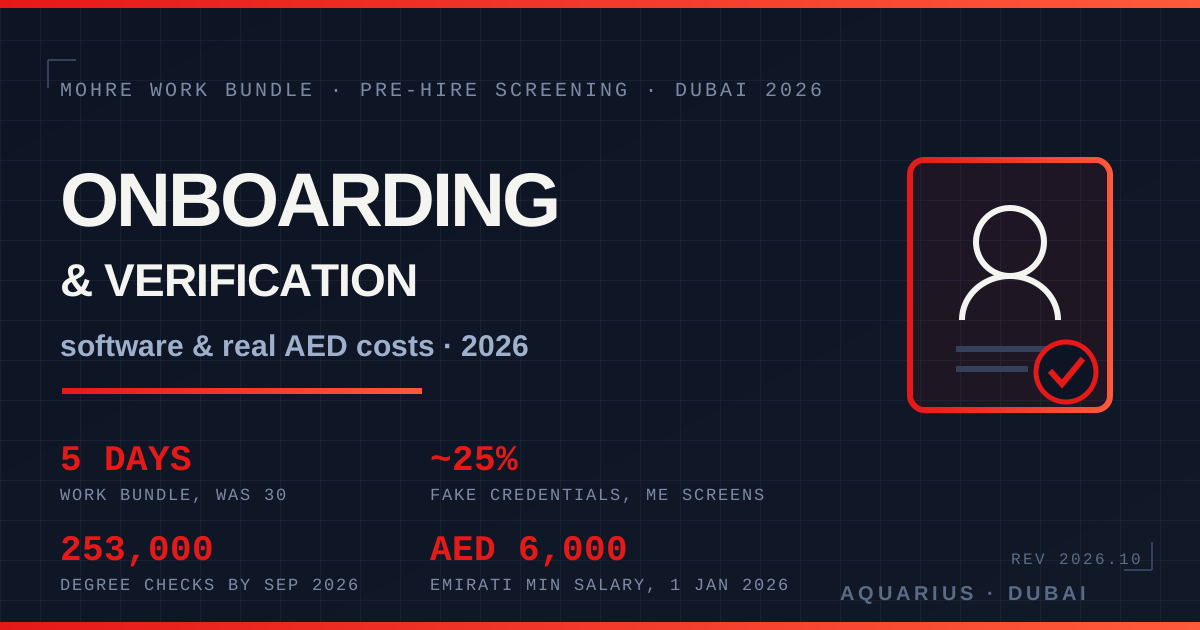
Short answer: onboarding software in Dubai is not an HR nicety, it is the system that runs three government clocks at once — the MoHRE work permit, the ICP residence file and the Emirates ID — plus the pre-hire screening that decides whether the person you just sponsored is who their CV says they are. The UAE processed 253,000 academic qualification verification requests by early September 2026, up from 178,600 in all of 2025, and corporate screeners put the share of Middle East candidates holding fake degrees at roughly 25%. A ready HRMS costs AED 15 to 50 per employee per month; a custom onboarding and verification platform that actually mirrors MoHRE, ICP and your screening vendor runs AED 45,000 to 350,000 to build.
The numbers that should worry every Dubai hiring manager
Start with the fraud side, because it has moved faster than anyone's process. The UAE Ministry of Higher Education and Scientific Research handled 178,600 qualification verification requests in 2025, and by the beginning of September 2026 that figure had already reached 253,000 (The National, 14 September 2026). Forging a qualification in the UAE carries up to three years in jail and a Dh30,000 fine, and under Article 252 of Federal Decree-Law No. 31 of 2021 official document forgery can reach 10 years.
Screening firms see the other end of that funnel. Quest Research puts the proportion of people screened in the Middle East who hold fake academic degrees or certificates at nearly 25%. And the threat is no longer a doctored PDF: Gartner predicts that by 2028 one in four candidate profiles globally will be fake or materially misleading, after a 2Q25 survey of 3,000 candidates in which 6% admitted to interview fraud — posing as someone else, or sending someone else in their place. In the Gulf, 33% of UAE recruiters and HR decision-makers say they are not confident they could spot an AI-assisted application.
Meanwhile the spend is already moving. The UAE human capital management market was valued at USD 773.49 million in 2024 and is forecast to reach USD 1,414.42 million by 2029, a 12.8% CAGR (MarketsandMarkets). Dubai companies are buying HR systems at pace. Most of them still onboard new joiners out of a shared drive and a WhatsApp group.
Most Dubai businesses treat onboarding as paperwork. It is actually a compliance pipeline with a 5-day government SLA attached to it — and a fraud surface at the front door.
Three clocks, one workflow: what UAE onboarding really involves
Outside the UAE, onboarding software means a welcome email, a policy acknowledgement and a laptop request. Here it means orchestrating three separate authorities before the person can legally sit at a desk.
MoHRE's Work Bundle, delivered through the Work in UAE platform, bundled the work entry permit, medical fitness test, biometrics, Emirates ID and residence permit into a single application. The published effect: required documents cut from 16 to 5, steps from 15 to 5, and total issuance time from 30 working days to 5. Phase two extended it to all seven emirates in June 2024, and MoHRE's own service card lists 2 working days for the work permit itself.
Two 2026 rules changed what your system has to check before it can even submit. First, a work permit can no longer be issued or renewed unless valid health insurance has been verified electronically — MoHRE's October 2026 guidance formalised the existing requirement and wired the check into the automated permit system, with the employer carrying the cost and the policy required to stay live for the whole permit period (Morgan Lewis, October 2026). Second, the minimum salary for Emiratis in the private sector rose to AED 6,000 per month from 1 January 2026, and from 1 July 2026 an Emirati paid below that no longer counts toward the establishment's Emiratisation target, with new work permits suspendable until the salary is corrected.
Translate that into software requirements and the shape of the build is obvious: an insurance policy field with a real expiry date and a blocking validation, a per-nationality document checklist, a salary floor rule for Emirati hires, and a status timeline that tracks permit, medical, biometrics, Emirates ID and visa stamping as separate states rather than one vague "in progress" flag. If you are already running WPS-compliant HR and payroll software, onboarding is the module that feeds it.
The government cost stack per new hire
Before you price software, price the process it automates. These are the per-employee public fees Dubai employers pay on a standard mainland hire in 2026.
| Item | Fee (AED) | Note |
|---|---|---|
| MoHRE work permit | 250 / 1,200 / 3,450 | Depends on company classification category |
| Entry permit | 500 – 1,150 | Higher when applied for inside the country |
| Medical fitness test | 320 – 750 | Standard vs VIP / same-day tiers |
| Emirates ID | ~370 | ICP, per the residency duration |
| Residence visa issuance | 500 – 600 | Plus typing and service centre charges |
| Good conduct certificate | 50 / 100 | In-country use vs use abroad |
| MoFAIC document attestation | 150 per document | Personal or educational; commercial documents far higher |
| Typical 2-year employment visa, all in | 3,000 – 7,000 | Government plus service fees |
Regulated sectors stack more on top. A healthcare hire needs primary source verification through DataFlow before a DHA or MOH licence: published 2026 fees run around AED 982 for a general dentist, AED 1,297 for a specialist and about AED 1,681 for MOH, with turnaround commonly 15 to 45 business days depending on how fast universities and past employers answer. That verification wait, not the paperwork, is what pushes a clinic's start date out by a month — the same timing problem that derails clinic system rollouts.
The screening layer, and the consent rule people skip
Commercial background screening in the UAE is a separate spend from the visa. Market rates in 2026 sit at roughly AED 200 to 500 for an employment verification, AED 800 to 2,000 per educational document where attestation is involved, and AED 800 to 3,500 for a comprehensive package covering employment, education, criminal record and references. Criminal record checks through the Ministry of Interior or Dubai Police are usually back within 1 to 2 business days when routed properly.
Here is the part that gets built wrong. Under the UAE's Personal Data Protection Law, you need explicit written consent from the candidate before processing their personal data for a background check — general or implied consent in a signed offer letter does not carry it, and the consent has to name which checks are being run and why. Checks should also be proportionate to the role rather than blanket-applied across every hire. In practice that means your onboarding system needs a versioned, timestamped, per-check consent record, a retention clock, and the ability to show exactly who inside the company opened a candidate's documents. A folder of scanned passports on a shared drive fails all three. Our UAE PDPL compliance checklist covers the wider obligations.
Buy an HRMS or build the workflow?
Honest answer: most Dubai SMEs under 50 staff should buy. Off-the-shelf HR platforms in the UAE land between AED 15 and AED 50 per employee per month for a well-rounded HRMS. Zoho People starts near AED 6 per employee per month but does not include WPS payroll; regional platforms with WPS and insurance modules quote in the AED 40 to 70 per employee per month band; BambooHR's entry tier is around USD 6 to 10 per employee per month. At 40 staff that is a few thousand dirhams a year, and you are done.
Building makes sense when one of four things is true: you onboard at volume (contracting, hospitality, facilities, staffing), you run multiple entities across mainland and free zones with different document sets, your sector has a licensing gate like DataFlow or DHA Sheryan that no generic HRMS models, or your screening and PRO workflow currently lives in spreadsheets that nobody can audit. Those are the cases where a bought tool forces you to run a parallel manual process anyway.
| Build scope | AED range | Typical timeline |
|---|---|---|
| Onboarding portal: offer, e-sign, document vault, checklist | 45,000 – 85,000 | 5 – 7 weeks |
| Full onboarding plus screening workflow and permit/visa status tracker | 95,000 – 180,000 | 9 – 14 weeks |
| Multi-entity enterprise build with ATS, HRMS and payroll integration | 180,000 – 350,000 | 4 – 7 months |
| Screening vendor API integration (education, employment, criminal) | 25,000 – 60,000 | 3 – 5 weeks |
| UAE Pass sign-in plus Emirates ID and passport OCR capture | 20,000 – 55,000 | 3 – 6 weeks |
| Arabic and RTL interface | 12,000 – 30,000 | 2 – 4 weeks |
| Support, compliance updates and care plan | 3,500 – 12,000 / month | Ongoing |
Identity capture is where custom builds earn their money fastest. Pulling verified name, Emirates ID number and nationality straight from UAE Pass removes the most common source of permit rejections — a transliterated name that does not match the passport — and kills an entire round of re-typing.
The ROI math, in Dubai terms
Onboarding quality is not a soft metric. Research widely cited from Brandon Hall Group found strong onboarding improved new hire retention by 82% and productivity by over 70%, while Gallup finds only 12% of employees say their employer does a good job of onboarding. 20% of all employee turnover happens inside the first 45 days, and median time to full productivity is around 65 days.
Now price a failure locally. UAE estimates put the cost of a bad hire at 30% to 150% of the role's annual salary once you add re-advertising, recruitment fees, gratuity, replacement visa costs and lost output; recruitment agencies here charge 15% to 20% of first-year salary for standard professional roles and 20% to 30% for niche or executive hires. On an AED 240,000 package, one avoidable bad hire at the conservative end is roughly AED 72,000 — the same order as an entire onboarding portal build. Two of them pays for the full screening workflow.
That is the real business case, and it is a cost-of-inaction case, not a productivity-theatre one: the system pays for itself by catching the candidate whose employment history does not verify, and by not losing a good hire in week three to a chaotic first fortnight.
Four mistakes we see in Dubai onboarding builds
- Treating the visa as HR's problem and the screening as the PRO's. They are one pipeline. Splitting them across two systems is why nobody can answer "where is this joiner?" without three phone calls. A single tracker is the whole point, and it pairs naturally with PRO and visa compliance software.
- Collecting consent once, generically. PDPL expects explicit, specific, written consent per check. One tick box labelled "I agree to verification" is not a defensible record.
- No expiry engine. Passports, visas, Emirates IDs, labour cards, health insurance, professional licences and trade licences all expire on different dates. If your system cannot alert at 90, 60 and 30 days, it is a filing cabinet with a login.
- Ignoring the interview-fraud layer. With Gartner forecasting one in four fake candidate profiles by 2028, remote-hire identity checks — liveness, document-to-face matching, consistent interviewer logs — belong in the workflow now, not in a 2028 roadmap.
FAQ
How long does employee onboarding take in Dubai in 2026?
Through MoHRE's Work Bundle the work permit and residence process is published at 5 working days, down from 30, with the work permit itself listed at 2 working days. Real elapsed time depends on the medical fitness slot, biometrics appointment and, in regulated sectors, primary source verification, which can add 15 to 45 business days.
Are background checks legal in the UAE?
Yes, with conditions. You need the candidate's explicit written consent before processing their personal data, the checks should be proportionate to the role, and criminal record checks run through the Ministry of Interior or Dubai Police rather than private databases. Document the consent and the purpose of each check.
How much does a background check cost per candidate in Dubai?
Market rates in 2026 run about AED 200 to 500 for employment verification, AED 800 to 2,000 per educational document where attestation is involved, and AED 800 to 3,500 for a comprehensive package. Add AED 50 or 100 for a good conduct certificate and AED 150 per document for MoFAIC attestation.
Can I just use an off-the-shelf HRMS instead of building?
For under roughly 50 staff on a single mainland licence, usually yes — budget AED 15 to 50 per employee per month. Build when you onboard at volume, span multiple entities and free zones, face a sector licensing gate, or need screening and permit tracking in one audited trail. See our pricing page for how we scope that.
What does an onboarding platform need to track for UAE compliance?
At minimum: work permit and residence status as separate states, Emirates ID, medical fitness, a valid health insurance policy with its expiry (now gating permit issuance and renewal), labour contract version and consent to changes, Emirati salary floor of AED 6,000 where relevant, and per-check screening consent with a retention clock.
Where Aquarius comes in
We build onboarding and verification workflows for Dubai companies the way the government process actually runs: one pipeline from signed offer to stamped visa, with the screening, consent records and expiry alerts inside it rather than bolted on. Fixed scope, fixed price, Arabic and English from day one, and a care plan that keeps the compliance rules current as MoHRE and ICP change them — which, in 2026, they did twice.
If you are hiring at any volume in Dubai and your onboarding currently lives in a spreadsheet, tell us how many joiners a month you process and we will come back with a scoped build and an honest buy-versus-build recommendation, including the case where buying an HRMS is the right answer and we say so.