
PRO Services and Visa Compliance Software in Dubai (2026): Real AED Costs and the Expiry Dates That Fine You
The UAE processed 9.7 million work permit transactions in 2025, and 2026 turned missed expiry dates into monthly fines. Real AED costs for PRO services and for building visa compliance software.
- PUBLISHED
- 22 SEPT 2026
- READ TIME
- 11 MIN
- AUTHOR
- AQUARIUS · DUBAI
- UNIT
- REV 2026.09
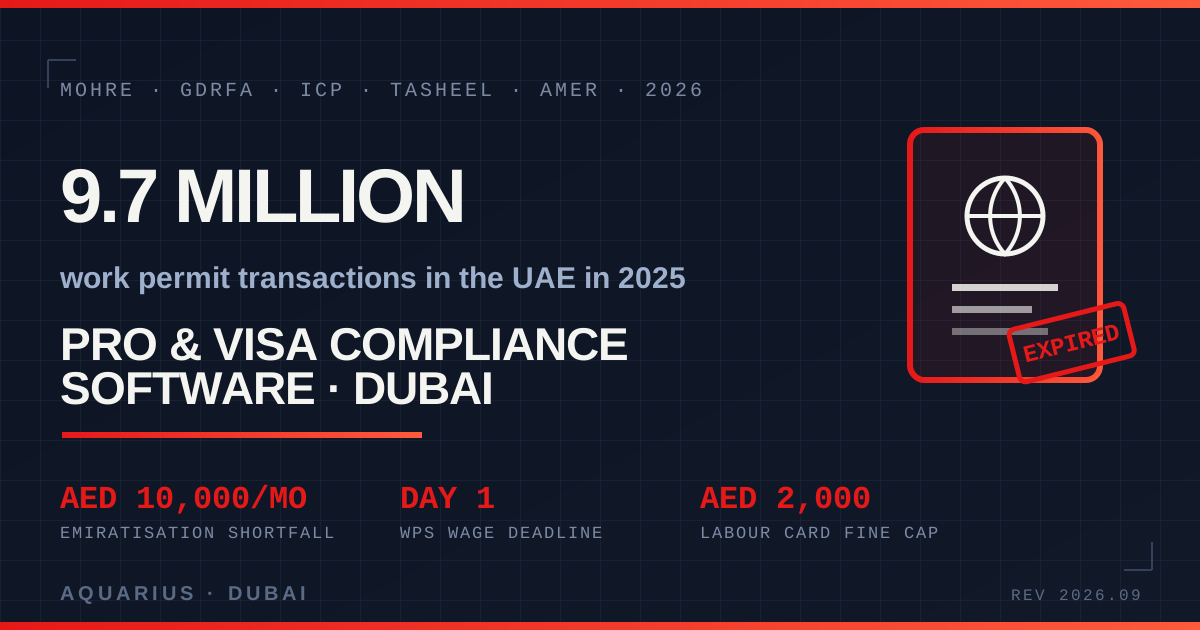
Short answer: Outsourced PRO services in Dubai run roughly AED 1,500 to AED 3,000 a month on retainer for a small company, or AED 2,500 to AED 7,000 per employee visa pay-as-you-go, on top of government fees. Software that tracks the same obligations in-house — visas, labour cards, Emirates IDs, insurance, WPS and Emiratisation — costs AED 45,000 to AED 420,000+ to build in 2026. The reason the build now pencils out is not efficiency. It is that three separate 2026 rule changes turned missed expiry dates into recurring monthly fines. Updated September 2026.
The scale of this is easy to underestimate. The Ministry of Human Resources and Emiratisation processed nearly 9.7 million work permits and contract renewals in 2025 — 4,181,597 new work permits, 5,552,558 contract renewals, plus 2,394,740 cancellation transactions and 110,403 applications to open new establishment records. Every one of those transactions has an expiry date attached. In most Dubai companies, that date lives in a spreadsheet tab that one person maintains.
This guide covers what changed in 2026, what PRO services really cost, what the software has to do, and honest AED build bands. Aquarius is an AI-native web and app development studio in Dubai, so these are the numbers we put in front of clients before they commit budget.
Key takeaways
- The wage buffer is gone. From 1 June 2026, MOHRE enforces a unified deadline: salaries must be paid on or before the first day of the month through the Wage Protection System. Anything later is already late.
- Work permit suspension now starts at day 5 of a WPS delay, not day 17 — new permits, renewals and transfers all freeze until wages settle.
- Emiratisation became a monthly bill. Companies with 50+ employees had to hit 8% skilled-role Emiratisation by 30 June 2026. From 1 July 2026, non-compliance costs AED 10,000 per month per unfilled position — AED 120,000 a year for a single missed seat.
- Labour card lapses compound: AED 500 if the card is not renewed within 60 days of expiry, then AED 200 a month, capped at AED 2,000 — per employee.
- Overstay is AED 50 per day, and past 30 days you need an exit permit at roughly AED 250–300 through GDRFA or ICP.
- Build bands: AED 45,000–95,000 for an expiry and document tracker, AED 120,000–240,000 for a PRO agency platform with a client portal, AED 260,000–420,000+ for a multi-entity workforce compliance system.
Why 2026 broke the spreadsheet
Dubai companies have tracked visa expiries in Excel for twenty years and mostly got away with it, because the penalty for being a week late was a one-off fine and an awkward conversation. Three changes inside twelve months ended that model, and all three share a shape: the penalty is recurring and per head.
1. WPS: a one-day window, enforced from day five
The Wage Protection System is not new, but the 2026 timing rules are. From 1 June 2026, private sector wages must clear through WPS on or before the first day of the following month — there is no grace buffer to lean on. Miss it and the escalation is automatic: work permit services suspend at day 5, and a delay running 10 to 60 days attracts AED 1,000 per unpaid worker, capped around AED 50,000 per cycle. Persistent cases are referred to the Public Prosecution.
The operational consequence is specific. A payroll approval that used to be a mid-month task is now a hard monthly deadline with a dependency chain in front of it: valid labour cards, active IBANs, correct MOL establishment IDs and an accurate headcount. One stale record in that chain and the SIF file rejects.
2. Emiratisation: AED 10,000 a month, per seat
Private companies with 50 or more employees must raise Emiratis in skilled roles by 2% a year — 1% by 30 June, 1% by 31 December. The 30 June 2026 milestone was 8%. MOHRE began imposing financial contributions from 1 July 2026 at AED 10,000 per month for each unfilled position, which is AED 120,000 a year for one seat and scales linearly with how far behind you are. The counterweight is real too: companies with strong results join the Emiratisation Partners Club, which carries discounts of up to 80% on MOHRE service fees.
Emiratisation compliance is arithmetic on a moving headcount. It needs a system that knows, today, how many skilled roles you have, how many are held by UAE nationals, and what the next semester target implies — not a quarterly reconciliation done from memory.
3. Health insurance everywhere, tied to the residency permit
Since 1 January 2025, employers across all emirates — including Sharjah, Ajman, Umm Al Quwain, Ras Al Khaimah and Fujairah — must provide health insurance as a condition of issuing or renewing a residence permit. The Basic package starts at about AED 320 a year for ages 1 to 64 with a minimum annual benefit limit of AED 150,000. That coupling matters for software: insurance expiry is now upstream of visa renewal, so it belongs in the same expiry engine, not in a broker inbox.
Here is the part most Dubai businesses get wrong. They treat PRO work as a procurement decision — which agency, what fee — when in 2026 it is a data-integrity decision. The agency submits the transaction. Nobody but you owns the calendar behind it.
What PRO services actually cost in Dubai (2026 AED)
Real market ranges, separated into what the PRO charges and what the government charges. Confusing the two is the single most common budgeting error we see.
| Item | Typical AED range | Who charges it |
|---|---|---|
| PRO retainer, 1–5 employees | 1,500 – 3,000 / month | Service provider |
| PRO retainer, 6–30 employees | 3,000 – 6,000 / month | Service provider |
| Employment visa, pay-as-you-go service fee | 1,200 – 2,000 | Service provider |
| Employment visa, all-in per employee | 2,500 – 7,000 | Combined |
| Government fees per employment visa | 3,500 – 5,000 | MOHRE / GDRFA / ICP |
| Mainland 2-year visa package, typical total | 5,000 – 7,000+ | Combined |
| Free zone 2-year visa package, typical total | 4,000 – 5,500 | Combined |
| MOHRE work permit issuance (by employer category) | 250 / 1,200 / 3,450 | MOHRE |
| Work permit application fee | 50 | MOHRE |
| Entry permit | 250 – 500 | GDRFA / ICP |
| Residence stamping | 500 – 600 | GDRFA / ICP |
| In-country status change | 520 – 575 | GDRFA / ICP |
| Amer or Tasheel centre transaction fee | 200 – 400 | Service centre |
| Basic health insurance, per employee | from 320 / year | Insurer |
Two structural notes. Free zone packages typically land 30–40% below mainland equivalents, which is why the same 20-person company can face wildly different annual renewal bills depending on where it was licensed. And UAE labour law requires the employer to bear 100% of employment visa costs — work permit, labour card, medical, Emirates ID, approvals and health insurance. Recharging any of it to the employee is not a cost-saving strategy; it is a violation.
Dubai service-centre coverage is dense — Amer centres handle GDRFA residency, Emirates ID and status changes, while Tasheel runs MOHRE labour transactions, work permits, contracts and WPS across roughly 15+ Dubai branches. Neither network gives you an API. They give you a queue and a receipt, which is precisely why the tracking layer has to be yours.
What PRO and visa compliance software has to do in Dubai
The functional bar is higher than a reminder list. These are the modules that matter locally, in roughly the order clients discover they need them.
- A single expiry engine. Passport, entry permit, residence visa, labour card, Emirates ID, health insurance, medical fitness, establishment card, trade licence and any professional card — one table, one alert ladder at 90 / 60 / 30 / 7 days, escalating to a named owner rather than a shared inbox.
- Document vault with versioning. Every scan tied to the person, the transaction and the issuing authority, with the superseded copy kept. Renewals fail on missing attestations more often than on missing money.
- Transaction workflow per authority. MOHRE, GDRFA, ICP and free zone portals have different sequences and different rejection reasons. Model each as a state machine with a status, a submitted-by, a reference number and a cost line, so a rejected application is visible the same day.
- WPS preparation and validation. Generate and pre-validate the SIF against MOL establishment ID, labour card numbers and IBANs before submission, with a hard block on the first of the month if any record is stale. See our deeper guide to HR and payroll software with WPS in Dubai.
- Emiratisation dashboard. Live skilled-role headcount, current national percentage, distance to the next 1% milestone, and a projected monthly exposure at AED 10,000 per unfilled seat. Executives act on the exposure figure, not the percentage.
- Cost ledger per employee. Government fees, centre fees, PRO fees, medical, insurance and typing charges captured per transaction, so the true cost of a hire and a renewal is a report rather than an argument.
- Automated document data capture. Passport MRZ, Emirates ID and visa stamps read on upload beat manual entry on both speed and error rate — and Arabic documents need OCR that actually handles Arabic script, which is a real engineering choice, not a checkbox. We cover it in AI document processing and Arabic OCR in Dubai.
- Bilingual English and Arabic with full RTL, including printed forms and employee-facing screens.
- UAE PASS sign-in where employees self-serve documents and consent — see UAE PASS integration.
- PDPL-aware data handling. Passport scans, medical results and Emirates ID numbers are exactly the personal data the UAE Personal Data Protection Law cares about. Retention rules, access logs and consent belong in the design, as covered in our UAE PDPL compliance checklist.
One design note from experience: build the expiry engine first and everything else around it. Teams that start with a pretty employee directory and bolt on reminders end up with a directory nobody trusts, because the dates were never the system of record.
What it costs to build in Dubai (2026 AED)
These are our fixed-scope 2026 bands for systems delivered from Dubai, with design, build, QA and handover included.
| Scope | Typical AED range | Timeline |
|---|---|---|
| Visa and document expiry tracker (expiry engine, document vault, alert ladder, admin console) | 45,000 – 95,000 | 5 – 9 weeks |
| PRO agency platform (client portal, per-authority transaction workflow, quoting, VAT invoicing, bilingual) | 120,000 – 240,000 | 12 – 18 weeks |
| Multi-entity workforce compliance system (WPS preparation, Emiratisation tracking, insurance, gratuity, ERP or HRMS integration) | 260,000 – 420,000+ | 20 – 30 weeks |
| Add-on: AI passport and Emirates ID data capture | 40,000 – 85,000 | 4 – 8 weeks |
| Add-on: employee self-service app with UAE PASS | 55,000 – 110,000 | 6 – 10 weeks |
| Add-on: full Arabic and RTL | +20 – 35% of build | Parallel |
| Annual maintenance, hosting and support | 15 – 25% of build cost | Ongoing |
The buy alternative is real and often correct: UAE HRMS platforms run roughly AED 40–70 per employee per month for SMEs, with implementation fees of AED 15,000–50,000. For a 40-person company that is about AED 19,200–33,600 a year plus setup — cheaper than any custom build, and the right answer if standard modules fit.
Custom wins in three situations: you are a PRO or business-setup firm and the workflow is your product; you run multiple entities across mainland and free zones with different rulebooks; or you need the system to talk to an ERP, an accounting stack or a client portal that already exists. If you are in the first camp, our guide to business setup consultancy websites and CRM in Dubai covers the client-acquisition half of the same build.
Now the arithmetic. Take a 60-person Dubai mainland company. Two Emiratisation seats unfilled from 1 July 2026 costs AED 20,000 a month — AED 240,000 a year. One WPS cycle missed across 30 workers at AED 1,000 each is AED 30,000, plus a permit freeze that stalls every hire in progress. Five labour cards left to run past 60 days is AED 2,500 immediately and up to AED 10,000 if the drift continues. Against that, an AED 45,000–95,000 tracker is paid back by avoiding roughly one bad quarter — and the PRO retainer it partially replaces is another AED 36,000–72,000 a year for a company of that size.
How we approach it at Aquarius: the expiry schema and alert ladder are agreed in a written discovery document before development starts, fee schedules and Emiratisation targets are configuration rather than hard-coded constants so a ministerial change is a data update, PDPL retention and access rules are designed in at the start, you get full source code and IP transfer on final payment, and pricing is fixed-scope in AED with a written change-order rate. See our published bands on pricing and the full stack on services.
Planning a visa, PRO or workforce compliance system in Dubai? Send us your headcount, entity structure (mainland, free zone or both) and whether you already run an HRMS, and we will come back with a fixed AED quote, the renewal-clock map, and a build plan that survives an inspection. Reach us on contact — WhatsApp +971 56 351 3436 or hello@aquarius-advt.me. Aquarius is an AI-native web and app development studio in Dubai.
FAQ
How much do PRO services cost in Dubai in 2026?
A retainer for a company with 1 to 5 employees typically runs AED 1,500 to 3,000 a month, and AED 3,000 to 6,000 for 6 to 30 employees. On a pay-as-you-go basis, expect AED 1,200 to 2,000 as the service fee per employment visa, with government fees of roughly AED 3,500 to 5,000 on top — an all-in figure of about AED 2,500 to 7,000 per employee visa. Amer and Tasheel centre transaction fees are a separate AED 200 to 400.
What is the fine for missing Emiratisation targets in 2026?
Private companies with 50 or more employees had to reach 8% Emiratisation in skilled roles by 30 June 2026. From 1 July 2026, MOHRE imposes financial contributions of AED 10,000 per month for each position not filled by an Emirati — AED 120,000 per year per seat. Targets rise 2% a year, split into 1% by 30 June and 1% by 31 December.
What happens if a labour card expires in the UAE?
MOHRE charges AED 500 if the labour card is not renewed within 60 days of expiry, then AED 200 per month of continued delay, capped at AED 2,000. Working on an expired permit can trigger a work ban, visa cancellation and deportation, and employers with unpaid fines can have their MOHRE account suspended until settlement. Fines can be checked using the MOHRE fine calculator or at any Tasheel centre.
When must salaries be paid under WPS in 2026?
From 1 June 2026, MOHRE enforces a unified deadline requiring private sector salaries to be paid on or before the first day of each month through the Wage Protection System, with no buffer period. Work permit services suspend from day 5 of a delay, and delays of 10 to 60 days attract fines of AED 1,000 per unpaid worker, capped at around AED 50,000 per cycle per company.
Should a Dubai company buy an HRMS or build custom visa software?
Buy if standard modules fit: UAE HRMS platforms cost roughly AED 40 to 70 per employee per month for SMEs plus AED 15,000 to 50,000 implementation, which beats any custom build on price. Build custom when the workflow is your product (PRO, business setup or recruitment firms), when you run multiple entities across mainland and free zones with different rulebooks, or when the system must integrate with an existing ERP or client portal. A hybrid — a custom compliance layer over a standard payroll tool — is the most common outcome.
Does the employee ever pay for their own UAE work visa?
No. UAE labour law requires the employer to bear 100% of employment visa costs, including the work permit, labour card, medical examination, Emirates ID, government approvals and health insurance. Since 1 January 2025 health insurance is also a condition of issuing or renewing a residence permit across all emirates, with the Basic package starting from about AED 320 a year and a minimum annual benefit limit of AED 150,000.