
Entity SEO for Dubai Businesses (2026): Knowledge Panels, Wikidata and the Brand Mention Gap
AI Overviews now hit more than 80% of branded searches, and brand mentions beat backlinks 3:1 for AI visibility. How Dubai businesses build an entity that Google and AI can actually name.
- PUBLISHED
- 06 NOV 2026
- READ TIME
- 12 MIN
- AUTHOR
- AQUARIUS · DUBAI
- UNIT
- REV 2026.09
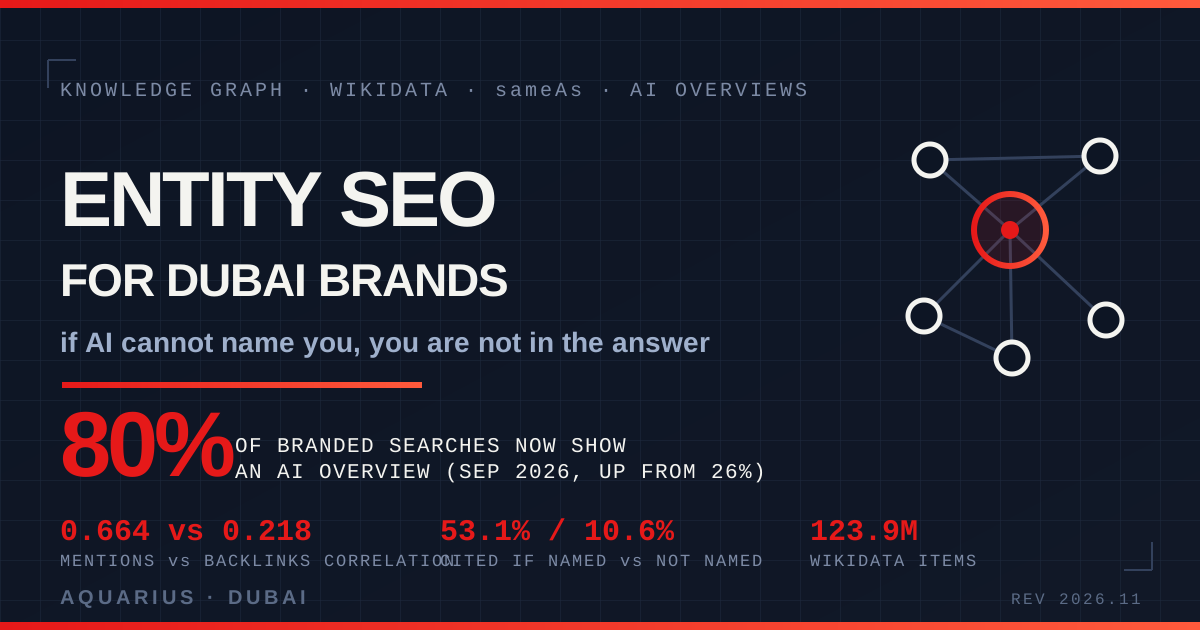
Short answer: Entity SEO is the work of making Google and the AI engines recognise your company as a specific, verified thing — not a string of keywords. It matters more than it did a year ago because AI Overviews now appear on more than 80% of branded searches, up from about 26% at the start of September 2026, and because branded web mentions correlate with AI Overview visibility at 0.664 against just 0.218 for backlinks. For a Dubai SME the foundation work costs AED 8,000 to AED 25,000 as a one-off, then folds into a normal AED 3,000 to AED 8,000 a month retainer.
Here is the part most Dubai businesses get wrong: they treat their brand name as a keyword to rank for. It is not. It is an identity claim that Google either resolves to a real entity or quietly discards. If it discards it, you do not rank badly — you are absent from the layer that answers the question, and your competitor gets named instead of you.
The numbers that moved in late 2026
Something changed in September 2026. DemandSphere tracked branded keywords daily across all markets and devices and found AI Overview presence on branded queries sitting near 27% for most of the month, then jumping to 90.5% on 27 September and holding above 80% thereafter. Semrush put the same shift at more than 82% by 29 September. Earlier spikes on 18, 20, 23 and 24 September each collapsed back to the roughly 30% baseline within a day. This one did not.
Translate that for a Dubai business. When a prospect, a procurement officer or a candidate searches your company name, there is now a four-in-five chance that Google writes a paragraph about you above your own website. You did not approve that paragraph. It is assembled from whatever Google believes about your entity.
Two more numbers set the stakes. In the UAE, Google still takes 99.74% of search referrals against ChatGPT’s 0.26% as of August 2026 (Statcounter, from over 3 billion monthly page views) — so this is not an argument for abandoning Google for chatbots. At the same time UAE working-age GenAI adoption hit 73.3% in Q2 2026, up from 70.1% in Q1, among the highest rates in the world. Your buyers are heavy AI users who still arrive through Google. Both surfaces read the same entity data.
The stat that should end the backlinks-only argument: Ahrefs analysed 75,000 brands and found branded web mentions correlated with AI Overview brand visibility at 0.664, versus 0.218 for backlink count — roughly three to one. Brands in the top quartile averaged 169 AI Overview mentions; the bottom two quartiles averaged between zero and three. And 26% of the brands studied had no AI Overview mentions at all. Correlation is not causation, but the ranking of signals is hard to ignore.
Then there is the mention gap itself. Seer Interactive analysed 541,213 LLM responses covering 20 brands across six AI platforms. When a brand was mentioned in the response, its citation rate was 53.1%. When it was not mentioned, citation rate fell to 10.6%. The platforms behave differently too: ChatGPT showed an 87.0% citation rate but only a 20.7% brand mention rate, while AI Overviews ran 84.9% citations with a 61.0% brand mention rate. Being named is the gate. The link follows the name, not the other way round.
What an entity actually is
An entity is a uniquely identified node in a knowledge graph: a company, a person, a place, a product, a licence. It has an identifier, a set of attributes, and relationships to other nodes. Google’s Knowledge Graph is the big one. Google’s last official figure, from May 2020, was 500 billion facts about 5 billion entities; third-party estimates now put it at roughly 1.6 trillion facts about 54 billion entities, though Google has not confirmed a newer number.
The important event is the opposite of growth. In June 2025 Google pruned the graph hard, reportedly removing over three billion entities in a single week — widely read as a move to a leaner, higher-precision dataset for AI features. The lesson for a Dubai SME is blunt: a thinly-evidenced entity is now a liability, not a placeholder. Low-confidence nodes get dropped, and a dropped node cannot be cited.
Alongside it sits Wikidata, the open structured database that feeds a significant portion of the Knowledge Graph. It currently holds 123,916,180 items, built from 2.56 billion edits by around 49,669 active editors. It is open to contribution, which makes it the one major entity source a Dubai company can legitimately influence directly — if it meets the notability bar.
The six places Google learns who you are
Entity SEO is not one task. It is making six independent sources agree on the same facts about you, so the confidence score clears the bar. Disagreement is the failure mode, not absence.
1. Your own site, declared in schema
One Organization block, on one canonical URL, with legalName, alternateName, address, telephone, vatID (your TRN), foundingDate, logo and a sameAs array pointing at every profile you control. This is your entity home — the page everything else should resolve back to. We cover the markup mechanics in our guide to schema markup and structured data for Dubai websites.
2. Google Business Profile
For any business with a Dubai address, this is the strongest single identity signal and the usual trigger for a local knowledge panel. Name, category, address and phone must match the trade licence and the website exactly. Practical mechanics are in our Google Maps and local SEO guide for Dubai.
3. Wikidata
A properly sourced item with instance of: business, headquarters location, inception date, official website and external identifiers. Each claim needs an independent reference. Unsourced claims get reverted, and a reverted item is worse than no item.
4. Independent mentions in credible publications
Gulf News, Khaleej Times, Arabian Business, The National, Zawya, trade press, conference programmes, award shortlists. Unlinked mentions count. This is the signal the Ahrefs data ranked first, and the one Dubai companies systematically underfund because it does not show up in a backlink report.
5. Structured directories and registries
Dubai Chamber listing, free zone directory, LinkedIn company page, Crunchbase, app store developer name, Apple Business Connect, Bing Places. Each is a low-cost corroboration of the same five facts.
6. Review platforms
Google reviews, Trustpilot, Clutch, sector-specific platforms. Review corpora are increasingly the text AI engines quote when describing what a company is like, not just whether it exists. See online reputation and review management in Dubai.
What each entity asset costs in Dubai
Real ranges for a Dubai SME in 2026. These are build costs, not retainers — most of this is done once and then maintained.
| Entity asset | What it feeds | One-off cost (AED) | Time to effect |
|---|---|---|---|
| Organization schema + sameAs on entity home | Knowledge Graph, AI Overviews, AI Mode | 1,500 – 4,000 | 2 – 6 weeks |
| Google Business Profile build and verification | Local panel, Maps, branded SERP | 1,000 – 3,000 per location | 1 – 3 weeks |
| Wikidata item, fully sourced | Knowledge Graph, LLM corpora | 2,500 – 6,000 | 1 – 4 months |
| Directory and registry alignment (12 – 20 listings) | Corroboration, NAP consistency | 2,000 – 5,000 | 4 – 8 weeks |
| Founder and executive entity pages | Person entity, E-E-A-T | 2,000 – 5,000 | 1 – 3 months |
| Arabic name and transliteration alignment | Arabic SERP, Arabic AI answers | 1,500 – 4,000 | 4 – 10 weeks |
| Ongoing mention and digital PR programme | The 0.664 signal | 4,000 – 15,000 / month | 3 – 9 months |
Foundation work — everything above the PR line — lands at AED 8,000 to AED 25,000 for a single-location Dubai SME in one language. Multi-branch retail or a group with several trade licences runs higher, because every entity has to be modelled separately and then related correctly.
Four entity traps specific to Dubai
These are not in the international playbooks, and they are why generic entity advice underperforms in this market.
Trade licence name versus trading name. Your DED or free zone licence may read “Al Noor General Trading L.L.C.” while the brand on the shopfront is “Noor”. Both are true. Declare only one and you fragment your identity across two partially-evidenced nodes. Put the legal name in legalName, the brand in alternateName, and use the same pair everywhere.
Arabic name variants. Arabic transliteration is not deterministic — Mohammed, Mohammad, Muhammad and Mohamed are four strings and, left undeclared, up to four weak entities. Add every variant you actually use to alternateName, including the Arabic script form. This matters more as Arabic-language AI answers grow; see our Arabic website localisation guide.
Free zone address churn. Flexi-desk and co-working addresses change often, and each change leaves a stale address claim in a directory somewhere. Stale addresses are the most common reason a Dubai knowledge panel shows the wrong location, or none at all. Keep one source-of-truth record and update every listing in a single pass.
Group structures. Dubai businesses grow by adding licences, not by consolidating. 37,373 new companies joined Dubai Chamber of Commerce in the first nine months of 2026, against 53,838 in the same period of 2025, and member exports and re-exports reached AED 252 billion. A holding company plus four operating licences is five entities, and Google will not infer the relationships for you. Model parent, subsidiary and brand explicitly.
Knowledge panels: how they actually appear
You cannot buy or submit a knowledge panel. Google generates one when its confidence in your entity clears an internal threshold. As of September 2026, Semrush Sensor recorded knowledge panels in 18.85% of SERPs among the top 20 results; Semrush’s 2025 SERP Features Report put the broader figure at 36% of all SERPs. For navigational queries — someone searching your brand name — panel presence is far higher, and 68% of navigational searches end in zero clicks because the answer is already on the page.
Once a panel exists, claim it. Sign in as the entity, use the claim option beneath the panel, pass verification, and you unlock “suggest an edit”. That is the only legitimate correction channel. Until you own it, the panel repeats whatever the six sources above collectively claim — including an old address, the wrong founder, or nothing at all.
What inaction costs, and how we run it
Run the arithmetic on your own branded search volume. If 80% of branded searches now render an AI Overview and your entity is unresolved, the paragraph above your website is assembled from third-party fragments. On the Seer data, a brand that is not named in an AI response drops from a 53.1% citation rate to 10.6% — roughly a five-fold cut in the chance of being the source the buyer clicks. For a Dubai B2B company where one qualified lead is worth AED 15,000 to AED 60,000 in contract value, losing the branded answer is the most expensive cheap problem in your marketing stack.
How Aquarius runs it: we start with an entity audit across the six sources and produce a disagreement map — every place your name, address, phone, licence name or founder differs. We fix the entity home first (schema, canonical, sameAs), then Google Business Profile, then registries and directories in one coordinated pass, so the facts change simultaneously rather than over six months. Wikidata only if you clear notability, because a reverted item hurts. Then we measure: branded SERP capture, panel presence, and whether AI Overviews and ChatGPT name you correctly when asked what you do. Entity foundation work sits inside our normal pricing, and the audit is fixed-fee — if it finds your entity already clean, you pay for the audit and nothing else.
For the wider search picture, read our guide to Google AI Overviews and SEO in the UAE, and how AI shopping agents resolve merchants before they transact.
FAQ
Is entity SEO different from normal SEO in Dubai?
It is a layer underneath it. Normal SEO competes for a query; entity SEO establishes that you exist as a specific company with specific attributes. Without the entity layer your pages can rank while the AI answer above them names someone else.
How long before a knowledge panel appears?
Realistically three to nine months from a clean start, assuming the six sources agree and some independent mentions exist. Schema and Google Business Profile changes often register in two to six weeks, but the panel is a confidence threshold rather than a switch, so it shows up later than the inputs.
Do we need a Wikipedia page?
No, and most Dubai SMEs will not qualify. Wikidata is the realistic target: it feeds a significant share of the Knowledge Graph and accepts well-sourced entries from companies that would never clear Wikipedia’s notability bar. Attempt a Wikipedia article only where independent coverage genuinely exists.
Does this help with ChatGPT and Perplexity, not just Google?
Yes, through a different mechanism. Those engines lean on retrieval and training corpora rather than Google’s graph, but both are built from the same public web mentions, directories and review platforms. In the Seer data ChatGPT showed an 87.0% citation rate with only a 20.7% brand mention rate — it cites heavily but names brands sparingly, so mention work is what moves it.
What is the single highest-leverage first step?
The disagreement audit. Most Dubai companies have four to nine conflicting versions of their own name, address and phone number in public. Removing contradictions is cheaper and faster than adding new signals, and contradictions are exactly what holds a confidence score below the panel threshold.
Make Google say the right thing about you
Branded search is no longer a page you own. It is a paragraph Google writes, from sources you can either curate or ignore. If you run a Dubai business and have never checked what your entity data actually says, start there — request the entity audit and we will show you the disagreement map before you commit to anything.