
Equipment Rental Software in Dubai (2026): Utilisation, TPI Certificates and Real AED Build Costs
Dubai equipment rental software in 2026: what it costs in AED, the utilisation maths that pays for it, DM GU48 inspection certificates and the 2027 e-invoicing deadline.
- PUBLISHED
- 19 SEPT 2026
- READ TIME
- 11 MIN
- AUTHOR
- AQUARIUS · DUBAI
- UNIT
- REV 2026.09
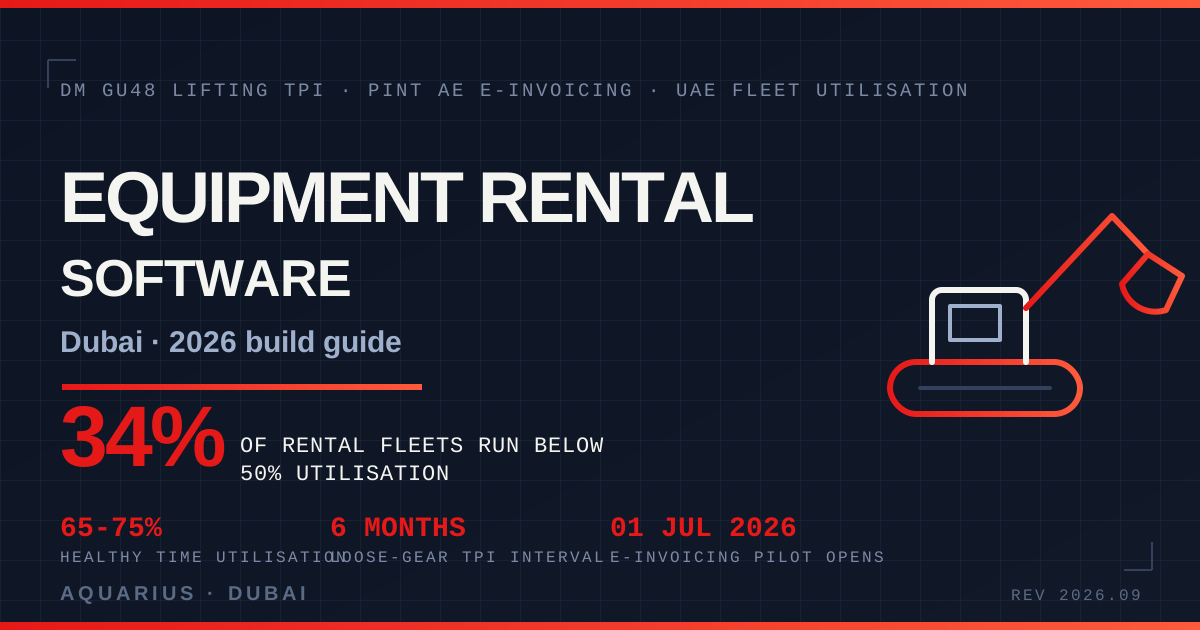
Short answer: Equipment rental management software in Dubai costs roughly AED 45,000–120,000 for a single-yard system, AED 120,000–320,000 for a multi-depot platform with telematics and a customer portal, and AED 350,000+ for an enterprise rollout across emirates. The payback is not in saved admin hours. It is in utilisation: 34% of rental companies run below 50% utilisation while a healthy fleet sits at 65–75%, and every idle excavator in a Dubai yard burns roughly AED 1,800–2,900 a day in depreciation, insurance and finance. Updated September 2026.
Dubai has plenty of rental companies with AED 40 million of iron in the yard and a dispatch process that lives in WhatsApp, a wall planner and one person's memory. It works — right up to the quarter when three jobs overlap, a machine goes out with an expired third-party inspection certificate, and nobody can say which of the forty units is actually earning. This is the 2026 build brief for fixing that, with real UAE numbers attached to every decision.
Key takeaways
- Utilisation is the only metric that pays for the software. Target 65–75% time utilisation; above 85% you are turning away bookings, below 55% you are financing idle steel.
- Dubai adds a compliance module generic rental software does not ship with. Dubai Municipality guideline GU48 requires third-party examination certificates on lifting equipment — six-monthly for loose gear, annually for machines.
- Your invoicing has a legal deadline. The UAE e-invoicing pilot opens 1 July 2026; businesses above AED 50 million revenue must appoint an accredited service provider by 30 October 2026 and issue structured invoices from 1 January 2027.
- Telematics is table stakes, not a phase two. Engine hours should drive both the invoice and the service schedule — and 2G/3G trackers are being switched off as UAE networks sunset.
- Build cost is set by depots, integrations and roles — not by how many screens you sketch.
Why 2026 is the year Dubai rental yards outgrew the spreadsheet
Three numbers set the stakes.
First, demand. The UAE construction market is worth roughly USD 44.5–48.7 billion in 2026, and construction was the fastest-moving major sector in Dubai's economy: it grew 8.2% year on year in Q1 2026 and contributed 8.1% of Dubai's GDP, which itself reached AED 232 billion in the quarter. Nationally, USD 30 billion of projects were awarded in Q1 2026 alone, and the pipeline behind it is heavier still — the Dubai Metro Blue Line at around AED 20 billion and the Al Maktoum International Airport expansion at a headline AED 128 billion.
Second, the rental market riding on it. The UAE construction equipment rental market was worth about USD 1.72 billion in 2025 and is forecast to reach USD 2.59 billion by 2030 — an 8.5% CAGR. Other analysts model the leasing and rental segment at USD 1.37 billion in 2024 rising to USD 2.22 billion by 2030. The forecasts disagree on the decimal and agree on the direction: more machines, more depots, more contracts per month per dispatcher.
Third, the hole in the bucket. Industry benchmarking for 2026 finds 34% of rental companies operating below 50% utilisation, blamed on scheduling errors, assets stranded at remote sites and maintenance delays. In a market growing 8% a year, that is not a rounding error. That is half a fleet financed and not earning.
The metric most Dubai yards measure wrong
Ask a rental manager how the fleet is doing and you usually get a revenue number. Revenue hides the problem. There are two utilisation figures, and you need both on the same dashboard.
Time utilisation is the share of available days a machine is out on hire. The healthy band is 65–75%, with roughly 60–70% as the practical sweet spot. Consistently above 85% and you are refusing work you could have taken with one more unit. Below 55% and you are paying finance on idle capital.
Dollar utilisation is revenue earned against the asset's original cost. Large national chains target around 55–65%; smaller general rental centres can approach 100%. This is the one that catches the quiet killer — a machine on hire 80% of the time at a discounted rate looks busy and loses money.
The myth that costs Dubai yards the most: that an idle machine is merely "not earning". It is actively spending. A USD 150,000 excavator parked in a Jebel Ali yard still carries USD 500–800 per day — about AED 1,835–2,940 — in insurance, storage, depreciation and financing. Small kit such as generators and compressors carries USD 25–50 a day each, which disappears into the noise until you multiply it by sixty units.
What a Dubai rental system actually has to do
Off-the-shelf rental software handles the generic half well. The half that breaks in the UAE is the half nobody demos. Here is the module list we scope against, and what makes each one local.
| Module | What it does | The Dubai-specific part |
|---|---|---|
| Asset register | Every unit with serial, hour meter, purchase cost, depreciation | Certificate register attached per asset (TPI, load test, insurance) |
| Availability and booking | Calendar by asset class, holds, conflicts, overlapping jobs | Multi-depot across Dubai, Sharjah and Abu Dhabi with inter-emirate transfers |
| Contracts and rates | Daily, weekly, monthly rate cards, long-hire discounts | Operator-supplied vs bare hire, and who carries the visa and labour obligation |
| Dispatch and delivery | Driver assignment, low-bed scheduling, delivery and collection charges | Per-trip transport fees by distance, permits for oversize loads |
| Site handover | Photo condition reports, signed on site, damage evidence | Bilingual EN/AR forms for site crews, offline capture on weak-signal sites |
| Telematics ingest | Engine hours, idle time, location, fuel, geofences | 4G LTE / LTE-M hardware, heat-ruggedised units, 2G sunset migration |
| Maintenance | Hour-based service intervals, breakdown tickets, parts | Certificate expiry blocks dispatch before it reaches the client's gate |
| Invoicing | Cycle billing, part-periods, damage recharges, deposits | 5% VAT against a valid TRN, and PINT AE structured invoicing from 2026–27 |
| Customer portal | Client sees live hires, off-hire requests, documents | Off-hire timestamping that ends disputes about who stopped the clock |
Price the software against your rate card, not against a SaaS list price
Advertised 2026 Dubai hire rates give you the denominator for every ROI conversation:
| Equipment | Per day (AED) | Per month (AED) |
|---|---|---|
| Excavator | 1,800–5,500 | 15,600–52,300 |
| Boom lift / powered access | 920–3,300 | 7,800–31,400 |
| Boom loader / telehandler (17 m) | 800–1,200 | Quoted on long-hire discount |
Weekly and monthly hire cuts the effective per-day rate sharply, and delivery and collection are billed separately per trip by distance. That structure is exactly why rate logic belongs in software: part-period billing, tiered long-hire discounts and separate transport lines are where manual invoicing quietly leaks margin.
The compliance module generic rental software does not have
This is the part that turns a nice-to-have system into a defensible one. In Dubai, third-party inspection of lifting equipment is mandatory, enforced under Dubai Municipality guideline GU48, and certification must come from an inspection body accredited by the Emirates International Accreditation Centre to ISO/IEC 17020. The practical rules your software has to encode:
- Loose gear — slings, shackles, chains, lifting beams — needs a thorough examination every six months.
- Machines — cranes, hoists, forklifts, MEWPs and cherry pickers — are typically on an annual certificate.
- Any repair, overload or modification triggers immediate re-inspection, regardless of where the machine sits in its cycle.
Encode it once and the system stops a unit whose certificate expires mid-hire from ever being allocated to a four-week job. Leave it in a spreadsheet and you eventually send a machine to a main-contractor site where the HSE officer checks the paperwork at the gate, refuses it, and remembers your name at the next tender.
Telematics: engine hours should write the invoice
The 2026 standard is a unified telematics layer — one platform ingesting hardwired trackers, OBD dongles, battery-powered BLE tags on small kit, and native OEM feeds from the machine manufacturer. Devices transmit over 4G LTE or LTE-M, and older 2G/3G hardware is being retired as networks sunset. If your fleet still runs legacy trackers, budget the swap alongside the software.
The payoff is not the map. It is that engine hours become one source of truth for three things at once: hour-based billing on plant hired by usage, service intervals that trigger on real hours instead of a calendar guess, and idle-time reporting that shows which client sites are sitting on your machine without running it. Add geofences and you get the theft control the segment needs, since heavy equipment is valuable, mobile, frequently unattended overnight and hard to recover. The same architecture we describe in our Dubai fleet tracking and logistics software guide applies here, with harsher duty cycles.
What it costs to build in Dubai, and what it returns
These are 2026 AED bands for work delivered from Dubai, excluding 5% VAT, assuming fixed scope, source-code handover and your own cloud accounts.
| Tier | Scope | Cost (AED) | Timeline |
|---|---|---|---|
| Single yard | Asset register, availability calendar, contracts, dispatch, condition reports, VAT invoicing, 2–3 user roles | 45,000–120,000 | 8–14 weeks |
| Multi-depot platform | Everything above plus telematics ingest, maintenance and certificate engine, customer portal, rate-card tiers, accounting integration | 120,000–320,000 | 4–7 months |
| Enterprise / group | Multi-company, multi-emirate, ERP integration, procurement and disposal workflow, BI layer, e-invoicing via an accredited provider | 350,000–700,000+ | 7–12 months |
Budget 15–20% of build cost per year for hosting, security patches and changes — the same maintenance ratio we apply across custom software projects in Dubai. Telematics hardware and SIM plans are a separate operating line, not part of the build.
The arithmetic that decides whether to build at all
Take a mid-size Dubai yard: 40 machines, average achievable hire value of AED 18,000 per machine per month. Full utilisation would be AED 720,000 a month. At 55% time utilisation the yard bills AED 396,000. Lift utilisation to 62% — a realistic gain from killing double-bookings, cutting return-to-yard idle days and off-hiring on time — and the same fleet bills AED 446,400. That is AED 50,400 a month, roughly AED 604,800 a year, against a AED 160,000 platform. Payback lands inside four months.
Run it in reverse and it becomes the cost-of-inaction number: seven points of utilisation on a 40-machine fleet is over half a million dirhams a year that never appears on any invoice, so nobody ever grieves it.
The 2027 deadline you should build toward now
The UAE is moving to mandatory structured e-invoicing on a Peppol-based five-corner model. Invoices must be issued as PINT AE compliant XML and transmitted through a Ministry-approved Accredited Service Provider. The Ministry of Finance published version 1.1 of its Electronic Invoicing Guidelines on 1 June 2026, and the dates that matter are:
- 1 July 2026 — pilot phase opens, with voluntary adoption available to all businesses.
- 30 October 2026 — businesses with revenue of AED 50 million or more must have appointed an ASP.
- 1 January 2027 — mandatory e-invoicing begins for those large businesses.
- 31 March 2027 — all remaining businesses must have appointed an ASP.
- 1 July 2027 — mandatory e-invoicing for SMEs.
Rental billing is unusually exposed here, because a single hire produces part-period charges, transport lines, damage recharges and deposit adjustments — all of which have to map cleanly into a structured schema. Building the invoice engine schema-aware now costs a fraction of retrofitting it in Q4 2026. Our UAE e-invoicing and VAT invoicing guide covers the mechanics.
Build or buy?
Buy if your operation is genuinely standard: one depot, one rate card, no operator supply, no unusual compliance. International rental SaaS will beat any custom build on price and you should take it. Build when your differentiators live in the gaps — multi-emirate transfers, operator-supplied hire with visa and labour tracking, certificate-gated dispatch, a client portal your main contractors will actually log into, or an ERP you cannot replace. The honest test: list the three things that make your yard win work, then ask whether the SaaS demo handled any of them.
Running a rental fleet in the UAE? Aquarius is an AI-native web and app development studio in Dubai. We build rental platforms utilisation-first: the asset register, certificate engine and telematics ingest wired in from sprint one, an invoice engine designed for PINT AE before the deadline forces it, and a dashboard where time and dollar utilisation sit side by side. Fixed AED scope, source-code handover, no lock-in. See our services, check transparent AED pricing, or book a free yard walkthrough.
FAQ
How much does equipment rental software cost in Dubai in 2026?
A single-yard system runs AED 45,000–120,000, a multi-depot platform with telematics and a customer portal AED 120,000–320,000, and an enterprise multi-company rollout AED 350,000–700,000+. Add 15–20% of build cost per year for maintenance, plus telematics hardware and SIM costs as a separate operating line.
What is a good utilisation rate for a rental fleet in the UAE?
Target 65–75% time utilisation, with 60–70% as the practical sweet spot. Above 85% you are consistently turning away bookings and should add units; below 55% you are financing idle capital. Track dollar utilisation alongside it — large chains target 55–65% — because a machine hired 80% of the time at a discounted rate looks healthy and is not.
Does Dubai require third-party inspection certificates on rental equipment?
Yes. Third-party inspection of lifting equipment is mandatory and enforced under Dubai Municipality guideline GU48, with certification from a body accredited by the Emirates International Accreditation Centre to ISO/IEC 17020. Loose gear generally needs a thorough examination every six months and machines annually, and any repair, overload or modification triggers immediate re-inspection.
When does UAE e-invoicing affect a rental company?
The pilot opens 1 July 2026. If your revenue is AED 50 million or more you must appoint an accredited service provider by 30 October 2026 and issue PINT AE structured invoices from 1 January 2027. Everyone else appoints by 31 March 2027 and goes live 1 July 2027. Build your invoice engine schema-aware now rather than retrofitting it under deadline.
Should I buy off-the-shelf rental software or build custom?
Buy if you run one depot, one rate card and no unusual compliance — international rental SaaS will be cheaper. Build when your advantage lives in the gaps: multi-emirate transfers, operator-supplied hire, certificate-gated dispatch, or an ERP integration you cannot drop. List the three things that win you work and check whether the demo handled them.
Do I need telematics on every machine?
Not on every unit, but on everything where engine hours drive billing or servicing, and on anything valuable enough to be worth stealing. Use hardwired 4G LTE or LTE-M trackers on plant and cheap BLE tags on small kit. If your fleet still runs 2G or 3G devices, plan the replacement into the same budget, because those networks are being switched off.
If you want to see where your utilisation is leaking before you spend a dirham on software, send us your fleet list and last quarter's hire data and we will map it against the benchmarks above. Related reading: construction project management software in Dubai and field service management software.