
Green Hosting in Dubai (2026): What Your Website Actually Emits, and Why It Is Now a Scope 2 Line Item
Dubai's grid ran at 383.3 g CO2e per kWh in 2025 and the median page now weighs 2.56 MB. Real numbers on website carbon, UAE green hosting options, and AED costs.
- PUBLISHED
- 28 OCT 2026
- READ TIME
- 12 MIN
- AUTHOR
- AQUARIUS · DUBAI
- UNIT
- REV 2026.09
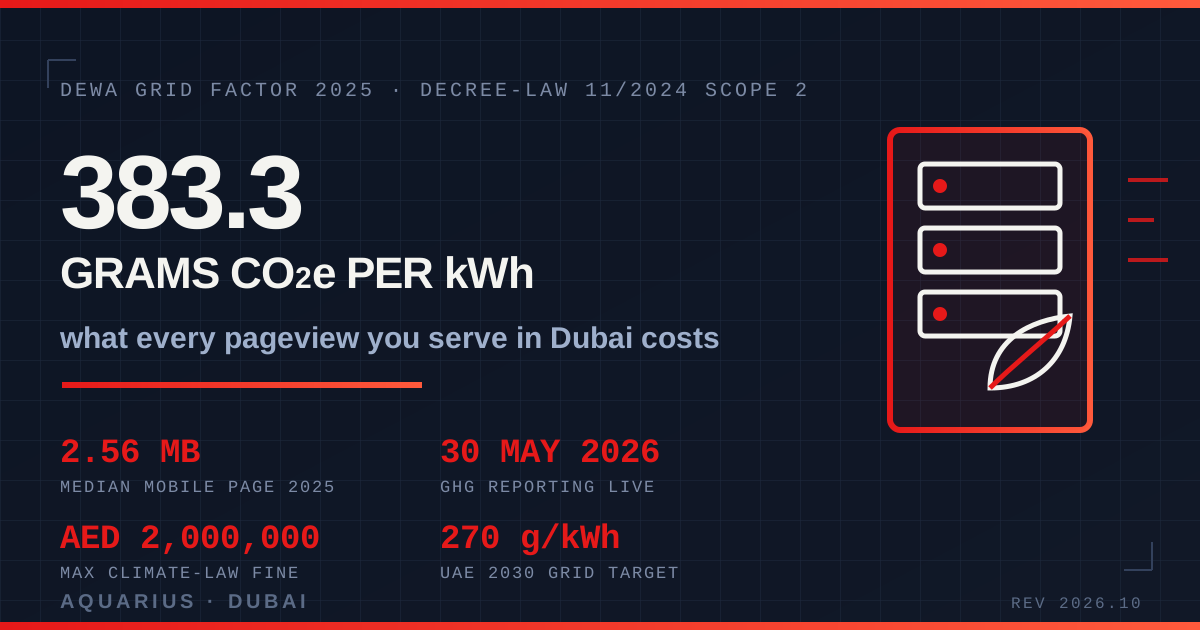
Short answer: every pageview your website serves from a UAE data centre is charged against a grid that emitted 383.3 grams of CO2e per kWh in 2025, and since 30 May 2026 that electricity is a reportable Scope 2 number under the UAE climate law, not a marketing talking point. A median web page now weighs 2.56 MB on mobile, so the cheapest carbon reduction available to most Dubai businesses is not a new hosting contract — it is deleting payload. Expect AED 18,000–45,000 for a measured page-weight and hosting carbon overhaul, and a renewable-powered Dubai colocation or cloud region at roughly parity with what you already pay.
Key takeaways
- DEWA’s carbon intensity was 0.3833 tCO2e/MWh — 383.3 g/kWh — in 2025. The wider UAE grid sat near 468 g/kWh in 2024. The national target is 0.27 kg/kWh by 2030, down from 0.556 kg/kWh in 2021.
- Federal Decree-Law No. 11 of 2024 came into force 30 May 2025 with first compliance on 30 May 2026. It applies to all UAE entities including free-zone companies, covers Scope 1 and Scope 2 plus relevant Scope 3, and carries administrative fines up to AED 2 million escalating to activity suspension.
- Your hosting bill is Scope 2. Your SaaS, CDN and ad tech are Scope 3. Nobody puts the website in the inventory, and it is one of the few line items a marketing team can actually shrink in a quarter.
- The median mobile page hit 2.56 MB in 2025 (desktop 2.86 MB), up 8.4% in a year from 2.4 MB, and up roughly 200% from the 845 KB median of 2015. Ten years of 5G bought nothing but bloat.
- Dubai has a genuinely green option most agencies have never quoted: Moro Hub, a Digital DEWA subsidiary, runs what Guinness World Records certified as the world’s largest solar-powered data centre, with a 100+ MW, 66,000 m² Warsan campus phasing in from H2 2026.
Three numbers that just turned your website into a carbon line item
Most Dubai businesses treat website sustainability as a brand slide. Three 2025–2026 data points changed that.
The grid number. DEWA reported carbon intensity of 0.3833 tCO2e per MWh for 2025 — 383.3 g/kWh. Actual DEWA emissions were 27.34 MtCO2e against a business-as-usual scenario of 38.07 MtCO2e, a 28.2% reduction. The broader UAE grid was dirtier, around 468 g/kWh in 2024. Either way, a kilowatt-hour consumed in Dubai carries real carbon today, and the national trajectory — from 0.556 kg/kWh in 2021 to a 0.27 kg/kWh target by 2030 — means the number you report this year is the worst one you will ever report.
The legal number. Federal Decree-Law No. 11 of 2024 on the Reduction of Climate Change Effects entered into force on 30 May 2025, with the first full compliance date landing 30 May 2026. In-scope entities — which, unusually, means essentially every company operating in the UAE, free zones included — must measure, report and reduce Scope 1 and Scope 2 greenhouse gas emissions, with relevant Scope 3 captured in the inventory. Penalties run to administrative fines of up to AED 2 million, with escalation to suspension of activity. That deadline has already passed. If your first inventory is being assembled now, you are late, and the digital estate is the part nobody has numbers for.
The payload number. The HTTP Archive Web Almanac put the 2025 median page at 2.56 MB on mobile and 2.86 MB on desktop, measured across millions of sites. Mobile grew 8.4% in twelve months; desktop 7.3%. Against the 2015 mobile median of 845 KB, that is roughly a 200% increase. Every one of those megabytes is electricity — in a data centre, across a network, and on the device of a customer in Deira.
Put the three together and you get the uncomfortable conclusion: the typical Dubai corporate website is a measurable, reportable, reducible emissions source that currently appears in nobody’s carbon inventory.
How much carbon does a website actually emit?
Honest answer: it depends on payload, hosting energy mix, visitor device and cache behaviour, and every public figure is a model output, not a meter reading. The widely used Sustainable Web Design model lands most pages between 0.2 g and 1 g of CO2 per pageview, with 2025 analyses of average sites clustering near 0.36 g per view at the efficient end.
Take the midpoint of that published range — 0.5 g per view — and the arithmetic gets concrete fast. These are derived figures from the model range, not measurements of your site:
| Monthly pageviews | At 0.5 g/view | Annual | Rough equivalent |
|---|---|---|---|
| 25,000 (SME brochure site) | 12.5 kg/month | 150 kg CO2e | A tank of fuel, give or take |
| 100,000 (active content site) | 50 kg/month | 600 kg CO2e | Roughly 1,565 kWh on the DEWA factor |
| 500,000 (regional e-commerce) | 250 kg/month | 3 tonnes CO2e | A reportable line in any inventory |
| 2,000,000 (portal / marketplace) | 1,000 kg/month | 12 tonnes CO2e | Bigger than a small office’s Scope 2 |
Two things fall out of that table. First, below roughly 100,000 monthly views the website is a rounding error in your inventory and you should not spend money on it for carbon reasons alone. Second, above half a million views it is large enough that an auditor will ask, and you will not have an answer unless someone measured.
The important nuance: the model is driven by data transferred. That is why page weight, not hosting, is the lever with the best return — and conveniently, the same lever that moves your Core Web Vitals and conversion rate. Carbon reduction and speed optimisation are the same project with two budget codes.
Green hosting in the UAE: the four real options
Here is where Dubai is genuinely unusual. Most markets force a choice between data residency and a clean energy mix. The UAE is close to offering both, because the emirate’s utility owns a data centre business.
Moro Hub, a subsidiary of Digital DEWA, operates the facility certified by Guinness World Records in November 2022 as the largest solar-powered data centre in the world. Its new Warsan Green Data Centre spans over 66,000 m² with planned capacity above 100 MW, first phase launching in H2 2026, and the Emirates Group co-located into the solar-powered campus in March 2025. That is not greenwash — it is a utility-owned facility fed from the Mohammed bin Rashid Al Maktoum Solar Park, which reached 3,860 MW installed capacity at the end of 2025 (about 21.5% of DEWA’s total generation capacity, after adding 1,000 MW in 2025 alone) and is targeted to exceed 8,000 MW by 2030 as Dubai lifts its clean-energy share target to 36% by 2030 and 100% by 2050.
The hyperscalers are the more common answer, and the region map matters:
| Option | UAE presence | Carbon posture | Best for |
|---|---|---|---|
| Moro Hub / Digital DEWA colocation | Dubai (Warsan, phase 1 H2 2026) | Solar-powered, utility-owned, strongest local renewable claim | Regulated entities, government suppliers, anyone who must evidence the energy source |
| Microsoft Azure | UAE North (Dubai) and UAE Central (Abu Dhabi), live since 2019 | Published per-service emissions tooling; two in-country regions | Enterprise workloads needing in-country failover |
| AWS | Middle East (UAE) me-central-1, 3 availability zones, since 2022 | Carbon footprint tooling per account; mature region | Most product and SaaS builds |
| Google Cloud | No UAE region as of 2026; nearest is Doha | Strong carbon-free energy reporting, wrong jurisdiction | Workloads with no UAE residency requirement |
| Edge / static (Cloudflare, Vercel-class) | Dubai points of presence | Lowest transfer energy per view; origin almost never hit | Marketing sites, documentation, content |
The market is moving underneath all of this. The UAE data centre market is estimated at USD 1.74 billion in 2026, up from USD 1.48 billion in 2025, heading to USD 3.86 billion by 2031 at a 17.33% CAGR. Installed capacity sits above 500 MW (507.7 MW in 2025, forecast 675.8 MW by 2030), with more than USD 30 billion of committed AI-ready infrastructure investment flowing in by mid-2026 — the Stargate UAE and Microsoft–G42 build-outs alone, at 200 MW each, roughly double national capacity by late 2026 or early 2027. Translation: the grid draw attributable to UAE digital infrastructure is about to double, which is exactly why regulators started asking for numbers.
If data residency rather than carbon is your driver, we covered that separately in website hosting and data residency in Dubai. The two decisions are usually made in the same meeting and should be.
Page weight is the cheap half, and most Dubai sites are carrying dead payload
Switching hosting changes the emissions factor. Cutting payload changes the energy itself — across the data centre, the network and the visitor’s phone. From audits of UAE corporate sites, the same five offenders recur:
- Unoptimised hero imagery. A 1.8 MB JPEG hero where a 120 KB AVIF or WebP would be visually identical. This single fix frequently removes more than half of total page weight.
- Font stacks nobody chose. Four weights of two families, including Arabic webfonts loaded on English pages. Subsetting and
font-displaydiscipline typically recovers 200–400 KB. - Tag-manager sprawl. Ten to fifteen marketing tags, half belonging to campaigns that ended in 2024, each pulling third-party JavaScript on every view. This is also Scope 3 you are paying for in someone else’s inventory.
- Video autoplay in the hero. The single most expensive design decision in UAE corporate web design. A poster image with click-to-play keeps the effect and drops megabytes per view.
- No caching or CDN strategy. Serving every asset from a single Dubai origin to a visitor in Riyadh or London means long-haul transfer on repeat views that a CDN would have answered locally for nearly nothing.
Fix those five and a 2.56 MB median page commonly lands under 800 KB — a roughly 69% reduction in transferred bytes, and therefore in the transfer-driven portion of the carbon model. No hosting migration, no procurement cycle, no new vendor. It also usually moves Largest Contentful Paint enough to change your Google ranking position, which is the part the CFO cares about.
What this costs in AED
Indicative Dubai market ranges for the work, based on what we scope for UAE clients:
| Scope of work | Indicative cost | What you get |
|---|---|---|
| Carbon and performance baseline audit | AED 6,000–12,000 | Measured transfer volume, per-template page weight, modelled gCO2e per view, hosting energy mix documented for your inventory |
| Page-weight and Core Web Vitals remediation | AED 18,000–45,000 | Image pipeline, font subsetting, tag cleanup, caching and CDN configuration, before/after measurement |
| Green hosting migration | AED 15,000–60,000 one-off | Move to a UAE renewable-powered or hyperscaler region with residency intact, plus evidence pack |
| Low-carbon rebuild (static or edge-first) | AED 55,000–160,000 | Static or edge-rendered architecture, near-zero origin compute, typically 70–90% less transferred data |
| Annual reporting support | AED 9,000–24,000 / year | Quarterly digital-emissions figures formatted for your climate-law submission |
| Do nothing | Up to AED 2,000,000 in fines, plus suspension risk | An inventory with a hole in it, and a slow website |
Note what is not on that list: carbon offsets for your website. Offsetting a 600 kg annual footprint costs less than the invoice for measuring it and changes nothing about your page speed. Reduce first; the reduction is the asset.
Hosting cost itself rarely moves much. A renewable-powered UAE colocation or in-country cloud region generally prices at parity with the alternative, and an edge-first static architecture usually costs less than the VPS it replaces, because you stop paying for compute that renders the same marketing page a hundred thousand times. If your cloud bill is the bigger worry, our note on cloud cost optimisation and FinOps in Dubai covers that side.
How Aquarius does it
We treat this as one engineering job with two outputs: a faster site and a number you can hand to whoever is assembling your climate-law submission. That means measuring real transfer volume from your CDN logs rather than guessing from a free online calculator, applying the DEWA factor rather than a generic global one, cutting payload before touching contracts, and documenting the hosting energy mix so the figure survives review. Most engagements start with the baseline audit, because it is cheap and it usually proves that the expensive option on the table was unnecessary. See our pricing, look at what we build in services, or send us your URL and we will tell you in one call whether your website is material enough to bother with.
FAQ
Does the UAE climate law really cover my website?
It covers your emissions, and your website consumes electricity. Hosting you pay for directly is Scope 2; SaaS, CDN, analytics and ad tech sit in Scope 3. Federal Decree-Law No. 11 of 2024 requires in-scope entities — including free-zone companies — to measure, report and reduce Scope 1 and 2 with relevant Scope 3 captured. No regulator has published a website-specific methodology, which is exactly why a documented, defensible estimate beats a blank cell.
Is hosting in Dubai worse for carbon than hosting in Europe?
On grid factor alone, usually yes — DEWA’s 383.3 g/kWh is well above a hydro- or nuclear-heavy European grid. But a solar-powered UAE facility such as Moro Hub narrows that gap substantially, and hosting locally cuts network transfer distance for UAE visitors and keeps you inside PDPL data-residency expectations. Residency and latency usually outrank raw grid factor; the honest move is to host in-country and cut payload hard.
What is a good carbon figure per pageview?
Published models put most pages between 0.2 g and 1 g of CO2 per view. Under 0.3 g is a genuinely lean page. Above 1 g means you are shipping several megabytes and almost certainly failing Core Web Vitals at the same time.
Do green hosting badges mean anything?
Only with evidence behind them. Ask for the facility, the energy source, and whether the claim rests on on-site generation, a power purchase agreement, or unbundled certificates bought after the fact. A Digital DEWA solar facility and a renewable certificate purchased in another market are not the same claim, and an auditor will treat them differently.
Will any of this help my SEO?
Not directly — Google does not rank on carbon. Indirectly, strongly: every byte you remove improves Largest Contentful Paint and Interaction to Next Paint, which are ranking inputs and conversion drivers. The carbon work is a speed project with a compliance deliverable attached.
We already report ESG. Is this duplicated effort?
Partly. If you have a reporting platform in place, this produces an input to it rather than a parallel process — see our breakdown of ESG and carbon reporting software in Dubai. What platforms do not do is measure your digital estate; they assume somebody hands them the number.
The Dubai takeaway: the first compliance deadline under the UAE climate law passed on 30 May 2026, national data centre capacity is on track to double by early 2027, and the median web page got 8.4% heavier last year. Your website is the one emissions line a marketing team can cut by two-thirds in a few weeks, for a budget smaller than one trade-show stand — and the cut makes the site faster while it is at it. Measure it before someone asks you to.