
Hedge Accounting for Dubai Businesses (2026): Why IFRS 9 Designation Is a Date You Cannot Backdate
IFRS 9 hedge accounting starts the day the designation memo exists, not the day you trade. The 2026 Dubai mechanics: EIBOR at 4.40%, the Article 30 swap trap, and the data layer that makes it audit-proof.
- PUBLISHED
- 14 NOV 2026
- READ TIME
- 13 MIN
- AUTHOR
- AQUARIUS · DUBAI
- UNIT
- REV 2026.09
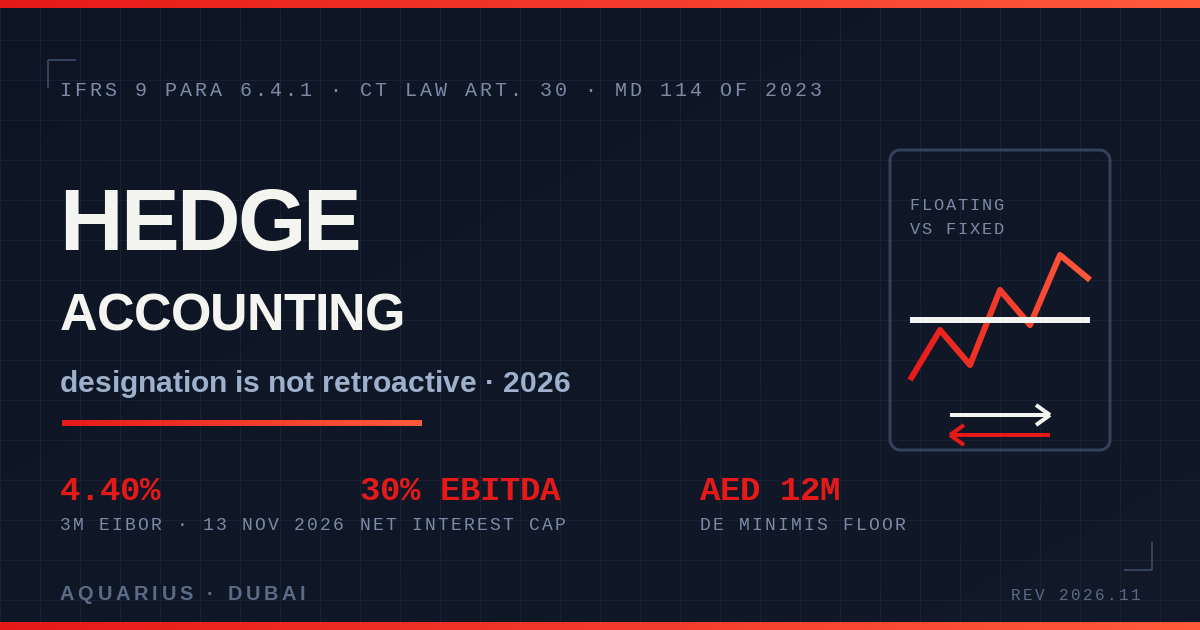
Short answer: Hedge accounting under IFRS 9 is optional, and it is not retroactive. You get it only from the date formal written designation documentation exists — naming the hedged item, the hedging instrument, the risk being hedged, the risk management objective and the method you will use to assess effectiveness. A Dubai company that signs an interest rate swap in January and writes the designation memo during the year-end audit in March gets no hedge accounting for that year. Every dirham of mark-to-market movement lands in profit or loss instead, and under UAE Corporate Tax, profit or loss is the starting point for the tax base.
That is the whole trap. The hedge works commercially — the bank pays when rates rise, exactly as designed — but the accounts and the tax return refuse to follow it, because a document was late. There is no catch-up election, no prior-period correction, no auditor discretion. IFRS 9 designation is a date, and the date is the day the file was written.
Why this became a Dubai problem in 2026
UAE non-oil foreign trade hit a record AED 1.937 trillion in the first half of 2026, up 13.1% year on year, with non-oil exports at AED 452.8 billion (up 23.9%) and trade with CEPA partner countries at AED 304.3 billion. That growth is denominated in currencies the dirham does not track. The AED is pegged to the US dollar at 3.6725, so a Dubai importer buying from the United States carries almost no currency risk — but the same company buying from the eurozone, the UK, India, China or Türkiye carries all of it. The peg is a dollar peg, not a hedge.
On the financing side, the 3-month EIBOR was 4.40% on 13 November 2026, against a 2000–2026 average of 2.64% — roughly 176 basis points above its own long-run norm. The Central Bank of the UAE held the base rate on the overnight deposit facility at 3.90% on 29 October 2026, following the US Federal Reserve. Floating-rate debt priced off EIBOR is therefore expensive and, more importantly, uncertain. UAE corporates responded the obvious way: with swaps, caps, collars and forward contracts.
Then the accounting changed underneath them. The IASB published its Risk Mitigation Accounting exposure draft on 3 December 2025, proposing amendments to IFRS 9 and IFRS 7 and a third model that is neither fair value hedge accounting nor cash flow hedge accounting. The comment deadline was extended in May 2026 to 30 November 2026 to line up with fieldwork submissions. The IASB has also stated its intention to withdraw the IAS 39 macro hedge requirements and the IFRS 9 paragraph 6.1.3 carve-out that still lets entities apply them.
Most Dubai finance teams do not fail hedge accounting on the maths. They fail it on the file: a swap confirmation sitting in an email thread, with no dated designation memo anywhere in the system.
What IFRS 9 actually requires
IFRS 9 recognises three hedge relationships: a fair value hedge (hedging exposure to changes in the fair value of a recognised asset, liability or firm commitment), a cash flow hedge (hedging variability in cash flows, typically a floating-rate loan or a highly probable forecast foreign-currency purchase), and a hedge of a net investment in a foreign operation.
To qualify, a relationship must clear three effectiveness conditions set out in IFRS 9 paragraph 6.4.1:
- There is an economic relationship between the hedged item and the hedging instrument — their values move in opposite directions because of the same risk.
- Credit risk does not dominate the value changes arising from that economic relationship.
- The hedge ratio designated equals the actual quantity of hedged item and hedging instrument the entity uses, with no deliberate imbalance that would create accounting-driven ineffectiveness.
Two things about this list surprise teams that learned hedging under the old standard. First, the 80–125% bright line is gone — that was IAS 39, and IFRS 9 replaced it with a forward-looking, objectives-based assessment. Second, effectiveness assessment under IFRS 9 is prospective, required at inception and at each reporting date; retrospective testing is no longer the gate, although ineffectiveness still has to be measured and recognised.
Two mechanics then do most of the work in practice. Rebalancing lets you adjust the hedge ratio of a continuing relationship rather than kill and re-designate it — which matters, because a fresh designation resets the clock. And the costs of hedging provisions let you separate the forward element of a forward contract, the foreign currency basis spread or the time value of an option, and park those in other comprehensive income instead of letting them pollute profit or loss.
The one control that genuinely cannot be fixed later
Formal designation and documentation at inception is the only hedge accounting condition with no remedy. Effectiveness can be re-assessed. A hedge ratio can be rebalanced. An ineffective portion can be measured and booked. But a designation memo dated after the trade date does not create hedge accounting for the period in between, and the auditor who finds it will push the full mark-to-market through profit or loss for that window.
This is why hedge accounting is a systems problem for Dubai SMEs rather than a technical-accounting problem. The technical answer is in the standard. The failure is operational: treasury executes with the bank, finance finds out at month end, and nobody owns the document in between.
Where the mark-to-market actually lands
The table below is the version every CFO should keep on one page — the same AED 100 million floating-rate loan, swapped to fixed, under three different states of paperwork.
| Position | Swap fair value movement goes to | In the Corporate Tax base now? | IFRS 7 disclosure burden | System requirement |
|---|---|---|---|---|
| No designation (swap held, no hedge accounting) | Profit or loss, in full, every period | Yes — it is inside accounting net profit or loss | Lighter: instrument-level only | Valuation feed and a derivative register |
| Cash flow hedge, designated at inception | Effective portion to OCI (cash flow hedge reserve); ineffective portion to profit or loss | Only as amounts are recycled from the reserve into profit or loss | Heavy: reserve reconciliation, timing of expected recycling, ineffectiveness | OCI subledger with a dated recycling schedule |
| Fair value hedge, designated at inception | Both legs to profit or loss — the hedged item is remeasured for the hedged risk | Yes, but largely offset by the hedged item adjustment | Heavy: hedged item basis adjustments by risk component | Basis-adjustment tracking on the hedged item itself |
| Designation memo written late (after trade date) | Profit or loss until the memo date, hedge accounting only after it | Yes, for the undocumented window | Both, plus an explanation nobody enjoys writing | Immutable, timestamped designation record |
Read the last row twice. It is not a theoretical case — it is the single most common hedge accounting finding in owner-managed UAE groups, and it is created entirely by workflow, not by judgement.
The data layer: nine things a hedge accounting module has to hold
Off-the-shelf ERPs sold in the UAE handle loans and FX revaluation competently and hedge relationships barely at all. If you are building or buying, these are the nine stores that have to exist, because each one maps to an audit question:
- Deal and documentation registry — trade confirmations, ISDA master agreement, CSA terms, counterparty and notional, with the trade date as a non-editable field.
- Designation record — hedged item, hedging instrument, risk, risk management objective and strategy, effectiveness method, all written once and timestamped, with edits held as new versions rather than overwrites.
- Hedged item linkage — down to the facility, the drawdown schedule, the purchase order or the forecast transaction, with the evidence that a forecast is still highly probable.
- Valuation engine and curve data — EIBOR and SOFR curve snapshots with versioning, so a valuation can be reproduced on the date it was struck, not re-derived from today's curve.
- Effectiveness testing — critical terms match, dollar offset or regression, plus the hypothetical derivative where the hedged risk is a component.
- OCI reserve subledger — cash flow hedge reserve by relationship, with the expected recycling profile by period and basis adjustments where the hedged item is a non-financial asset.
- Rebalancing and discontinuation trail — what changed, when, why, and which periods each state covered.
- Disclosure pack — the IFRS 7 tables: risk management strategy, carrying amounts of hedging instruments, hedge ineffectiveness recognised, and the reserve reconciliation.
- Tax pack — the profit-or-loss versus OCI split, interest-component tagging for the Article 30 calculation, and a record of any realisation-basis election.
That last store is the one almost nobody builds, and it is the one the FTA will eventually ask about. For the adjacent plumbing — cash positioning, facility tracking, bank connectivity — see our note on treasury management system development in Dubai; for the currency mechanics underneath an FX hedge, see multi-currency accounting and IAS 21 functional currency.
The Article 30 trap: your swap is interest
Here is where Dubai diverges sharply from generic IFRS advice. Under the UAE Corporate Tax Law, the definition of Interest for the general interest deduction limitation rule is broad, and it expressly reaches derivatives. Per the FTA's interest deduction guidance, the interest component of forward contracts, futures, options, interest rate swaps, foreign exchange swap agreements and other financial derivatives is Interest, and so are the costs directly related to entering those contracts — arrangement fees, guarantee fees and commitment fees incurred in connection with raising finance.
The consequence is counterintuitive: hedging a loan does not take the cost outside the cap. It can push you further inside it. Article 30 allows a deduction for Net Interest Expenditure of the greater of 30% of tax-adjusted EBITDA or AED 12 million. Anything disallowed is carried forward for ten tax periods. Banks, insurance businesses, certain regulated financial service entities and natural persons sit outside the rule, which means almost every trading, contracting, logistics and real estate group in Dubai sits inside it.
So a company that fixes its exposure with a pay-fixed swap converts a variable interest cost into a fixed one and adds the swap's interest legs and entry fees to the same capped pool. If you are near the AED 12 million floor, the hedge itself can be what tips you over the line. Model it before you trade, not after.
Separately, the specific interest limitation rule denies the deduction for interest on related-party loans used to fund dividends, share redemptions, capital reductions or the acquisition of ownership in a related party, unless the lender is subject to Corporate Tax or similar foreign tax on that interest at a rate of at least 9%. Intra-group hedging arrangements that route through a parent need to be read against that rule too.
The unrealised-gains election does not cover your derivatives
Article 20 of the Corporate Tax Law starts taxable income at Accounting Income — the accounting net profit or loss in financial statements prepared under accepted standards, adjusted for unrealised gains and losses, exempt income and reliefs. Two consequences follow for hedging.
First, Accounting Income is profit or loss, not total comprehensive income. Amounts sitting in the cash flow hedge reserve are therefore outside the tax base until they are recycled into profit or loss. That makes the recycling schedule a tax attribute, not just a disclosure note — which is exactly why the OCI subledger above needs dated periods rather than a single balance.
Second, the realisation basis election under Article 20(3), operationalised by Ministerial Decision No. 114 of 2023, comes in two flavours: all assets and liabilities subject to fair value or impairment accounting, or only those held on capital account. The popular capital-account-only version is the wrong instrument here. Derivatives held to hedge trading or financing exposures, and FX movements on receivables, payables and intercompany balances, are revenue-account items. The capital-account election leaves them fully in the tax base. Banks and insurance providers face a harder limit still: they cannot elect the realisation basis for assets and liabilities subject to fair value or impairment accounting at all.
The pattern is the same one that catches UAE groups on inventory write-downs and on expected credit losses — see our note on IFRS 9 expected credit loss provisioning, and on the capital side, capital work in progress and IAS 23 borrowing costs, where capitalised interest feeds the very Article 30 cap discussed above.
What it costs to get this right in Dubai
The cost of not doing it is arithmetic. A company carrying AED 50 million of unhedged floating-rate debt pays roughly AED 500,000 more a year for every 100 basis points EIBOR moves. With 3-month EIBOR at 4.40% against a long-run average of 2.64%, the exposure is not hypothetical; it is already priced in. And a hedge that is commercially right but accounted for without designation delivers the economics while handing the P&L and the tax computation full mark-to-market volatility — the worst of both outcomes.
Our build ranges for the hedge accounting layer in Dubai, as a module bolted onto an existing ERP or finance stack:
- AED 45,000–90,000 — derivative register, immutable designation record with versioning, trade-date controls, and the IFRS 7 disclosure tables. The right starting point for a group with under ten live relationships.
- AED 90,000–180,000 — adds the valuation engine with versioned EIBOR/SOFR curve snapshots, prospective effectiveness testing with hypothetical derivatives, and the OCI reserve subledger with a period-by-period recycling schedule.
- AED 180,000–380,000 — multi-entity, multi-currency groups: rebalancing and discontinuation trails, intercompany hedge relationships, the Article 30 interest-component tagging feed, and a tax pack that reconciles profit or loss to OCI by relationship.
Indicative ranges from our own Dubai engagements, scoped per build rather than quoted blind — see pricing for how we structure them. Every tier ships with the designation workflow first, because that is the control with no retrofit.
We build the data layer; your auditor and tax adviser own the positions. If you have swaps, caps, collars or forwards live and you are not certain the designation files are dated before the trades, that is a one-week diagnostic, not a project. Tell us what is on the book and we will tell you what is documented.
FAQ
Is hedge accounting mandatory in the UAE?
No. Hedge accounting is an election under IFRS 9, not a requirement. Without it, derivatives are measured at fair value with all movements in profit or loss. Hedge accounting is what lets the accounting follow the economics — and it only applies from the date formal designation documentation exists.
Can I apply hedge accounting retrospectively to a swap I signed earlier this year?
No. Designation is prospective from the date the documentation is in place. For the period between the trade date and the designation date, the full fair value movement goes through profit or loss, and that flows into Accounting Income for Corporate Tax purposes.
Do interest rate swap payments count against the 30% EBITDA interest cap in the UAE?
Yes. The interest component of interest rate swaps, FX swaps, forwards, futures and options is treated as Interest, and fees directly related to entering those contracts are Interest expenditure. They form part of Net Interest Expenditure tested against the greater of 30% of tax-adjusted EBITDA or AED 12 million, with disallowed amounts carried forward ten tax periods.
Does the realisation basis election stop my derivative fair value movements being taxed?
Only in the broader form. The election covering all assets and liabilities subject to fair value or impairment accounting can; the capital-account-only version does not, because hedging derivatives and FX on trade and intercompany balances are revenue-account items. Banks and insurance providers cannot make the election for fair-value or impairment items at all.
Is the 80–125% effectiveness test still required?
No. The 80–125% bright line belonged to IAS 39. IFRS 9 replaced it with the paragraph 6.4.1 conditions — economic relationship, credit risk not dominant, and a hedge ratio matching actual quantities — assessed prospectively at inception and at each reporting date.
What is changing with hedge accounting after 2026?
The IASB's Risk Mitigation Accounting exposure draft, published 3 December 2025 with comments due 30 November 2026, proposes a new model for dynamic interest rate risk management alongside IFRS 9 and IFRS 7 amendments, and signals withdrawal of the IAS 39 macro hedge requirements. Build your designation and reserve data properly now and the migration is a mapping exercise rather than a rebuild.