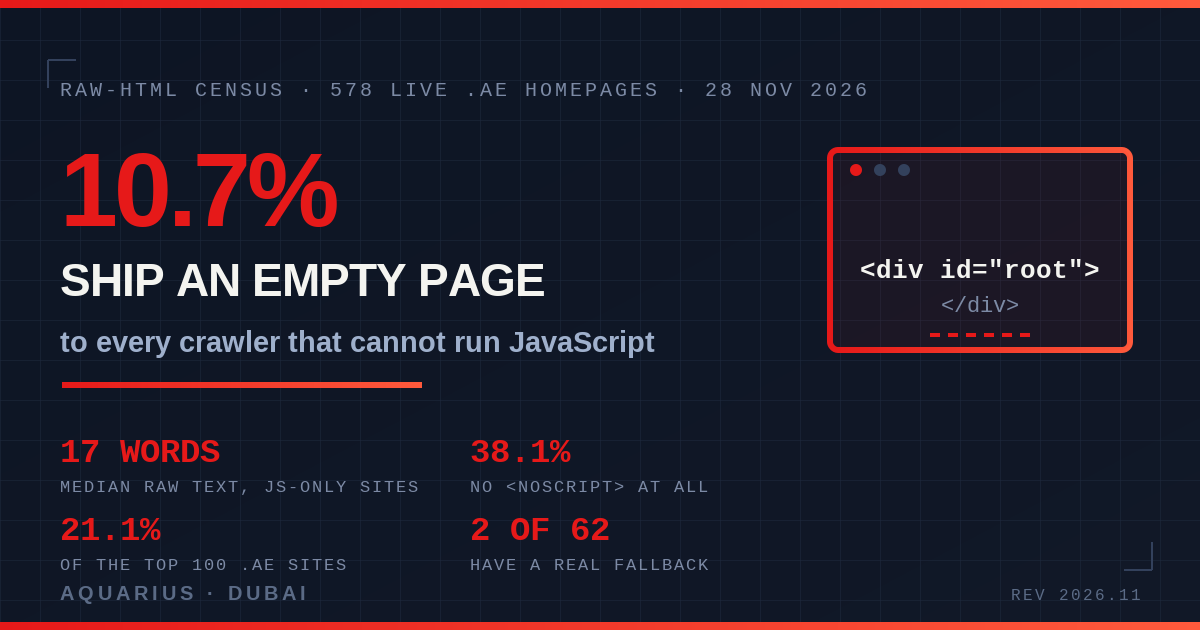
We fetched 578 live .ae homepages on 28 November 2026 with JavaScript switched off — exactly as GPTBot, ClaudeBot and PerplexityBot see them. 10.7% returned under 100 words or an empty app shell. Among the 100 most-visited .ae sites that figure rises to 21.1%. Google renders JavaScript, so these sites still rank. The AI crawlers now responsible for 52% of all crawler traffic do not render it, so to them those homepages are blank.
That is the gap most Dubai technical teams have not measured, because every tool they test with runs a browser.
Dubai’s homepage now has two audiences
The UAE is as close to fully online as a country gets: 11.5 million internet users at 99.0% population penetration , per DataReportal’s Digital 2027: UAE report published 4 November 2026. Search here is a Google monopoly — StatCounter put Google at 95.42% of UAE search referrals in October 2026 , with Bing a distant 2.43%.
But the machines reading your site are no longer mostly search engines. Cloudflare’s bot report of 1 July 2026 found that 52% of crawler requests are now for AI training, up from 22% in Spring 2025 , with mixed-use crawlers blending search, agents and training accounting for over 36% of activity.
And those crawlers do not execute your JavaScript. Vercel tested the major ones directly and published the result: “Most AI crawlers don’t execute JavaScript. We tested the major ones (ChatGPT, Claude, and others), and the results were consistent: none of them render client-side content.” GPTBot, OAI-SearchBot, ClaudeBot, PerplexityBot, Meta-ExternalAgent and Bytespider all fetch JavaScript files and never run them. Gemini and AppleBot are the exceptions.
The imbalance is already brutal. Cloudflare’s crawl-to-refer measurements for July 2025 showed Anthropic crawling 38,065 pages for every single visitor it referred back , OpenAI 1,091 to 1, and Perplexity 194.8 to 1. Those crawlers are taking thousands of passes at your content. If your content is not in the HTML, they take thousands of passes at nothing.
What we measured, and how
We took the Tranco top .ae host list — 787 domains — and requested each homepage once over HTTPS with a desktop Chrome user agent, following redirects, apex then www then HTTP. 594 returned a 200 with an HTML content type; 578 of those shipped more than 1 KB of markup and form the sample.
From the raw response body only — no browser, no hydration — we stripped scripts, styles, comments and <noscript> blocks, then counted visible words, headings, links, JSON-LD blocks, and whether a single-page-app mount node (#__next, #root, #app, #__nuxt, app-root, #___gatsby) was present and empty. That is the document an AI crawler indexes.
The .ae median is healthy. The top of the market is not.
First the good news, because it contradicts the usual scare story. The median .ae homepage delivers 911 words of real text before any JavaScript runs . The HTTP Archive’s 2025 Web Almanac put the global median raw homepage at 316 words on mobile. Dubai’s web is roughly three times more server-rendered than the world average, largely because so much of it is WordPress (99 of 578 sites) and Shopify (39).
Percentile Raw words in HTML What that means to an AI crawler
p10 81 Barely a paragraph. Not citable. p25 497 Thin but indexable. p50 (median) 911 Healthy. Nearly 3x the global median of 316. p75 1,895 Strong. Plenty of passages to quote. p90 3,473 Full catalogue or news front page in HTML.
Now the problem. The distribution has a cliff at the bottom, and the cliff is concentrated at the top of the market . Of the 71 measurable hosts inside the Tranco top 100 for .ae, 15 — 21.1% — ship under 100 raw words or an empty shell. In the long tail below rank 100 the rate is 9.3%. Median raw words for the top 100 is 530 ; for everything below it, 949 .
The biggest, best-funded, most-rebuilt .ae properties are the ones invisible to AI crawlers. That is the inversion nobody expects, and it has a simple cause: those are the sites that could afford an Angular, Next.js or Nuxt rewrite in the last three years, and the rewrite shipped client-side.
The 62: what an AI crawler actually receives
62 of 578 homepages (10.7%) are JavaScript-dependent by our definition. Their median raw text is 17 words . Eight return literally zero words. Forty return 25 or fewer. The median JavaScript-dependent homepage is 12.6 KB of markup against a sample-wide median of 189.4 KB — almost all of it an empty wrapper and a script tag.
Verified on both apex and www on 28 November 2026, these Dubai and UAE names return zero or near-zero raw text:
rta.ae — Dubai’s Roads and Transport Authority: 0 words, 0 headings, 0 links.parkin.ae — Dubai’s listed parking operator: 0 words.uaepass.ae — the national digital identity: 0 words (empty Nuxt mount).moi.gov.ae and growth.gov.ae — 0 words each.dha.gov.ae — Dubai Health Authority: 20 words, 1 heading.du.ae — 13 words. wam.ae , the state news agency — 3 words.sharjah.ae — 21 words, 3 headings.
Ten of the 56 .gov.ae hosts in the sample are JavaScript-dependent. When a resident asks ChatGPT how to renew a Dubai vehicle registration, the authoritative source is a blank document and the model answers from a forum post instead.
Framework fingerprints inside the 62: Angular 10, Next.js 5, Nuxt 4. But 44 of the 62 carry no recognisable framework fingerprint at all — bespoke or in-house SPAs, the hardest kind to get fixed because no upgrade path ships with them.
Links and structure vanish too
It is not only text. 37 homepages (6.4%) contain zero links in raw HTML , so a non-rendering crawler reaches the homepage and finds no route to any other page. 49 have no heading element of any kind. 167 — 28.9% — have no <h1>, which lines up with what we found in our heading-structure scan of .ae homepages . And 254 (43.9%) ship no JSON-LD at all in the raw document — consistent with our structured-data census , and worth knowing that the Almanac found only 2% of sites globally add structured data via JavaScript, so client-side schema injection is not what is happening here. It is simply absent.
Myth-bust: <noscript> has not been a fallback for years
The standard answer to “what if JavaScript does not run” is <noscript>. We counted it. It is dead.
220 of 578 homepages (38.1%) have no <noscript> element whatsoever. Another 215 (37.2%) have one that contains only a tracking pixel or iframe — a Google Tag Manager or Meta fallback beacon with under 15 characters of text. 38 contain an “enable JavaScript in your browser” message, which is a dead end, not content. Only 25 sites in the entire sample ship 100 or more characters of genuine fallback text.
And here is the number that matters: of the 62 JavaScript-dependent homepages, exactly 2 have real <noscript> content . The sites that need a fallback are the sites that do not have one. 38 of the 62 have no headings either, so there is no skeleton for a crawler to latch onto.
Several Dubai retailers — alainpharmacy.ae, unioncoop.ae, binsina.ae, dyson.ae, grandstores.ae — do carry the legacy Magento “JavaScript seems to be disabled in your browser” string. Worth noting that all five also ship 480 to 3,700 raw words, so their content is fine. The <noscript> is template boilerplate, not a safety net anyone is relying on.
Free: the 2027 Dubai AI-Crawler Visibility Checklist The 14 raw-HTML checks we ran on 578 .ae homepages, as a one-page audit you can run against your own site in an afternoon — plus the curl command that shows you exactly what GPTBot sees.
Get the free checklist → Why “but Google renders JavaScript” is the wrong test
Google does render. That is settled. On Search Off the Record in July 2024, Martin Splitt asked how Google decides which pages get rendered, and Zoe Clifford of Google’s rendering team answered: “We just render all of them, as long as they’re HTML, and not other content types like PDFs.”
But Google’s own documentation attaches conditions that Dubai teams routinely skip past:
Rendering is queued, not immediate. “Googlebot queues all pages with a 200 HTTP status code for rendering… The page may stay on this queue for a few seconds, but it can take longer than that.” For a Dubai Shopping Festival landing page or a limited-run offer, “longer than that” is the whole campaign.There is a 2 MB cap. Google’s “Inside Googlebot” post confirms it processes only the first 2 MB of an HTML document, and ignores any single resource over 2 MB. Push your content below that line with script and it is not read.Non-200 responses may never get rendered — which makes JavaScript-only navigation on custom 404 pages a dead end.Canonicals are processed both before and after rendering. If your raw and rendered canonical disagree, Google says that confuses its indexing systems.And Google states it plainly: “not all bots can run JavaScript.”
Google still recommends server-side and edge-side rendering for critical content. The Almanac’s own observation is the cleanest summary of the pattern: “the more words, the less they rely on client-side rendering.” The global rendered-versus-raw median word gap is only 16% on mobile. Healthy sites barely need the render.
What it costs to fix this in Dubai
You do not need to rebuild. In almost every one of the 62 cases, the fix is to make the first response carry the page’s real content, and nothing else changes. Typical Dubai market ranges, for a single-site engagement:
Fix What changes Dubai cost (AED) Timeline
Raw-HTML visibility audit Exact word, link, heading and schema counts per template; crawler-by-crawler report 3,500 – 7,500 3 – 5 days Prerender / static snapshot layer Cached HTML served to non-rendering agents. No app rewrite 12,000 – 28,000 2 – 3 weeks SSR for key routes (Next.js / Nuxt / Angular Universal) Home, category, product, contact rendered server-side 28,000 – 65,000 4 – 8 weeks Server-rendered JSON-LD + heading repair Organization, LocalBusiness, Product and FAQ schema in the first byte 4,500 – 11,000 1 – 2 weeks Full HTML-first rebuild New front end, server-rendered by default 45,000 – 140,000 8 – 16 weeks
Set that against what is moving. UAE e-commerce reached AED 42.2 billion in 2025 — 15.7% of total UAE retail — and is forecast to hit AED 67.2 billion by 2030 (EZDubai / Euromonitor). Spread across the year that is roughly AED 4.8 million of UAE online retail transacting every hour . A homepage that is blank to a third of the crawlers reading the web is not a technical debt item. It is a share-of-voice decision being made by default.
How Aquarius does it
We start with the measurement, not the rebuild, because the 62 sites in this scan fall into three very different buckets and only one of them needs real engineering. We fetch every key template with JavaScript disabled and the exact user agents GPTBot, ClaudeBot and PerplexityBot send, diff raw against rendered, and tell you which pages are actually at risk. Most clients find two or three templates matter and the rest are fine.
Then we fix the cheapest sufficient layer. Prerendering a Next.js or Nuxt app for non-rendering agents usually takes days, not a quarter, and it does not touch your product roadmap. Full SSR only when the route genuinely needs it — see our guide to React Server Components and rendering modes for where that line sits. If you want the citation side of this too, our AEO guide to getting cited by AI search covers what goes in the HTML once the HTML exists.
Risk reversal: the audit is fixed-fee and the deliverable is yours whether or not you hire us to implement. If it shows your raw HTML is already healthy — and for 89.3% of .ae homepages it is — we will tell you that and bill you for the audit only. See our pricing , review the services , or send us your domain and we will run the raw-HTML check for free and send you the numbers.
FAQ
Do AI crawlers really not run JavaScript in 2026?
Correct for the major ones. Vercel’s testing found GPTBot, OAI-SearchBot, ChatGPT-User, ClaudeBot, PerplexityBot, Meta-ExternalAgent and Bytespider all fetch JavaScript files without executing them. Google’s Gemini crawler and AppleBot do render. So a client-side-only page is visible to Google and Apple, and blank to ChatGPT, Claude and Perplexity.
How do I check what a crawler sees on my own Dubai site?
Run curl -s https://yoursite.ae/ | sed -e 's/<script[^>]*>.*</script>//g' -e 's/<[^>]*>/ /g' | tr -s ' ' | wc -w and read the word count. Under 100 on a homepage means you have the problem. Then view source and look for an empty <div id="root"></div> or <div id="__next"></div>.
Will fixing this improve my Google rankings?
Possibly, but that is not the main reason to do it. Google already renders your page. The gains are faster indexing (you skip the render queue), immunity to the 2 MB processing cap, and becoming eligible for citation in ChatGPT, Claude and Perplexity answers at all. For most Dubai businesses the third one is now the largest uncaptured channel.
Is <noscript> enough?
No. Duplicating a homepage into <noscript> is unmaintainable and search engines treat it with suspicion when it diverges from the rendered page. Only 25 of 578 .ae homepages ship real fallback text, and only 2 of the 62 sites that need it. Server-render or prerender the actual content instead.
Does page weight matter here as well?
Yes, and in the opposite direction. JavaScript-dependent pages are tiny in HTML but heavy in script. Our DOM size and HTML payload scan covers the other end: the sample-wide median homepage carries 28 script tags, with inline script making up 14% of the document at the median and 59% at p90.
Method and limits
787 Tranco .ae hosts requested once each on 28 November 2026, 28 parallel workers, 20-second timeout, desktop Chrome user agent, redirects followed. 594 answered with HTML; 578 passed a 1 KB minimum-markup filter and form the reported sample. Word counts are visible text after removing scripts, styles, comments and <noscript>. “JavaScript-dependent” means an empty SPA mount node or fewer than 100 raw words. Single-fetch snapshots catch bot walls and maintenance pages as well as real SPAs, so treat individual hosts as indicative; every named example above was re-verified on both apex and www. Framework detection is fingerprint-based and undercounts bespoke stacks, which is why 44 of the 62 show no framework at all.