
Labour Accommodation Management Software in Dubai (2026): MOHRE Resolution 122, Bed-Level Records and Real AED Costs
MOHRE Resolution 122 of 2026 added hard ratios and live resident data to every UAE labour camp file. Real AED software costs, bed economics, and the shared-housing carve-out most Dubai employers miss.
- PUBLISHED
- 17 OCT 2026
- READ TIME
- 12 MIN
- AUTHOR
- AQUARIUS · DUBAI
- UNIT
- REV 2026.09
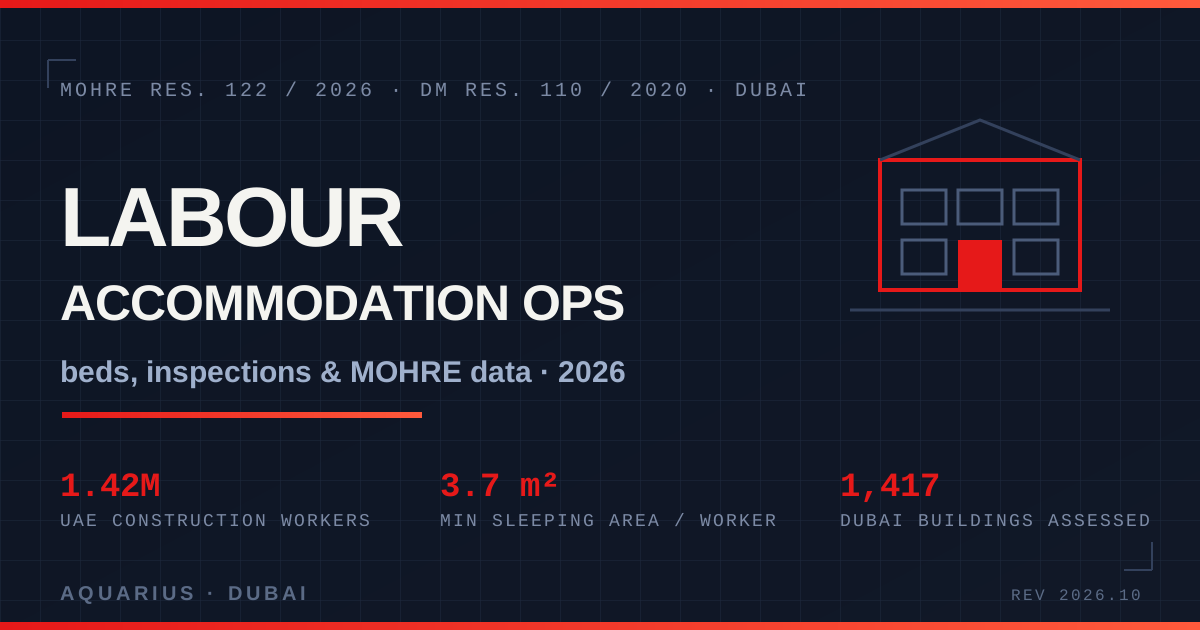
Short answer: If you employ 50 or more workers earning AED 1,500 or less a month, UAE law now requires you to house them and keep their accommodation data registered and current with MOHRE — and Ministerial Resolution No. 122 of 2026, published on 30 June 2026, added hard ratios you have to prove on demand: one cold drinking-water cooler per 30 workers, one supervisor per 200 workers, 24/7 licensed security with CCTV on entrances, lockers, multilingual rights notices and dedicated space for People of Determination and sick or injured workers.
That is no longer a clipboard job. Off-the-shelf facility software in the UAE runs AED 450 to AED 6,000 a month, or roughly AED 100 to AED 400 per user per month, and a purpose-built accommodation platform costs AED 25,000 to AED 110,000 once. The number that decides it is not the licence fee — it is how many beds you are paying for and cannot account for.
Key takeaways
- 1.42 million construction-sector workers were active in the UAE in Q1 2026 — the highest level since the Expo 2020 build cycle — after MOHRE issued 187,000 net construction work permits in 2025, up 22% year on year.
- The UAE private-sector workforce grew 12.4% in 2025 and a further 2.5% in Q1 2026. Every one of those arrivals needs a compliant bed before a work permit is useful.
- Dubai Municipality assessed 1,417 buildings under the Workers’ Accommodation Policy and classified 19 model accommodations — 7 Silver, 9 Gold and 3 Platinum. The floor is 3.7 m² of sleeping area per worker under Administrative Resolution No. 110 of 2020, plus 0.75–1.5 m² of outdoor and recreational space per person.
- Bed economics are brutal and local: AED 500 to AED 1,500 per person per month depending on area and facilities, with Sonapur rooms at AED 1,400–2,000 for 4–6 people and Al Quoz at AED 2,400–3,200 for 6–8.
- Most Dubai employers get this wrong: they assume the new Law No. 4 of 2026 on shared housing covers their labour camp. It does not. Collective labour accommodation is explicitly carved out and still sits under DM Resolution 110 of 2020 and MOHRE’s accommodation regime — so the permit, the standard and the inspector are all different.
Why accommodation became a data problem in 2026
The scale came first. 1.42 million construction workers were on the books across the UAE in Q1 2026, the highest stock figure since the Expo 2020 peak, driven by 187,000 net construction work permits in 2025 — a 22% jump. The wider private-sector workforce expanded 12.4% in 2025 and 2.5% in Q1 2026, with the number of establishments still rising. Headcount growth at that pace lands on the accommodation manager before it lands anywhere else.
Then the standard tightened. Dubai Municipality’s Workers’ Accommodation Policy work produced an assessment of 1,417 buildings, a unified government database of workers’ areas, and a classification exercise that named 19 model accommodations: 7 Silver, 9 Gold, 3 Platinum. The baseline numbers are published and non-negotiable: 3.7 m² of sleeping area per worker under Administrative Resolution No. 110 of 2020, between 0.75 and 1.5 m² of outdoor and recreational space per person, and roughly 8.9 to 10.3 m² of gross floor area per person for supporting services.
Finally, the reporting changed. MOHRE’s Labour Accommodation System is the national platform where companies with 50 or more employees register accommodation data electronically. Compliance pressure is real: private-sector companies meeting the standards rose roughly tenfold against February 2022, when Ministerial Decision No. 44 of 2022 took effect, and 103 inspection campaigns ran in 2023 alone. Under the 2026 resolution, accommodation owners must register and maintain current resident-worker data — and MOHRE may suspend the establishment’s file for incorrect data or breaches. A suspended file stops new work permits, which stops mobilisation, which stops the project.
What the 2026 rules actually require you to prove
Ministerial Resolution No. 122 of 2026 (published 30 June 2026) applies where both tests are met: 50 or more employees and a monthly wage of AED 1,500 or less. Commission-based workers at occupational level 5 or above sit outside the wage test, and local authorities can widen the thresholds inside their own emirate. On top of the older space and ventilation standards, it adds requirements that are each a field in a database rather than a line in a policy document:
- One cold drinking-water cooler per 30 workers — a ratio against live occupancy, not design capacity.
- One supervisor per 200 workers, which means a roster you can show per block, per shift.
- 24/7 security guarding by a licensed company, with CCTV at entrances.
- Dedicated facilities for People of Determination and for injured or sick workers.
- Multilingual rights and safety information, free internet access and electronic awareness screens.
- Secure personal lockers and a working complaints channel.
- Registered, current resident data filed with MOHRE — with file suspension as the penalty for getting it wrong.
The carve-out that trips people up
Dubai Law No. 4 of 2026, published 16 March 2026, regulates shared housing — multiple individuals or families sharing one property unit, including in free zones and special development zones. It requires a Dubai Municipality permit, registered lease contracts, approved occupancy limits, bans subleasing by residents, and carries fines from AED 500 to AED 500,000 with suspension, permit cancellation and eviction available for repeat offenders. It is a serious law, and it is not your labour camp: collective labour accommodation is expressly left to separate legislation. If you run both — a camp in Jebel Ali and shared staff apartments in Al Barsha — you are managing two different permit regimes in one portfolio, and your system has to tag each unit with which regime applies.
Buy or build: the real AED numbers
The honest split: if you manage under about 300 beds in one location, a configured off-the-shelf tool or even a free accommodation tool plus a disciplined spreadsheet will hold. Above that — multiple camps, a mix of camp and shared apartments, subcontractor workers mixed with your own, or an operator renting beds to third-party employers — the integration work is where the cost sits, and generic software starts charging you for the privilege of not fitting.
| Option | 2026 price (AED) | Best fit |
|---|---|---|
| Free / freemium accommodation tools | 0, limited scope | Single camp, under ~150 beds |
| Lightweight CMMS, per user | 100 – 200 / user / month | Maintenance tickets only |
| Full CAFM platform, per user | 100 – 400 / user / month | FM-led operations with assets and PPM |
| CAFM / FM SaaS, platform tier | 450 – 6,000 / month | Mid-size portfolios, several buildings |
| Implementation and data migration | +50% – 100% of first-year licence | Any mid-size rollout — budget it up front |
| Global CAFM + UAE compliance add-ons | 100,000 – 500,000+ | Closing WPS and Emirates ID gaps on foreign platforms |
| Purpose-built accommodation platform (custom) | 25,000 – 110,000 one-time | Multi-camp operators, mixed portfolios, bed resellers |
Set that against what the beds themselves cost. Dubai labour accommodation runs AED 500 to AED 1,500 per person per month, with MOHRE-approved bed spaces advertised from roughly AED 350 to AED 750 per bed, Sonapur rooms at AED 1,400–2,000 for 4–6 occupants, Jebel Ali at AED 2,200–3,000 for 6–10, Al Quoz at AED 2,400–3,200 for 6–8, and fully equipped high-capacity rooms in Dubai Investments Park at AED 7,500–8,500 a month. On a 1,000-bed portfolio at AED 800 a bed, you are moving AED 800,000 a month. A 5% gap between beds paid for and beds actually occupied by a named, currently employed worker is AED 40,000 a month — which is the entire annual cost of the software that would have found it.
The five records that decide an inspection
Inspections do not fail on intent. They fail because nobody can produce the document in the ten minutes it is asked for. Build the system around these five.
- Bed-level allocation. Block, room, bed, occupant, Emirates ID, employer, check-in and check-out dates. Room-level tracking is why portfolios carry phantom occupancy — a room marked full with two empty beds is money leaving every month.
- Live headcount against ratios. Coolers per 30 workers and supervisors per 200 are only meaningful against today’s occupancy. The system should flag the block that crossed the line yesterday, not at the next audit. This is the same logic as attendance and WPS-ready payroll — one source of truth for who is actually on site.
- Inspection and maintenance history. Pest control, water tank cleaning, AC servicing, fire system checks, Civil Defence sign-offs, with photos and dates per building. Pair it with your HSE compliance records so the same incident is not logged twice in two systems.
- Security and access. Licensed guarding contract, guard roster, CCTV coverage at entrances, visitor log. If you also run patrols and checkpoints, see patrol management under SIRA.
- Worker status linkage. A bed occupied by someone whose visa is cancelled or whose work permit has lapsed is a compliance finding and a billing dispute at once. Link allocation to the visa and permit record — our note on PRO and visa compliance software covers that data model.
Contractors usually want this joined to project mobilisation as well: heads needed on site next month, beds available, transport manifests, mess headcount. That is the seam between accommodation and construction project management, and it is where most spreadsheets quietly break.
What Aquarius builds, and what it costs
We build the accommodation system as an operations tool first and a compliance file second — because the compliance file is a by-product of running the place properly.
| Scope | What is included | AED (one-time) |
|---|---|---|
| Single-camp core | Bed-level allocation grid, resident records with Emirates ID, check-in / check-out, maintenance tickets with photos, mess headcount, inspection log | 25,000 – 45,000 |
| Multi-camp operations | Multiple buildings and blocks, live ratio alerts (coolers, supervisors), guard rosters, transport manifests, utility cost per bed, Arabic and English documents | 50,000 – 85,000 |
| Operator / mixed-portfolio platform | Third-party employer billing per bed, shared-housing vs collective-accommodation permit tagging, HR and visa data sync, MOHRE-ready resident data exports, dashboards per client | 85,000 – 110,000+ |
| Support and roadmap | Hosting, monitoring, regulation updates, enhancements | 2,500 – 9,000 / month |
Risk reversal is simple: fixed scope, fixed AED price with VAT shown separately, staged payments against dated milestones, and full source-code handover at the end — no per-bed licence that grows every time you win a project. Data stays on infrastructure you control, which matters when the records in it are Emirates ID numbers and worker files. Compare scopes on our pricing page.
The payback case is the reconciliation, not the dashboard. One correctly tracked 1,000-bed portfolio at AED 800 a bed recovering a 5% occupancy gap returns about AED 480,000 a year, against a one-time build in the AED 50,000–85,000 range. Even if your real gap is a fifth of that, the arithmetic still only runs one way — and it ignores the harder cost entirely, which is a suspended MOHRE file freezing permits while 200 workers wait to mobilise.
FAQ
Who must provide labour accommodation in the UAE in 2026?
Establishments with 50 or more employees whose monthly wage is AED 1,500 or less must provide accommodation meeting the published standards, under the MOHRE regime most recently updated by Ministerial Resolution No. 122 of 2026 (30 June 2026). Commission-based workers at occupational level 5 or above are outside the wage test, and individual emirates may adjust the thresholds locally.
How much space per worker does Dubai require?
A minimum of 3.7 m² of sleeping area per worker inside the room, per Dubai’s Administrative Resolution No. 110 of 2020, plus 0.75 to 1.5 m² of outdoor and recreational space per person and roughly 8.9 to 10.3 m² of gross floor area per person for supporting services across the workers’ area.
Does Dubai’s new shared housing law apply to labour camps?
No. Law No. 4 of 2026 (published 16 March 2026) governs shared housing in property units — permits from Dubai Municipality, registered leases, occupancy limits, no subleasing, and fines from AED 500 to AED 500,000. Collective labour accommodation is explicitly excluded and remains under separate legislation. Employers with both camps and shared staff apartments need to track which regime each unit falls under.
How much does labour accommodation management software cost in Dubai?
Off-the-shelf FM and CAFM platforms run AED 450 to AED 6,000 per month at platform level, or AED 100 to AED 400 per user per month, and implementation typically adds 50% to 100% of the first-year licence. Free accommodation tools exist for small single camps. A purpose-built platform is AED 25,000 to AED 110,000 once, which is usually the cheaper path above roughly 300 beds or two sites.
What does MOHRE actually check in the accommodation file?
That accommodation data is registered and current in the Labour Accommodation System, and that the physical standards hold against live occupancy — space per worker, one drinking-water cooler per 30 workers, one supervisor per 200 workers, 24/7 licensed security with CCTV at entrances, lockers, multilingual rights notices, and dedicated facilities for People of Determination and sick or injured workers. Incorrect data can get the establishment file suspended, which blocks new work permits.
Get your beds, records and headcount into one system
Send us your bed count, number of sites, and whether you house your own workers, subcontractors or paying third-party employers. We will come back with a fixed AED scope, a dated delivery plan, and a straight answer on whether you should buy a platform or build one. Start an accommodation platform build or compare scopes on our pricing page.