
Meal Plan Subscription App Development in Dubai (2026): Real AED Build Costs, the Card Tokenisation Deadline and the Health-Claim Permit Nobody Mentions
A Dubai meal-plan subscriber spends AED 2,100-2,900 a month against a USD 14.73 single delivery order. Here is what the app costs to build, and the two permits that sink launches.
- PUBLISHED
- 09 OCT 2026
- READ TIME
- 14 MIN
- AUTHOR
- AQUARIUS · DUBAI
- UNIT
- REV 2026.09
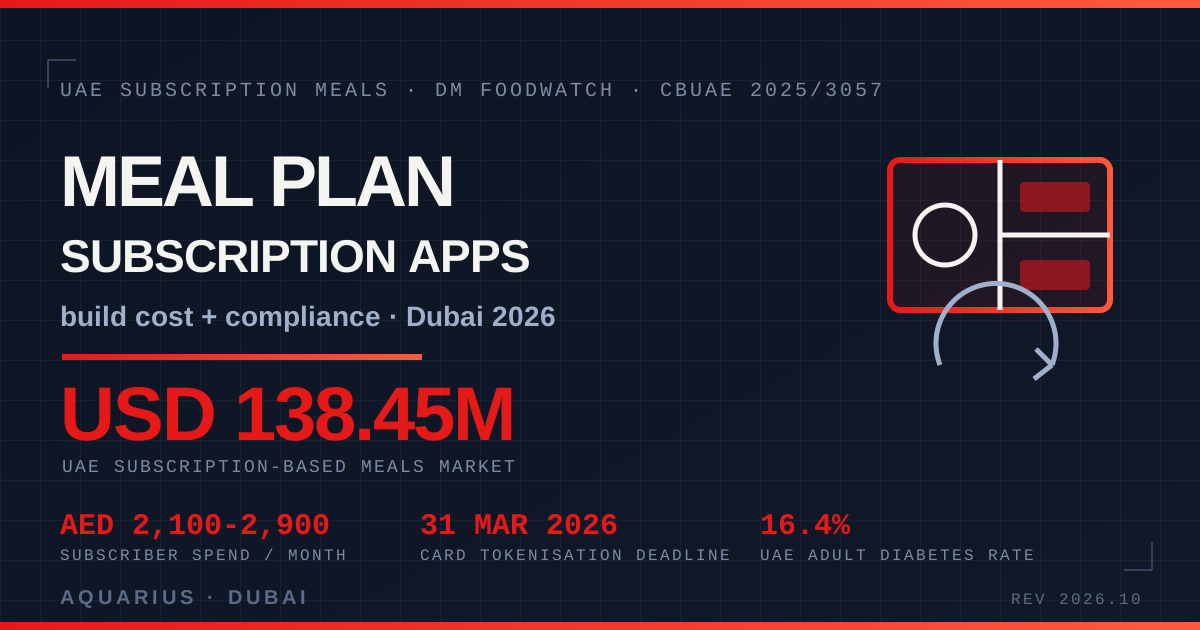
Short answer: A production meal-plan subscription platform in Dubai — customer app, subscription and billing engine, kitchen production dashboard and driver app — costs AED 160,000–320,000 for a launchable MVP over 12–18 weeks, and AED 350,000–600,000 for the full platform with routing, dietitian tooling and ERP integration. The economics justify it: a Dubai meal-plan subscriber spends AED 2,100–2,900 per month, while the average single food-delivery app order in the UAE is USD 14.73 (about AED 54). One subscriber is worth roughly 40–54 one-off orders a month. The two things that actually kill launches are not technical: Dubai Municipality requires prior certification before you publish any nutrition or health claim, and from 31 March 2026 CBUAE Notice 2025/3057 requires network tokenisation for every merchant-initiated card-on-file charge — which is exactly how a subscription renews.
Key takeaways
- The market is real but not huge — which is the opportunity. The UAE subscription-based meals market is valued at USD 138.45 million and growing at about 4.2% CAGR to 2030, sitting inside a UAE food-delivery app market worth USD 1.5 billion in 2025 compounding at 9.88%. Subscriptions are the high-margin slice, not the volume slice.
- Retention is the entire business model. Right Bite plans run from AED 22 per meal (Essentials) to AED 33 per meal (High Protein), landing monthly bills of AED 2,100–2,600 for a 1,200–1,500 kcal plan and AED 2,400–2,900 for 1,600–2,000 kcal. At that ticket size, a single failed renewal charge costs more than most apps earn in a week.
- 31 March 2026 is a hard date for your billing stack. CBUAE Notice 2025/3057, issued in May 2025, phases out SMS and email OTPs and requires acquirers to use network tokenisation for all merchant-initiated credential-on-file transactions. Penalties for significant violations reach AED 250,000 per violation.
- Your macros are a regulated claim. Every food establishment in Dubai must be registered on FoodWatch, and any nutrition or health claim on menus, display boards, advertising or promotional material — digital or print — needs prior certification from the Dubai Municipality Food Safety Department. The certification is free and runs in three online steps. The calorie badge in your app is covered by this.
- Most Dubai meal-plan founders get this backwards. They spend the budget on a beautiful ordering flow and bolt on billing at the end. The ordering flow is used once per customer. The pause, skip, swap and renew logic is used every single week, forever — and it is where churn is won or lost.
Why Dubai is the strongest meal-subscription market in the region
Three numbers set the stakes, and all three point the same way.
- The health driver is structural, not a fad. The UAE has one of the world’s highest type 2 diabetes burdens — roughly 16.4% of adults per International Diabetes Federation data, projected to reach about 21% by 2030 — alongside adult obesity measured between 28.0% and 31.7% depending on the cut-off used, rising to 35.5% among UAE nationals. Portion-controlled, macro-tracked food is not a lifestyle product here. It is a standing demand curve.
- The distribution rails already exist. UAE smartphone penetration hit an estimated 97.6% in 2025, nearly 90% of food and grocery orders are placed in apps, and the market is forecast to fulfil 111 million app orders in 2026 at an average order value of USD 14.73. You are not educating a market on ordering food from a phone.
- The category has proven it can scale from here. Calo — operating in the UAE, Saudi Arabia, Bahrain, Qatar and Kuwait — has raised about USD 90 million in total, including a USD 64 million Series B at a reported USD 250 million valuation, passed USD 100 million annualised revenue, grew over 50% year-over-year in H1 2025, and acquired two UK meal-subscription brands in 2025. The playbook works and it is funded.
Here is the shareable number. A single delivery order in the UAE averages about AED 54. A meal-plan subscriber averages AED 2,100–2,900 a month. That is the equivalent of 39 to 54 one-off orders from one customer, with no aggregator commission and no bidding for the order. This is why kitchens that already deliver through aggregators keep trying to build their own subscription channel — and why most of them underestimate the software. If aggregator commission is your pain point, our breakdown of food delivery app development cost in Dubai covers the direct-channel maths in detail.
What the app actually has to do (and what founders underbuild)
A meal-plan app is not a food-ordering app with a repeat button. It is a forward-dated production scheduler wearing an ordering interface. The customer buys a commitment; your kitchen buys inventory against that commitment three to five days ahead. Every feature below exists to protect that gap.
The subscription engine is the product
- Plan modelling. Calories per day, meals per day, days per week, delivery windows, cuisine or allergen exclusions, and a per-customer macro target. Right Bite-style tiering (Essentials, Weight Loss, Low Carb, High Protein) means plan definitions must be data, not code.
- Pause, skip, swap and freeze — with a cut-off. Dubai subscribers travel constantly. A pause requested after the kitchen has committed inventory has to either be refused with a clear reason or accepted as a credit. Implement a hard cut-off clock (typically 36–48 hours before the delivery date) and surface it in the app, or support will spend every evening arguing about it.
- Credits, proration and rollover. Skipped days become credits; credits extend the plan end date; a plan change mid-cycle prorates. These three rules generate most of the accounting disputes in this business and belong in a tested module, not in controller code.
- Renewal and dunning. Pre-authorise, retry on a schedule, notify before and after failure, and suspend production — not just app access — on a hard decline. A failed renewal that still sends food is a direct loss of AED 70–100 per day.
- VAT-correct invoicing. Covered below, and it is not optional.
Kitchen, labels and cold chain
The back of house is where the money leaks. You need a daily production run view (how many of each meal to cook tomorrow, derived from active subscriptions minus pauses), batch and portion tracking, and per-meal label generation carrying the macro breakdown and allergens. The Dubai Food Code requires clear identification of major allergens including nuts, milk, eggs, soy, wheat, fish and shellfish, and claims such as gluten-free or dairy-free must be supported by documentation — so your label generator and your supplier records have to agree with each other on demand.
Cold chain is the other half. The Food Code sets 5°C or below for refrigerated storage, -18°C or below for frozen, 60°C or above for hot holding and 75°C or above for cooking raw animal products, with enhanced scrutiny on transportation, packaging and temperature control during delivery. Practically: your driver app should capture a temperature reading and a delivery photo per drop, timestamped and retained. Our guides to cloud kitchen management software in Dubai and HACCP compliance software go deeper on the production side.
Driver app and routing
Meal plans deliver in tight pre-dawn windows to the same addresses every day — which is a gift, because routes are stable and can be sequenced once and reused. Build zone-based route sequencing, a driver handover screen, failed-delivery handling (building security, no answer, wrong tower) and proof of delivery. Note the permit chain: all vehicles carrying food in Dubai require Dubai Municipality Food Control Section approval before RTA licensing, the permit specifies which food types the vehicle may carry, and every delivery staff member needs a Food Handler Professional Identification Card from an approved training centre.
What it costs to build in Dubai, in AED
Realistic 2026 ranges for a Dubai-based build, excluding 5% VAT. A cross-platform Flutter or React Native customer app is the default choice here — two native codebases rarely earn their keep for this product.
| Module | What it covers | Cost (AED) | Timeline |
|---|---|---|---|
| Discovery and plan architecture | Plan and pricing model, cut-off rules, credit and proration logic written down before code, VAT treatment confirmed | 9,000–22,000 | 1–2 weeks |
| Customer app (iOS + Android) | Onboarding and macro calculator, plan builder, calendar with pause and skip, meal swap, address and delivery window, Arabic and English with RTL | 55,000–140,000 | 6–10 weeks |
| Subscription and billing engine | Tokenised card-on-file, renewals and dunning, credits, proration, rollover, plan change, VAT invoices with TRN | 35,000–85,000 | 3–6 weeks |
| Kitchen production dashboard | Daily production run, batch and portion tracking, macro and allergen label generation, waste and yield reporting | 28,000–70,000 | 3–5 weeks |
| Driver app and routing | Zone route sequencing, handover, proof of delivery with photo and temperature capture, failed-delivery flows | 30,000–75,000 | 3–5 weeks |
| Dietitian and menu CMS | Recipe and macro library, plan templates, claim-substantiation records, consultation notes | 18,000–45,000 | 2–4 weeks |
| Integrations | Payment gateway tokenisation, WhatsApp Business API notifications, accounting or ERP sync, analytics | 15,000–40,000 | 2–3 weeks |
Running costs are the number most business plans omit. Budget AED 1,200–4,500 per month for hosting and infrastructure at launch scale, payment processing of roughly 2.4–2.9% plus AED 1 per transaction, WhatsApp and SMS notification costs that scale with delivery count rather than revenue, Apple and Google developer fees, and 15–22% of build cost per year for maintenance, OS updates and the inevitable plan-rule changes. One operational detail worth pricing now: notifications in this product are transactional and daily, so messaging is a real line item, not a rounding error.
The three compliance items that actually stop launches
1. Card tokenisation: a 31 March 2026 deadline on your renewals
In May 2025 the Central Bank of the UAE issued Notice 2025/3057, directing licensed financial institutions to phase out SMS and email one-time passwords and static passwords for customer authentication, with a compliance deadline of 31 March 2026 and financial penalties for significant violations of up to AED 250,000 per violation. Buried in the same notice is the line that matters to every subscription business in the UAE: merchant acquirers must ensure network tokenisation is used for all credential-on-file transactions initiated by merchants.
Translated into build terms: the first charge is a customer-initiated transaction and must be fully authenticated through 3DS2. Every monthly renewal after that is a merchant-initiated transaction, exempt from re-authentication only because it references that first authenticated transaction and runs against a network token rather than a stored card number. If your gateway integration stores raw card references, or your renewals do not carry the correct initial-transaction reference, expect declines to climb and your acquirer to come asking. Put three questions to your provider in writing before you sign: do you issue network tokens, do you support the CIT-then-MIT flow with stored initial-transaction IDs, and how do you handle token lifecycle when a customer’s card is reissued. Our guide to subscription billing and recurring payments in the UAE walks the full flow, and last-mile delivery and COD integration covers the cash-on-delivery alternative many Dubai customers still prefer.
2. FoodWatch registration and nutrition-claim certification
All food establishments and related service providers in Dubai must be registered on the FoodWatch platform under a Dubai Municipality mandate. Separately — and this is the one founders discover after launch — food establishments making nutrition or health claims on menus, display boards, advertising materials and promotional materials, in digital or print format, must obtain prior certification from the Dubai Municipality Food Safety Department. The process is online, free of charge, and runs in three steps.
A meal-plan app is wall-to-wall nutrition claims: calorie counts per meal, protein and carb macros, plan names like “weight loss”, “high protein”, “low carb”, “gluten-free”. Treat the claim set as a release artefact. Keep a claim register mapping every badge and plan name in the app to its certification reference and its substantiating document, and gate new menu items behind it. Retro-fitting that register across 200 live recipes is a genuinely miserable week.
3. VAT: the tax point moves when customers prepay
UAE VAT applies at 5% on food and beverage sales — there is no reduced or zero rate for food as there is in the UK or EU, so every meal and every delivery fee carries it. For subscription and other periodic supplies, the date of supply is the earliest of the tax-invoice date, the payment due date shown on that invoice, the date payment is received, or one year from when the service was provided. Because meal plans are almost always prepaid, VAT typically becomes due when you take the money, not when the food is delivered, and is then adjusted on the final invoice to avoid double taxation.
Three build requirements fall out of that. Your billing engine must raise a valid tax invoice carrying your TRN at the point of charge; credits, pauses and refunds must produce proper adjustment documents rather than silent balance edits; and your reporting has to reconcile cash collected against meals delivered, because those two numbers will never match in a prepaid model. If you also plan to offer instalments, note that buy-now-pay-later changes the settlement picture again — see Tabby and Tamara integration for Dubai stores. And if your app gives personalised dietary advice or sells consultations, the practitioner behind it needs a Dubai Health Authority licence: DHA licensing for dietitians requires a relevant degree, at least 900 hours of supervised clinical training, around two years of experience and a passed Prometric exam. Shipping a “chat to our nutritionist” feature without that in place is a licensing problem, not a product decision.
The numbers that decide whether to build, and how we do it
Run the unit economics before the wireframes. At an AED 2,400 average monthly subscription, a 100-subscriber book is AED 240,000 a month in gross revenue. An MVP at the mid-point of the table above — around AED 240,000 — is therefore roughly one month of a 100-subscriber book. That is the whole investment case, and it is why the build decision is almost never about the build cost.
The cost of inaction is sharper. Aggregator-led growth means paying commission on every repeat order of a product your customer already wants to buy on repeat. On a customer worth AED 2,100–2,900 a month, even a modest commission rate compounds into five figures of annual margin per hundred customers — and you never own the customer relationship, the delivery window or the renewal. Meanwhile the billing deadline is fixed: if your renewals are not tokenised and running a clean CIT-to-MIT flow by 31 March 2026, your decline rate becomes your churn rate.
How Aquarius does it. We write the plan rules before the code — cut-off clock, credit policy, proration, rollover and refund paths — as a single table your operations lead signs off, because every one of those rules is a support ticket waiting to happen. Billing goes in first, not last, with network tokenisation and the stored initial-transaction reference verified against your actual acquirer in a test cycle rather than assumed from documentation. The kitchen dashboard ships with the customer app, because a daily production run derived from live subscriptions is the difference between margin and waste. Claims, allergens and label generation are wired to a register from day one so FoodWatch certification is a lookup, not an archaeology project. Arabic and RTL are in the first release, not phase two. Published ranges for the surrounding work sit on our pricing page.
If you are running a Dubai kitchen and weighing a subscription channel, send us four facts: current monthly orders, average order value, how many daily delivery zones you cover, and whether you already hold a food-transport vehicle permit. Send those over and we will come back with a scoped build, an AED range and the compliance list specific to your licence, within a day, no obligation.
FAQ
How much does a meal plan subscription app cost in Dubai?
A launchable MVP with a customer app, subscription and billing engine, kitchen production dashboard and a basic driver app costs AED 160,000–320,000 over 12–18 weeks. The full platform with route sequencing, dietitian CMS and ERP integration runs AED 350,000–600,000. Budget a further 15–22% of build cost per year for maintenance, plus AED 1,200–4,500 a month for hosting at launch scale.
Can I charge subscribers automatically every month in the UAE?
Yes, but the mechanics are regulated. The first payment must be a customer-initiated transaction fully authenticated through 3DS2. Subsequent renewals are merchant-initiated transactions that reference that first authentication, and under CBUAE Notice 2025/3057 your acquirer must use network tokenisation for all merchant-initiated credential-on-file transactions from 31 March 2026, with penalties for significant violations reaching AED 250,000. Confirm in writing that your gateway issues network tokens and stores initial-transaction references before you build against it.
Do I need a permit to show calories and macros in my app?
You need prior certification. Dubai Municipality requires food establishments making nutrition or health claims on menus, display boards, advertising and promotional materials — in digital or print format — to be certified by the Food Safety Department first, through a free three-step online process. Your establishment must also be registered on FoodWatch. Claims such as gluten-free or dairy-free additionally need supporting documentation under the Dubai Food Code, alongside clear allergen identification.
Is VAT charged on a prepaid meal plan in the UAE?
Yes, at 5% — UAE VAT has no reduced or zero rate for food. For periodic supplies the date of supply is the earliest of the tax-invoice date, the payment due date on that invoice, the date payment is received, or one year from when the service was provided. Because meal plans are usually prepaid, VAT generally falls due when you collect the money and is adjusted on the final invoice. Your billing engine must issue TRN-bearing tax invoices and proper adjustment documents for credits and refunds.
What is the single biggest cause of churn in meal-plan apps?
Friction around pause and skip, followed by failed renewal charges. Dubai subscribers travel often, and an app that cannot pause cleanly inside the kitchen cut-off window trains customers to cancel instead. Instrument three metrics from launch: pause-to-cancel conversion, renewal decline rate by card issuer, and meals delivered against meals paid for. All three are cheap to measure at build time and expensive to retro-fit.
Flutter or native for a meal-plan app?
Flutter or React Native for almost every case. The product is forms, calendars, lists and a payment sheet — nothing that needs platform-specific rendering — and a single codebase cuts build and maintenance cost materially against two native apps. Go native only for a specific requirement such as deep health-platform integration or a wearable companion app that genuinely needs it.