
Medical Billing & Claims Software in Dubai (2026): eClaimLink Now Runs on a Clock
Dubai processed 49.6 million insurance claims in 2025. The DHIC directive gives you one hour to file a pre-authorisation and charges 0.03% a day for late claims.
- PUBLISHED
- 20 SEPT 2026
- READ TIME
- 11 MIN
- AUTHOR
- AQUARIUS · DUBAI
- UNIT
- REV 2026.09
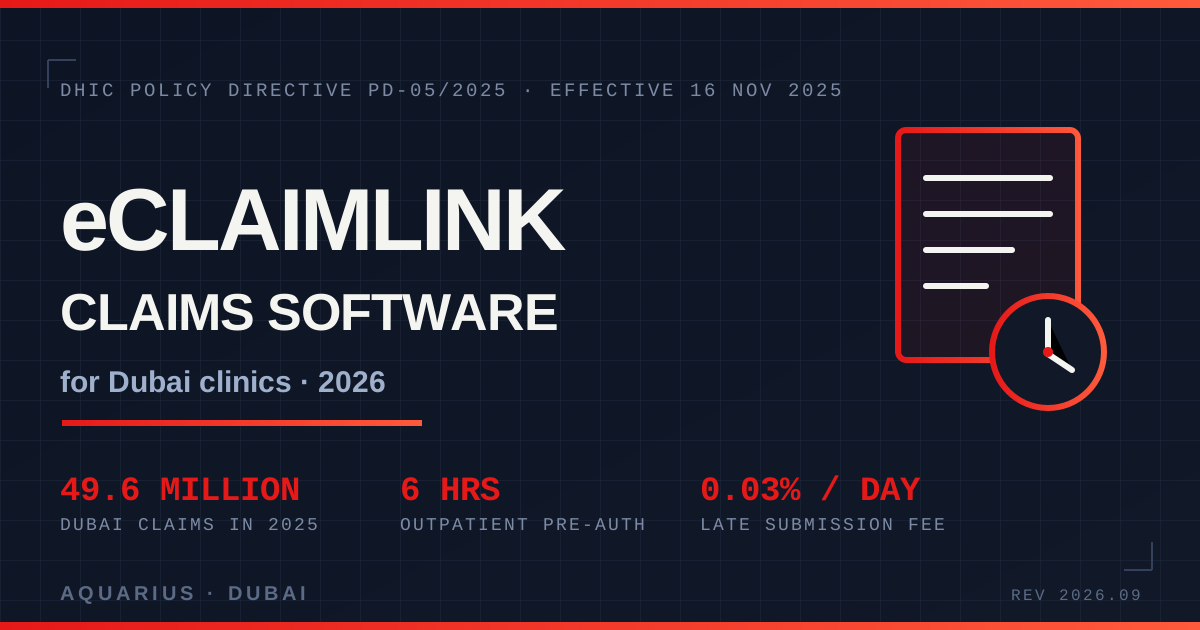
Short answer: Since the Dubai Health Insurance Corporation’s Claims Management Policy Directive took effect on 16 November 2025, every DHA-regulated provider must run claims through eClaimLink and the DHA Post Office (DHPO) against fixed clocks: a pre-authorisation must be filed within one hour of the physician’s order, insurers must answer elective outpatient requests in 6 hours and elective inpatient in 24 hours, and remittance must be posted within 45 calendar days for a first adjudication and 30 days for a resubmission. Late submissions attract a delay fee of 0.03% of the net claimed amount per day. In 2026 the binding constraint on a Dubai clinic’s cash flow is not its insurers — it is whether its software can hit those timers. Updated September 2026.
Here is what most Dubai clinics get wrong. They treat rejections as an insurance problem and hire another biller. But a denial is almost never a clinical dispute; it is a data defect — an unverified eligibility check, a code that does not match the diagnosis, an authorisation filed after the patient walked out. Those are software failures with a finance department bolted on top. Adding headcount to a broken pipeline just moves the leak downstream.
Key takeaways
- Dubai processed 49.6 million health insurance claims in 2025, up from 43.69 million in 2024 — a 13.5% jump in one year, across only 3,936 healthcare providers.
- The clocks are now regulatory, not contractual. One hour to file a pre-authorisation, 6 hours for an elective outpatient answer, 24 hours for elective inpatient, immediate for emergencies.
- 0.03% per day of the net claimed amount is the delay fee for missing submission timelines — a rounding error on one claim, a standing tax on a thousand of them.
- Unresolved denials cost clinics 5–20% of potential annual revenue. A well-run practice keeps first-pass denials under 5% and a clean claim rate at 95% or higher.
- Coding is the single biggest cause: roughly 32% of denials cite a coding problem, and eligibility errors follow close behind — both are preventable at the point of entry, not at appeal.
Why claims became Dubai’s biggest healthcare software problem
Start with the volume. Dubai’s health insurance system covered more than 4.9 million beneficiaries in 2025, up from about 4.6 million in 2024, and processed approximately 49.6 million claims against 43.69 million the year before. That ecosystem runs on 3,936 healthcare providers, 43 insurance companies, 140 brokers and 16 claims management entities — which works out to roughly 12,600 claims per provider per year, or around 1,050 every month for an average facility.
Now the supply side. The number of licensed health facilities in Dubai reached 5,800 in 2025 against 5,340 in 2024, growth of more than 8%, including 55 hospitals, 126 general medical clinics, 70 general dental clinics, 68 specialised clinics, 60 day-surgery centres and 222 home healthcare centres. The private healthcare workforce grew to 69,400 professionals from 64,100. More facilities, more insured patients, more claims per facility — and the same manual billing desk trying to keep up.
The money at stake is national in scale. UAE insurers wrote AED 74.8 billion in gross premiums in 2025, a 14.9% rise, with health the largest single line, and paid out AED 46.2 billion in claims, up 11% overall and 15.1% for health. Health policies grew 26.1% on the back of mandatory basic cover. Payers respond to that trajectory in exactly one way: tighter adjudication. Every clinic in Dubai is being audited harder in 2026 than it was in 2024, by systems that read structured data and never get tired.
What actually changed on 16 November 2025
The DHIC directive replaced and superseded the previous patchwork of claims regulations with one end-to-end framework covering pre-authorisation, submission, adjudication, settlement, reconciliation and compliance — and it applies to insurers, TPAs and providers alike. The operational effect is that time limits moved from being a payer’s service promise to being a rule you can be measured against.
| Stage | The clock | What your software must do |
|---|---|---|
| Pre-authorisation filing | Within 1 hour of the physician’s order | Generate the request from the clinical note, not from a separate admin queue |
| Elective outpatient response | 6 hours | Poll DHPO and escalate silently-expired requests automatically |
| Elective inpatient response | 24 hours | Track the deadline against the scheduled admission, not the request date |
| Emergency approval | Immediate, written confirmation within 24 hours | Capture and store the written confirmation against the encounter |
| First adjudication remittance | 45 calendar days | Age every submitted claim and flag the day it goes overdue |
| Resubmission remittance | 30 calendar days | Separate resubmission ageing from first-pass ageing |
| Late submission | 0.03% of net claimed amount per day | Hard-block the queue from ageing past the limit |
Read that table as a specification, because that is what it is. Every row is a timer, a state transition and an alert. No amount of billing experience makes a human reliable at watching 1,050 timers a month.
DHPO and eClaimLink, in plain terms
Two things get used interchangeably and are not the same. eClaimLink is the DHA’s e-claims platform and data dictionary — the code sets, formats and validation rules that define what a valid Dubai claim looks like. DHPO, the DHA Post Office, is the gateway those transactions actually travel through between providers and payers. Eligibility requests, prior authorisations, claim submissions and remittance advices are all XML documents exchanged through DHPO against published schemas — Claim.Submission, Prior.Authorization, RemittanceAdvice.
That matters for a build decision. An integration is not a portal login for your billing clerk; it is a machine-to-machine pipeline that produces schema-valid XML, handles acknowledgements, downloads remittances on a schedule and reconciles them back to encounters. Clinics that already went through a NABIDH EMR integration have the harder half of the work done: the same clinical record that feeds the health information exchange should feed the claim, with no re-keying between them.
Where the money actually leaks
Denials are the whole game. Clinics lose 5–20% of potential revenue each year to denials that are never worked, and the benchmark for a well-managed practice — first-pass denial rate under 5%, clean claim rate at or above 95%, accounts receivable under 40 days — is missed by most facilities by a wide margin. Industry first-pass acceptance sits around 83–87%, while top performers clear 95%+. On the average Dubai facility’s roughly 12,600 claims a year, the gap between an 85% and a 95% first-pass rate is about 1,260 claims that have to be reworked by hand.
The causes are boringly consistent. Around 32% of denials cite a coding problem; missing or outdated eligibility information is the other leading driver, along with absent prior authorisations and incomplete documentation. Not one of those requires clinical judgement to prevent. They require validation at the moment of entry — eligibility checked before the consultation, codes validated against the eClaimLink dictionary before submission, authorisation status blocking the claim rather than surfacing at adjudication.
Timing compounds it. Straightforward claims with no prior authorisation typically settle in 5–10 business days; claims pulled for manual review run 15–30 business days; disputed or escalated claims stretch to 45 days. Every avoidable denial does not just risk the money — it converts a ten-day receivable into a forty-five-day one. That is a working capital problem wearing a billing problem’s clothes.
Build, buy or outsource: what it costs in AED
There are three honest routes, and the right one depends on claim volume and how much of your workflow already lives in software. These are indicative 2026 Dubai ranges, not quotes.
| Route | Indicative 2026 cost | Best when |
|---|---|---|
| Off-the-shelf clinic system with an eClaimLink module | AED 500–3,000 per month | Single site, standard specialties, no unusual workflow |
| DHPO integration bolted onto an existing EMR | AED 25,000–70,000 one-off | You like your EMR but rekey claims by hand today |
| Custom claims engine, validation rules and denial dashboard | AED 40,000–120,000 | Multi-branch, high volume, or specialty coding rules |
| Reconciliation and remittance automation layer | AED 20,000–50,000 | Remittances arrive but nobody matches them to encounters |
| Outsourced RCM / medical billing | Usually a percentage of collections | You want the function gone — ask for the exact rate and any floor fee in writing |
Run the arithmetic before choosing. A facility billing AED 500,000 a month that leaves 10% of claims unworked is losing AED 50,000 a month — more than a full custom build every three months. The UAE medical billing outsourcing market is valued at roughly USD 120 million precisely because that maths is so common. The question is not whether the function is worth paying for; it is whether you pay for it once as software or forever as a percentage.
One caution on outsourcing: a billing partner working inside a bad system inherits the bad system. If eligibility is not checked at the front desk and codes are not validated before submission, the vendor’s first-pass rate will look a lot like yours, and you will be paying a share of collections for the privilege.
How Aquarius builds the claims layer
We treat the claim as an output of the clinical record, never as a separate document. The encounter, the codes, the authorisation reference and the supporting attachments assemble into a schema-valid DHPO transaction from data that was already captured once. On top of that sit three things clinics almost never have: a pre-submission validation gate that refuses claims failing dictionary, eligibility or authorisation checks; a timer engine that tracks the one-hour, 6-hour, 24-hour, 30-day and 45-day clocks and escalates before they expire; and a denial dashboard that groups rejections by reason code so you fix a pattern once instead of appealing the same mistake 200 times.
It connects to the rest of the stack the same way: the same patient record that drives your clinic booking system and your telemedicine app, with UAE data residency handled as a requirement rather than an afterthought. Indicative ranges by scope are on our pricing page; we scope the claims layer against your actual denial report, so the first conversation is about your reason codes, not our feature list.
Frequently asked questions
Is eClaimLink submission mandatory for Dubai clinics in 2026?
Yes. Electronic submission through eClaimLink is the mandated pathway for all DHA-regulated healthcare providers, and the DHIC Claims Management Policy Directive effective 16 November 2025 superseded the previous claims regulations for insurers, TPAs and providers alike.
How fast must a pre-authorisation be submitted in Dubai?
Within one hour of the physician’s order. The insurer or TPA must then respond within 6 hours for elective outpatient cases, 24 hours for elective inpatient cases, and immediately for emergencies with written confirmation inside 24 hours.
What is the penalty for late claim submission?
A delay fee of 0.03% of the net claimed amount per day. On its own it is small; across a monthly claim book it becomes a permanent discount on your own revenue, and it signals the same process weakness that drives denials.
What is a good denial rate for a Dubai clinic?
Under 5% first-pass denials, a clean claim rate of 95% or better, and accounts receivable under 40 days. Industry first-pass acceptance generally sits at 83–87%, so most facilities have real headroom before any new revenue is needed.
Do I need a new EMR to fix claims?
Usually not. If your EMR holds clean clinical data, a DHPO integration plus a validation and denial layer on top typically costs AED 25,000–70,000 and leaves the clinical workflow your doctors already know untouched. Replacing the EMR is a bigger project with a longer payback.
How long does a claims integration take to build?
Plan for 6–12 weeks for a DHPO integration with validation rules and a denial dashboard, depending on how clean the source data is and how many specialties you bill. Data clean-up, not the integration itself, is usually the long pole.
If your denial rate is above 10% or your receivables are past 60 days, the fix is measurable and it is not more staff. Send us a month of rejection reason codes and we will tell you which ones are software-preventable and what it costs to close them — before you commit to anything. Talk to Aquarius or see how we work on our services page.