
Pharmacy Management Software in Dubai (2026): Tatmeen, NABIDH and Real AED Build Costs
The EDE repriced 168 medicines on 30 May 2026 and Law 38/2024 carries AED 1,000,000 fines. Real AED costs to build Dubai pharmacy software with Tatmeen, NABIDH and e-claims wired in.
- PUBLISHED
- 04 OCT 2026
- READ TIME
- 12 MIN
- AUTHOR
- AQUARIUS · DUBAI
- UNIT
- REV 2026.09
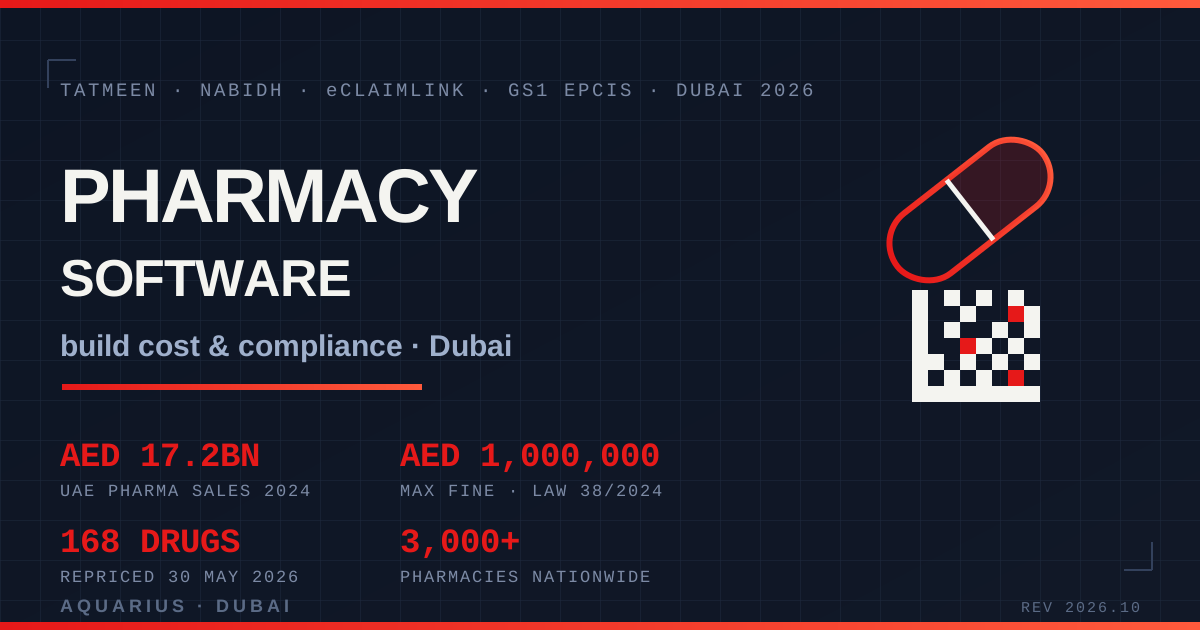
Short answer: in Dubai in 2026, pharmacy management software costs roughly AED 600-2,500 per month if you rent an off-the-shelf UAE product, or AED 60,000-150,000 one-off to build a dispensing and POS core you own, AED 180,000-450,000 for a full multi-branch platform with Tatmeen, NABIDH and e-claims wired in. The compliance half is not optional: a Dubai pharmacy that cannot report a dispensing event to Tatmeen in GS1 EPCIS format, or cannot send an eRx reference with its claim, is a pharmacy that fails inspection and gets its claims rejected.
That is the real decision. Most pharmacy owners in Dubai shop for features - stock, barcodes, loyalty - and discover the integrations after they have signed. Under Federal Decree-Law No. 38 of 2024, which moved authority to the new Emirates Drug Establishment and carries fines from AED 1,000 up to AED 1,000,000, software is now a licensing matter rather than an operations preference.
Why Dubai pharmacy margins are getting thinner (awareness)
Three real numbers set the stakes before any software conversation.
The market is big and crowded. UAE pharmaceutical sales reached AED 17.2 billion in 2024. The country operates 3,000-plus pharmacies at a density of 3.1 per 10,000 residents, with 13.3 pharmacists per 10,000 people - among the highest coverage anywhere in the region. Prescription and over-the-counter medicines account for 80% of the revenue mix. The chains have scaled hard: Life Pharmacy runs 475-plus stores and Aster Pharmacy 245-plus outlets, while the best-located single outlets in Dubai Mall and Business Bay clear daily sales above AED 100,000. Directory counts put Dubai itself in the region of 1,572-1,695 DHA-licensed pharmacies during 2026.
Regulated prices just moved against you. The Emirates Drug Establishment cut retail prices on 168 pharmaceutical products effective 30 May 2026, with reductions ranging from 5% to nearly 60% across cardiovascular, diabetes, oncology, respiratory and ophthalmic categories. Zocor 40 mg fell about 59.5% and Xalatan about 51.7%; Alunbrig 180 mg dropped from AED 26,433 to AED 21,108. In January 2026, 44 pharmaceutical services transferred from MOHAP to the EDE, including pricing and repricing approvals, and from 24 February 2026 a new rule requires multiple authorised agents per drug, ending single-agent monopolies. If your system cannot reprice a catalogue of thousands of SKUs on a mandated date, you are selling stock at the wrong price - or at a loss - until someone types it in.
Almost every basket is now an insurance claim. UAE health insurance coverage climbed from 41% in 2013 to about 93% by 2025, and mandatory schemes made up 86.22% of the market in 2025. The basic Northern Emirates package, live from 1 January 2025 at AED 320 per year with caps of AED 50,000 inpatient and AED 10,000 outpatient, is expected to add roughly 3 million more insured individuals to the pool. A pharmacy counter is now a claims desk, and a claims desk is software.
Most Dubai pharmacies get this wrong: they treat Tatmeen as a barcode scanner problem and the insurance side as the insurer's problem. Both are data-format problems. Tatmeen wants your dispensing event as a GS1 EPCIS message immediately after the physical event. eClaimLink wants Dubai Drug Codes and an eRx reference number. Miss the format and the medicine is legally undispensable or the claim is auto-rejected - and neither failure shows up on a feature comparison sheet.
The four integrations that decide whether the software is legal (consideration)
Forget the vendor feature grid. In Dubai, four connections do the deciding.
1. Tatmeen - national track and trace
Tatmeen is MOHAP's drug traceability platform, built with EVOTEQ and live since 13 December 2022, with serial-number reporting and aggregation mandatory from 1 January 2023. It covers pharmaceutical products and medical devices entering the country, and it runs on GS1 standards: 2D DataMatrix codes, Global Location Numbers and EPCIS event files, one file per event. For a pharmacy, that means scanning and registering receiving, dispensing and decommissioning events, reported immediately after the physical event. Under Article 66 of the new medical products law, the EDE is required to run this national system factory-to-patient and all designated pharmaceutical establishments must participate. No Tatmeen reporting, no legal dispensing of most products.
2. NABIDH - Dubai's health information exchange
Every DHA-licensed facility in Dubai, pharmacies included, must integrate its dispensing and prescription data with NABIDH for the licence to activate and stay valid. In practice that means HL7 or FHIR messaging for dispense records, support for DHA-issued e-prescriptions, controlled-drug reporting aligned to DHA requirements, and pharmacist licence records tied back to the Sheryan portal. Facilities outside Dubai connect to the federal Riayati national unified medical record instead - or to Malaffi in Abu Dhabi. A chain operating across emirates needs all three. Our guide to NABIDH integration for Dubai clinics covers the messaging detail.
3. eClaimLink and DHPO - getting paid
Dubai claims move through DHPO and eClaimLink, which standardise coding via the Dubai Drug Code (DDC) list and the eClaimLink data dictionary. The expensive detail: without an eRx reference number, the payer's system automatically rejects the related claim. The other common rejection causes are equally avoidable - eligibility not verified before dispensing, mismatched diagnosis and product codes, incomplete prior authorisations, and payloads that do not match the dictionary. Every one of those is a software behaviour, not a staff attitude. We break the claims plumbing down further in our piece on medical billing and claims software in Dubai.
4. Inventory, expiry and cold chain
With regulated prices and insurance-capped reimbursement, the money is made in stock control: batch and expiry tracking at pack level, near-expiry return windows to the distributor, narcotics and controlled-drug registers that survive an inspection, and temperature logs for refrigerated lines. If you carry insulin, vaccines or biologics, the monitoring obligations overlap with what we describe in cold chain temperature monitoring software.
Rent it or build it? The AED maths (decision)
Off-the-shelf UAE pharmacy products are cheap to start and fine for a single counter. The arithmetic changes with branches and with anything non-standard - a delivery arm, an e-commerce front, group-level purchasing or your own loyalty logic.
| Option | Typical 2026 cost | Time to live | What you own at the end |
|---|---|---|---|
| PharmacyPlus (subscription) | AED 800-2,500 / month | Days | A subscription |
| Aumet (subscription) | AED 600-1,800 / month | Days | A subscription |
| PharmaPOS (one-time licence) | AED 1,100-2,900 one-off | Days | A licence, upgrades extra |
| Instat (annual licence) | AED 5,000-15,000 / year | Weeks | A licence |
| Custom Dubai build (Aquarius) | AED 60,000-450,000 one-off by scope, plus care plan | 6-20 weeks by module | Repository, database, domain and data |
Run it over five years. A three-branch group on AED 2,000 a month per branch pays about AED 360,000 and ends with nothing transferable, no control over the roadmap, and a migration bill if the vendor's Tatmeen connector lags a regulation change. The same group can own a platform outright inside that number. One branch with ordinary workflows should rent - that is the honest answer, and we will tell you so on the call.
What we charge to build it in Dubai
| Module | What you get | Timeline | Dubai cost (AED) |
|---|---|---|---|
| Dispensing and POS core | Counter workflow, DDC-coded catalogue, batch and expiry at pack level, pricing rules, VAT handling, receipts in Arabic and English | 6-9 weeks | 60,000 - 150,000 |
| Tatmeen integration layer | GS1 2D DataMatrix scanning, GLN setup, EPCIS event generation for receiving, dispensing and decommissioning, retry and reconciliation queue | 4-6 weeks | 45,000 - 110,000 |
| e-claims and eRx | eClaimLink and DHPO submission, eRx reference capture, eligibility check before dispense, rejection dashboard and resubmission workflow | 5-8 weeks | 55,000 - 130,000 |
| NABIDH / Riayati / Malaffi | HL7 or FHIR dispense and prescription messaging, Sheryan licence mapping, controlled-drug reporting, per-emirate routing | 5-8 weeks | 50,000 - 120,000 |
| Full multi-branch platform | All of the above plus group purchasing, inter-branch transfers, supplier returns, recalls, loyalty, dashboards and roles | 12-20 weeks | 180,000 - 450,000 |
| Patient app and delivery | Refill reminders, prescription upload, rider dispatch, payment, order tracking | 6-10 weeks | 70,000 - 180,000 |
| UAE-resident hosting and hardening | In-country deployment, encryption, SSO and MFA, audit trail, PDPL documentation, penetration test remediation | 2-3 weeks | 25,000 - 60,000 |
| Care plan | Hosting, monitoring, regulatory and catalogue updates, support and small changes | monthly | 4,000 - 15,000 / mo |
The order that pays is dispensing core first, e-claims second, Tatmeen and health-exchange messaging third - each live and inspected before the next starts. Our pricing page shows how we stage fixed-price modules and our services cover build, integrations and hosting on one contract.
The cost of getting it wrong
This is the conversion number. Under Federal Decree-Law No. 38 of 2024, regulators may issue warnings, suspend or cancel licences and impose fines of AED 1,000 to AED 1,000,000 on establishments; licensed pharmacists face fines up to AED 500,000 and suspension for up to a year. Serious violations - forgery, unlicensed operation, handling unauthorised substances - carry six months to five years imprisonment and AED 50,000 to AED 1,000,000 in fines. Establishments were given a one-year grace period to align, extendable only by Cabinet decision. Set that against a one-off AED 45,000-110,000 Tatmeen layer and the business case writes itself. And that is before the quieter leak: rejected claims on an AED 17.2 billion market are revenue you dispensed stock to earn and never collected.
How Aquarius builds pharmacy software in Dubai
We are a Dubai web, app and AI studio, and three things follow. We scope to a fixed price and a fixed date before writing code, because a pharmacy group will not sign an open-ended estimate against a licence renewal. We build on stacks you can hire for in the UAE, so you are never hostage to one vendor's connector. And you own the repository, the database and the domain from day one - see our note on ownership and handover.
If the goal is a delivery and refill business rather than a counter rebuild, start with our breakdown of pharmacy and medicine delivery app development in Dubai. If you mainly need stock and till discipline across branches, the cheaper path is often the one in POS and inventory software development.
FAQ
How much does pharmacy management software cost in Dubai?
Renting a UAE product runs about AED 600-2,500 per month, or AED 1,100-2,900 one-off for a basic licence and AED 5,000-15,000 a year for annual licences. A custom build is AED 60,000-150,000 for a dispensing and POS core, AED 180,000-450,000 for a full multi-branch platform, plus AED 4,000-15,000 a month of care.
Is Tatmeen integration mandatory for Dubai pharmacies?
Yes. Tatmeen has been live since 13 December 2022, with serial reporting and aggregation mandatory from 1 January 2023, and the national track-and-trace system is now a statutory duty of the Emirates Drug Establishment under Article 66 of the medical products law. Pharmacies must scan GS1 2D DataMatrix codes and report receiving, dispensing and decommissioning events in GS1 EPCIS format, immediately after each physical event. Without it you cannot legally dispense most pharmaceutical products.
Does a Dubai pharmacy have to connect to NABIDH or Riayati?
DHA-licensed pharmacies in Dubai connect to NABIDH, and integration is tied to licence activation and validity. Facilities in the Northern Emirates connect to the federal Riayati platform, and Abu Dhabi facilities to Malaffi. A chain spanning emirates needs more than one connection, which is exactly why the integration layer should be built once and routed per branch.
Why do pharmacy insurance claims get rejected in Dubai?
The dominant causes are structural: no eRx reference number attached - which triggers automatic rejection - eligibility not checked before dispensing, diagnosis and product codes that do not match, incomplete authorisations, and payloads that break the eClaimLink dictionary or Dubai Drug Code list. Good software blocks each of those at the counter rather than discovering them a month later in a remittance file.
What happens to pharmacy software when the EDE changes drug prices?
You reprice on the effective date or you sell at the wrong price. The 168-product reduction of 30 May 2026, with cuts from 5% to about 60%, is the live example. A system worth paying for ingests the published price file, versions the old price for audit, flags stock bought above the new ceiling, and shows the margin impact before the date arrives.
How long does a pharmacy software build take in Dubai?
A dispensing and POS core is 6-9 weeks. Tatmeen reporting adds 4-6 weeks, e-claims and eRx 5-8 weeks, health-exchange messaging another 5-8 weeks, and a full multi-branch platform lands at 12-20 weeks. We ship modules in sequence so each one is live and inspectable before the next begins.
Next step
If you run a Dubai pharmacy where claims rejections are a monthly surprise, expiry write-offs are a guess, and nobody is certain every dispense reached Tatmeen, the useful first move is small: a two-week scoping pass that audits your current system against the DHA, Tatmeen and eClaimLink requirements, quantifies the rejected-claim leak in AED, and returns a fixed price per module. Talk to Aquarius and we will send the compliance checklist with it, no obligation.