
We Scanned 786 .ae Homepages for Motion Accessibility: 91.1% Auto-Play Animation You Cannot Pause (2027 Data)
First-hand scan of 561 .ae homepages: 91.1% auto-start motion with no pause control, but only 12.5% ship a reduced-motion rule that works. Most of the rest got it free from Bootstrap.
- PUBLISHED
- 26 NOV 2026
- READ TIME
- 12 MIN
- AUTHOR
- AQUARIUS · DUBAI
- UNIT
- REV 2026.09
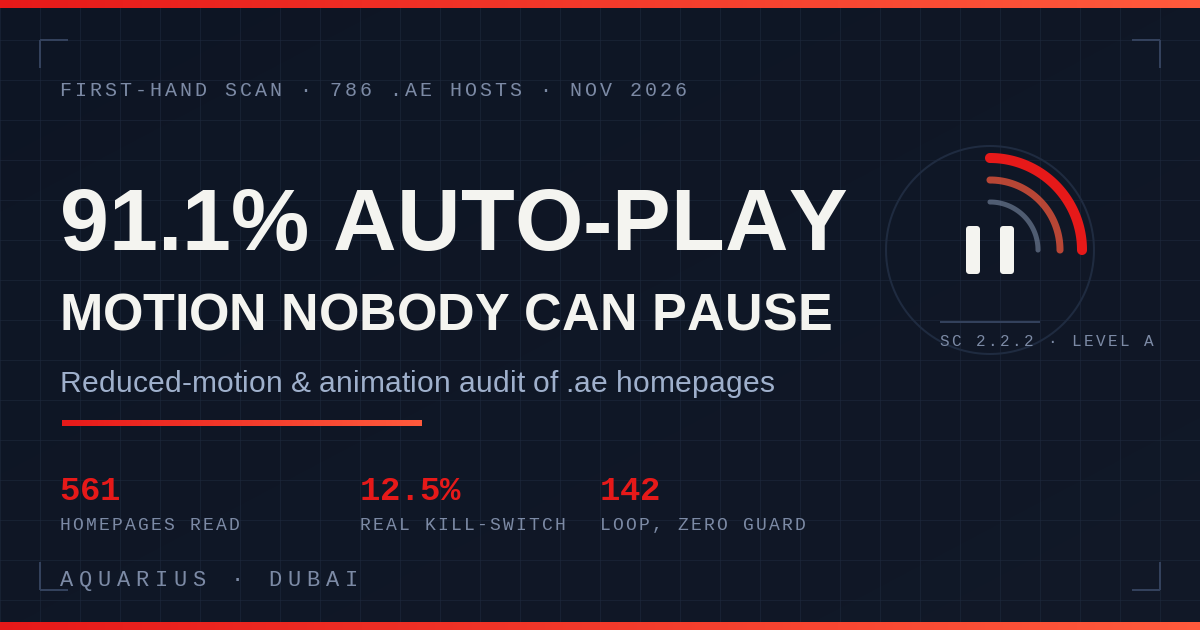
Short answer: we fetched the homepages of 786 of the most-visited .ae domains and statically read every stylesheet we could reach. 91.1% auto-start motion a visitor cannot pause, and only 12.5% ship a reduced-motion rule that actually switches their own animation off. The bigger surprise: the half of the web that "supports" prefers-reduced-motion mostly got it free from Bootstrap, not from a decision anyone made.
Why motion accessibility matters in the UAE right now
Three numbers set the stakes. The Web Almanac 2025 found 49.99% of desktop pages and 50.55% of mobile pages contain a prefers-reduced-motion media query — which reads like a win until you check who wrote it. Second, honouring that query is only a Level AAA requirement (WCAG SC 2.3.3 Animation from Interactions), while auto-playing motion that runs more than five seconds with no pause control fails SC 2.2.2 Pause, Stop, Hide at Level A — the floor, not the ceiling. Third, the audience is not niche: a JAMA Internal Medicine analysis of NHANES data put vestibular dysfunction at 35.4% of US adults aged 40+, roughly 69 million people, and a 2026 study in Headache of 2,000 Emirati adults aged 18–65 in Dubai found primary headache disorders in 39.1% of the sample, with episodic migraine in 272 of those 781 cases.
The regulatory hook is the same one we covered in our WCAG failure scan of .ae homepages: the TDRA's National Policy for Digital Accessibility holds federal entities to WCAG 2.1 Level AA, and the Dubai Universal Design Code carries the physical-and-digital access requirements locally. Level AA includes SC 2.2.2. Most Dubai businesses get this backwards — they treat reduced motion as the accessibility question and ignore the carousel that breaks a Level A criterion on the same page.
What we measured, and how
We took 786 .ae hosts from a public popularity ranking, requested each homepage with a desktop Chrome user agent, and followed redirects. 561 returned usable CSS; 102 were blocked by bot protection and the rest timed out or served nothing parseable. For every usable host we concatenated inline <style> blocks, up to eight linked stylesheets, and one level of @import, then brace-matched every @media block mentioning prefers-reduced-motion and read the declarations inside it.
That last step is the part other surveys skip, and it is where the story changes. A host "has" the query if the string appears anywhere in its CSS. A host has a working guard only if a reduce block targets something broad — *, html, body, :root — and sets animation or transition to none. We counted both.
The results
| What we checked | Hosts | Share of 561 | WCAG reference |
|---|---|---|---|
| Ships motion of any kind (keyframes, infinite loop, smooth scroll, autoplay video) | 531 | 94.7% | — |
| Auto-starting motion with no pause control found | 511 | 91.1% | SC 2.2.2 (A) |
| At least one infinite CSS animation | 504 | 89.8% | SC 2.2.2 (A) |
scroll-behavior: smooth set globally | 297 | 52.9% | SC 2.3.3 (AAA) |
Mentions prefers-reduced-motion anywhere | 370 | 66.0% | SC 2.3.3 (AAA) |
| Global kill-switch that stops its own animation | 70 | 12.5% | SC 2.3.3 (AAA) |
| Infinite animation and zero mention of the query | 142 | 25.3% | SC 2.2.2 (A) |
| No mention of the query at all | 191 | 34.0% | — |
Auto-playing <video> on the homepage | 65 | 11.6% | SC 2.2.2 (A) |
Handles reduced motion in JavaScript (matchMedia) | 13 | 2.3% | — |
Still shipping a <marquee> element | 5 | 0.9% | SC 2.2.2 (A) |
The <marquee> tag has been obsolete since HTML5 and the Web Almanac puts it at 0.09% of desktop pages globally. Five .ae homepages still use it, one of them an emirate government portal. Animation volume is also wildly uneven: the median host defines 14 @keyframes rules, the 90th percentile defines 120, and one host defines 733. Another runs 506 separate infinite animations on a single homepage.
The myth: half the web does not "support" reduced motion
This is the finding worth sharing. 370 of our hosts contain a prefers-reduced-motion query — 66.0%, comfortably above the global 50%. It means almost nothing, because the query usually arrives pre-installed.
We downloaded twelve real library builds and counted the reduced-motion blocks each one ships. Bootstrap 5.3.3 contains 32. Bootstrap 4.6.2 contains 19. MDB UI Kit contains 32. Font Awesome 6 and animate.css contain one each. Load Bootstrap and your site "supports reduced motion" in 32 places before you write a line of CSS — including the :root { scroll-behavior: smooth } rule that Bootstrap wraps in no-preference, which is an enhancement, not a guard.
Meanwhile the libraries that actually create the motion ship nothing. AOS, Swiper, slick, Owl Carousel, Foundation and normalize.css contain zero reduced-motion blocks between them. On our sample Swiper appears on 117 hosts, slick on 58, Elementor on 57, Owl on 55, marquee3k on 47, AOS on 47, animate.css on 44, GSAP on 38 and Lottie on 36. So the common Dubai homepage build is a Bootstrap theme that reports reduced-motion support it inherited, driving a Swiper carousel that has no idea the preference exists.
Strip the vendor blocks out and ask the only question that matters — does a reduce block switch this site's own animation off? — and 561 hosts collapse to 70. Government sites fare worse, not better: of 50 usable gov.ae homepages, 46 ship motion, 44 have auto-starting motion, 15 never mention the query, and exactly one (dubaipolice.gov.ae) has a working global kill-switch.
The fix is smaller than the audit
Honouring the preference is genuinely close to free. One rule at the end of your stylesheet covers the AAA criterion for CSS-driven motion:
@media (prefers-reduced-motion: reduce) { *, *::before, *::after { animation-duration: 0.01ms !important; animation-iteration-count: 1 !important; transition-duration: 0.01ms !important; scroll-behavior: auto !important; } }
That is the pattern all 70 passing hosts use in some form. What it does not cover is the Level A problem, and that is where the real work sits. JavaScript motion ignores CSS: GSAP timelines, Lottie players, Swiper autoplay and Elementor effects keep running. Only 13 hosts in our sample (2.3%) read the preference in JS at all, which is the single biggest gap we found. Carousel autoplay needs a visible pause control or an autoplay delay, auto-playing video needs controls, and <marquee> needs deleting.
Scope it in the order the criteria bite: Level A first (pause controls, autoplay, marquee), then the AAA CSS guard, then JS motion gating, then the manual pass.
What it costs to fix in Dubai
| Scope | Typical Dubai agency range (AED) | Timeline | Criteria closed |
|---|---|---|---|
| Global reduced-motion guard + smooth-scroll gating | 1,500 – 3,000 | 1–2 days | SC 2.3.3 (AAA) |
| Carousel / autoplay video pause controls | 3,500 – 9,000 | 3–5 days | SC 2.2.2 (A) |
JS motion gating (GSAP / Lottie / Swiper via matchMedia) | 5,000 – 14,000 | 4–8 days | SC 2.2.2 + 2.3.3 |
| Full motion + WCAG 2.1 AA audit with remediation plan | 12,000 – 28,000 | 2–3 weeks | Full AA pass |
| Rebuild on an accessible component system | 45,000 – 120,000+ | 6–12 weeks | AA by default |
The business case is not only compliance. Heavy homepage motion is also a performance tax, and the Deloitte and Google Milliseconds Make Millions study measured a 0.1-second mobile improvement producing an 8.4% lift in retail conversions and 9.2% higher average order value — on a market where StatCounter put UAE mobile share at 67.8% in October 2026. Deleting 506 infinite animations helps twice. Our Core Web Vitals guide for Dubai sites covers that side; our UAE accessibility compliance guide covers the legal side.
How Aquarius does it
We run the same scan on your site that we ran on these 786, so you get a per-rule list rather than a score: which stylesheets create the motion, which guard blocks are yours versus your framework's, and which components need a pause control to clear Level A. Fixes land as a pull request against your repo, with a before/after capture of each affected component. If a fix we shipped does not hold up in a re-audit, we redo it at no charge — the measurement is cheap and we would rather be right than fast. See pricing or send us your URL and we will tell you which bucket above you are in before you commit to anything.
FAQ
Is ignoring prefers-reduced-motion a WCAG failure?
Not at Level AA. SC 2.3.3 Animation from Interactions is Level AAA, so a site can ignore the preference entirely and still claim AA. What it cannot do is auto-play motion for more than five seconds without a pause, stop or hide mechanism — that is SC 2.2.2 at Level A, and 91.1% of the homepages we read are exposed to it.
Does the TDRA accessibility policy apply to private Dubai companies?
The National Policy for Digital Accessibility binds federal entities to WCAG 2.1 AA directly. Private businesses are reached through sector rules, procurement requirements and the broader People of Determination legislation rather than by that policy alone — but any company bidding for UAE government work is effectively held to the same bar.
How do I know if my reduced-motion support is real or inherited?
Search your compiled CSS for prefers-reduced-motion and look at the selectors inside each block. If they are all framework class names — .navbar-toggler, .carousel, .animate__, :root with only scroll-behavior — it came with the framework. A real guard targets *, html or body, or your own component classes.
Will a global animation kill-switch break my site?
Rarely, but test it. Animations used to communicate state — a loading spinner, an accordion that relies on a transition callback — can need an explicit exception. Setting duration to 0.01ms rather than none is the standard trick: the animation still fires its events, it just finishes instantly.
What are the limits of this scan?
It is static CSS analysis of homepages only. We read at most eight stylesheets per host, and 170 hosts declared more than that, so guard coverage is if anything undercounted. 20 hosts had a stylesheet we could not fetch. Motion created entirely in JavaScript — GSAP timelines, Lottie animations, Elementor effects — cannot be measured this way, which means the SC 2.2.2 exposure figure is a floor, not a ceiling.
If you want the per-rule version of this for your own site, send us the URL. The scan takes us under an hour.