
Self Storage Management Software in Dubai (2026): Real AED Build Costs, SIRA Rules and the Lien That Does Not Exist
Dubai added 226,885 residents in 2026 and storage street rates run AED 4.50-19 per sq ft. Real AED costs to build self-storage software, plus SIRA, VAT and the arrears trap.
- PUBLISHED
- 18 OCT 2026
- READ TIME
- 12 MIN
- AUTHOR
- AQUARIUS · DUBAI
- UNIT
- REV 2026.09
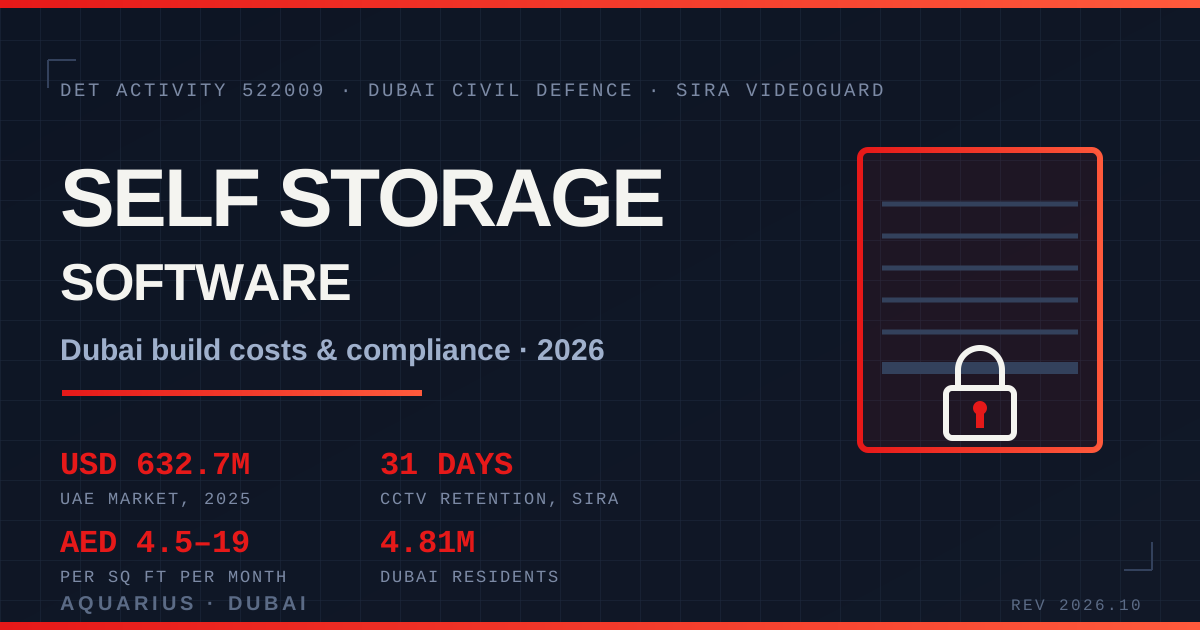
Short answer: Self-storage management software for a Dubai facility has to do four things the imported platforms were never built for: price units against local street rates of roughly AED 4.50–19 per sq ft per month, invoice with 5% VAT on every line because storage is a commercial supply, drive SIRA-approved access control with 31-day CCTV retention, and hold a defensible paper trail before you ever touch a defaulting tenant's goods. Off-the-shelf platforms run about USD 100–250 per facility per month; a custom Dubai build lands at AED 55,000–240,000 one-off depending on how many of those four you need done properly.
Self-storage is one of the few Dubai asset classes where the software is the operating margin. Units are commodities. Location is fixed once the lease is signed. What separates a facility running at 68% occupancy from one running at 94% is almost entirely pricing logic, how fast a walk-in becomes a signed contract, and whether anyone chases a late invoice before it becomes a legal problem. This guide covers the real AED numbers, the Dubai approvals that change the build, and where custom beats a subscription.
Key takeaways
- The UAE self-storage market was worth USD 632.7 million in 2025 and is forecast at USD 1,069.4 million by 2033, a 6.99% CAGR across 2026–2033. Medium units took 48.52% of 2025 revenue.
- Dubai's population reached 4,807,185 in October 2026, up 226,885 since 1 January and from 4,580,300 at the end of 2025 — and swells to 6.39 million by day as 1.81 million commuters and visitors arrive.
- Dubai operator The Box raised USD 12.5 million in debt led by Shorooq Partners for a new Dubai facility, taking its total debt funding to USD 31.5 million since 2014.
- Existing customer rate increases of 8–12% with under 3% incremental churn are the single largest revenue lever in the industry, and technology-enabled operators show a 500–1,200 basis point occupancy advantage over manual competitors.
- 78% of operators plan to extend automation and smart systems in 2026. Online rental, modern management software and dynamic pricing are now the floor, not the differentiator.
Why Dubai self-storage became a software problem in 2026
Start with the demand curve, because it explains the capital. Dubai added 226,885 residents between 1 January and mid-October 2026, reaching 4,807,185 — against 4,580,300 at the end of 2025. Roughly 85% of the population is expatriate. That mix is the self-storage thesis in one line: a population that moves often, arrives with shipped containers, downsizes when rents jump, and leaves on three months' notice. By day the emirate carries 6.39 million people as 1.81 million commuters, tourists and visitors come in, which is also why last-mile and valet-storage models work here and fail in lower-density markets.
The money has noticed. The UAE market stood at USD 632.7 million in 2025 heading to USD 1,069.4 million by 2033 at a 6.99% CAGR, and that is still only about 1.0% of global self-storage revenue — a market under-built relative to its population density. The Box, founded in Dubai in 2007 and offering units from 25 sq ft lockers to 1,000 sq ft rooms, closed USD 12.5 million of debt financing led by Shorooq Partners to build a new Dubai flagship, bringing its total debt raised to USD 31.5 million since 2014. Capital at that cost is underwritten on occupancy and rate trajectory, and both are software outputs.
What the street rate actually looks like
Published Dubai pricing clusters tightly enough to model. The practical band is AED 4.50–9 per sq ft per month for larger rooms, rising to AED 9–19 per sq ft for typical residential units and above AED 20 per sq ft for the smallest lockers — small units are always the best revenue per square foot and the hardest to keep full. Climate control adds 20–30%.
| Unit size | Non-climate (AED/month) | Climate-controlled (AED/month) |
|---|---|---|
| 10 sq ft locker | 150–250 | 200–320 |
| 25 sq ft | 300–450 | 380–570 |
| 50 sq ft | 550–750 | 700–950 |
| 100 sq ft | 900–1,300 | 1,150–1,650 |
| 200 sq ft | 1,600–2,200 | 2,050–2,800 |
| 300 sq ft | 2,200–3,000 | 2,800–3,800 |
All of those are ex-VAT. Storage units are treated as commercial property for UAE VAT, so the lease is a taxable supply at 5% on rent and on service fees — not the residential exemption people assume because the customer is a household. If your software quotes a tenant AED 750 and invoices AED 750, you are absorbing the VAT out of margin.
The five modules that decide the margin
1. Unit map and availability, not a spreadsheet of sizes
The core record is the unit, with its true dimensions, door type, floor, climate zone, access route and current state (vacant, reserved, occupied, in arrears, in dispute, under maintenance). Everything downstream — pricing, the website's live availability, the access controller — reads this one record. Operators who keep availability in a second system end up selling units twice.
2. Dynamic pricing and the ECRI engine
This is where the money is. Industry practice is to raise an existing tenant's rate 5–10% after six months and annually after that, with best-practice targets of 8–12% increases while holding incremental churn under 3%. Doing that by hand across 600 units is how operators either skip increases entirely or apply them so bluntly that good tenants leave. Software decides street rate by occupancy band and schedules each tenant's increase against their tenure, unit type and payment history.
3. Online rental that completes without a human
A reservation that needs a phone call back is a lost lead on a Friday evening. End-to-end means: live availability, quote with VAT shown, e-signed contract, ID capture, first payment, and a door code issued automatically. Payment-side, Dubai gives you options most markets do not — cards, and now Aani instant transfers and the Jaywan domestic scheme, which cut interchange on recurring monthly rent materially. We cover the integration mechanics in Aani and Jaywan payment integration in Dubai.
4. Smart access tied to the ledger
The overlock is the enforcement mechanism in this business, and it should be automatic: an unpaid invoice past its grace window revokes the door code and flags the unit. Tech-enabled operators deploying dynamic pricing, smart access and remote management show a 500 to 1,200 basis point occupancy advantage over unsophisticated competitors — that gap is the whole return on the build.
5. Arrears workflow with a legal spine
Most Dubai operators get this exactly wrong. They copy a US or UK software template that assumes a statutory self-storage lien — the right to auction a defaulting tenant's goods after notice. The UAE has no self-storage lien statute. What you have is your contract plus the retention and pledge-sale provisions of the Commercial Transactions Law (Federal Decree-Law No. 50 of 2022), which contemplate recovering dues from the price of goods net of keeping, storage and sale costs — a process with evidentiary requirements, not a button in a dashboard. Practically: your software's job is to generate the trail (signed contract, dated notices, delivery receipts, photographic inventory, invoice history) that lets counsel act, and to make disposal impossible without it. Build the audit log, take the legal advice, and never let an ops manager clear a unit on instinct.
The Dubai approvals that change the build
Four authorities touch a Dubai storage facility, and three of them leave requirements in your software.
- Department of Economy and Tourism (DET) — the trade licence, registered under activity 522009 (storage services). Your invoices carry the licence and TRN details; get the entity data model right once.
- Dubai Civil Defence (DCD) — fire and life safety under the UAE Fire and Life Safety Code of Practice. The completion certificate precedes the final trade licence. Software consequence: a prohibited-goods declaration on every contract, and a per-unit record of what is stored well enough to answer an inspector.
- Security Industry Regulatory Agency (SIRA) — CCTV and surveillance approval. Commercial premises need SIRA-certified cameras and recorders, a minimum 31-day retention (90 days for high-security categories such as banks and data centres), role-based access to footage, encryption, audit logs of who viewed what, and connection to SIRA's VideoGuard network. Fines start near AED 5,000 and reach AED 50,000-plus for serious breaches. If your management platform handles incident reports, it has to reference footage by timestamp and camera without letting staff export clips freely.
- Dubai Municipality and Ejari — building and health approvals, and registration of your own premises lease.
Then the one with a date on it: UAE e-invoicing. Businesses with annual revenue of AED 50 million or more must appoint an Accredited Service Provider by 30 October 2026, with mandatory e-invoicing from 1 January 2027; everyone else appoints an ASP by 31 March 2027 and goes live 1 July 2027. The penalty for missing the appointment is AED 5,000 per month. A storage operator issues hundreds of small recurring invoices a month, which makes this a structural change to your billing module rather than a finance task. If your platform can't emit a compliant document to an ASP, that is the next twelve months of work.
Build vs buy, in AED
The honest comparison. Storable (which now owns both storEDGE/Storable Edge and SiteLink) sits at roughly USD 100–250 per facility per month, with Storable Edge entry listings around USD 129–160 and SiteLink Web Edition commonly quoted near USD 150 — neither publishes a regional price, and every platform charges payment processing on top. For a single site with standard operations, buy. The case for building starts when you have multiple sites, a valet or mobile-storage arm, business-to-business contracts with per-pallet billing, or Arabic-first customer journeys the vendor won't ship.
| Scope | Dubai build cost (AED) | Typical timeline |
|---|---|---|
| Single-site core: unit map, contracts, VAT billing, online rental | 55,000–110,000 | 5–8 weeks |
| Multi-site platform with dynamic pricing and ECRI engine | 110,000–240,000 | 10–16 weeks |
| Smart access and IoT door/lock integration | 35,000–85,000 | 3–6 weeks |
| Customer app (iOS + Android) with e-sign and door control | 45,000–120,000 | 6–10 weeks |
| SIRA / CCTV evidence workflow and incident audit log | 25,000–60,000 | 2–4 weeks |
| VAT e-invoicing and ASP integration readiness | 20,000–55,000 | 3–5 weeks |
| Arabic / RTL customer journey | 15,000–35,000 | 2–3 weeks |
| Support, hosting and iteration | 3,500–12,000 / month | ongoing |
Where storage overlaps logistics — pallet locations, inbound goods receipts, B2B clients billing by volume — you are partly building a warehouse system, and our warehouse management system development guide covers that cost line. If the facility is one asset in a wider portfolio, the maintenance and asset side belongs in CAFM software rather than the storage platform. And if you are bolting storage onto a moving business, the demand-side app is closer to movers and packers app development.
The number that justifies the project
Run the arithmetic on your own rent roll before you decide. A 500-unit Dubai facility averaging AED 700 per unit per month bills AED 4.2 million a year at full occupancy. One percentage point of occupancy is AED 42,000 a year. The 500–1,200 basis point advantage that technology-enabled operators show over manual ones is therefore worth AED 210,000–504,000 annually on that single site — before you count the ECRI programme, which at 8–12% on a mature rent roll is usually larger again. Against an AED 110,000–240,000 multi-site build, the payback window is measured in months, and it is the reason 78% of operators are extending automation in 2026: the facilities that don't are the ones being bought.
How Aquarius builds these
We start with the rent roll and the unit map, not the UI — a two-week discovery that produces the pricing rules, the compliance field list and the arrears workflow in writing, so the quote is fixed rather than discovered. Then the core ships first and runs live on one site while the rest is built, because a storage platform that goes live at month four with everything is a platform that goes live at month seven. Fixed scope, fixed price, source code and infrastructure in your name, and a documented handover so you are never hostage to us. See our pricing for how the engagements are structured.
FAQ
Do I need a trade licence specifically for self-storage in Dubai?
Yes. A facility cannot legally open without a DET commercial licence registered under storage services activity 522009, plus the Dubai Civil Defence fire-safety completion certificate, SIRA approval for the surveillance system, Dubai Municipality building and health approvals, and Ejari registration of your premises lease.
Is VAT charged on a storage unit in Dubai?
Yes, at 5%. Storage units are classified with warehouses and industrial facilities for VAT purposes, so the lease is a taxable commercial supply on both rent and service fees — the residential-lease exemption does not apply because the tenant is a household. Registration is mandatory above AED 375,000 of taxable turnover in the preceding 12 months.
Can I auction a tenant's goods if they stop paying?
Not the way US operators do. There is no UAE self-storage lien statute. You rely on your contract together with retention and pledge-sale provisions under the Commercial Transactions Law (Federal Decree-Law No. 50 of 2022), and you take legal advice before acting. Your software's job is the evidence: signed contract, dated notices, inventory photographs, full invoice and access history.
How long must CCTV footage be kept?
A minimum of 31 days for commercial premises including warehouses and storage, rising to 90 days for high-security categories such as banks, data centres, healthcare and government. Cameras, recorders and storage must be SIRA-certified, footage encrypted and access logged, with the system connected to SIRA's VideoGuard network.
Is off-the-shelf software good enough for one Dubai site?
Usually, yes. At USD 100–250 per facility per month, a single conventional site is better served buying than building. Build when you run multiple sites, sell valet or mobile storage, bill B2B clients by pallet or volume, need an Arabic-first journey, or want pricing logic the vendor won't expose.
What does a custom Dubai self-storage platform cost?
AED 55,000–110,000 for a single-site core with online rental and VAT billing, AED 110,000–240,000 for a multi-site platform with dynamic pricing and an ECRI engine, plus AED 25,000–85,000 for smart access and SIRA evidence workflows, and AED 3,500–12,000 a month for support and hosting.
Before you sign anything
Get three numbers out of your own data first: current physical occupancy, current economic occupancy, and the average tenure of a tenant who has never had a rate increase. If the gap between physical and economic occupancy is wider than five points, you have a pricing and arrears problem that software fixes faster than a new building does. Tell us the three numbers and we will tell you honestly whether to buy a subscription or build — including when the answer is to buy.