
Version Disclosure: We Scanned 787 .ae Homepages and 167 Name Their Exact Software Build
We probed 787 .ae homepages: 29.6% publish an exact software version, 70 leak plugin builds, and only 10 are truly behind their own patch branch. Full census, fix order and AED costs.
- PUBLISHED
- 27 NOV 2026
- READ TIME
- 11 MIN
- AUTHOR
- AQUARIUS · DUBAI
- UNIT
- REV 2026.09
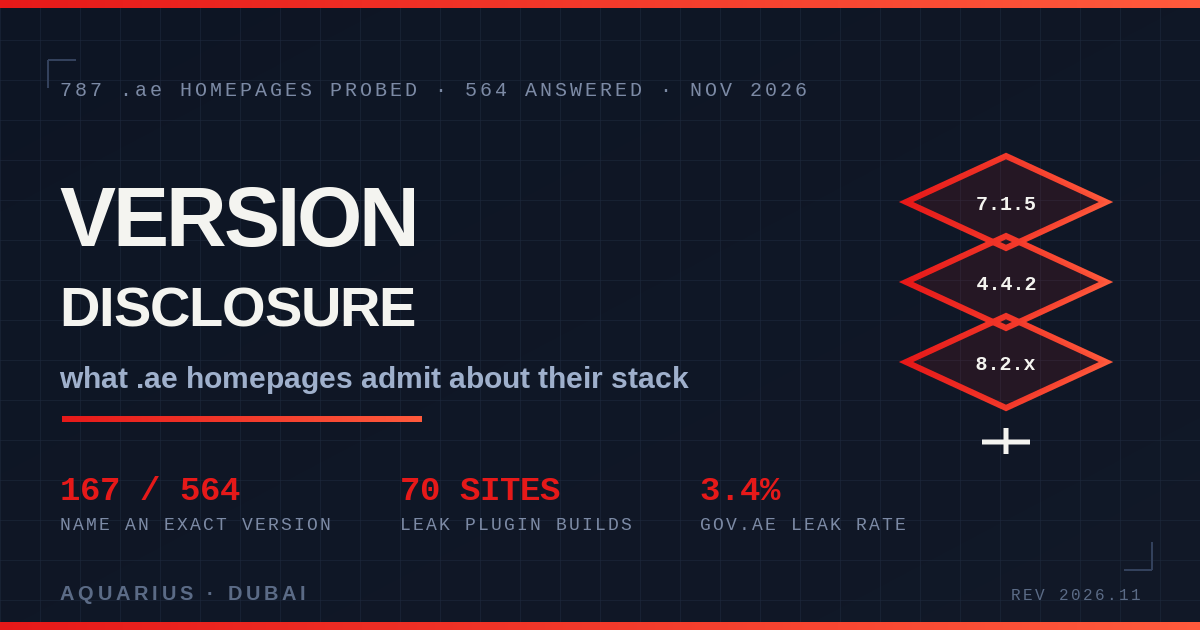
Short answer: we fetched 787 of the most-visited .ae homepages in November 2026 and read only what each site volunteers about its own software. 167 of the 564 that answered — 29.6% — publish at least one exact version number, either in an HTTP response header or in a <meta name="generator"> tag. The response headers are the smaller half of the problem. The HTML is the leaky half, and the thing it names most often is not the CMS — it is the plugins.
Most UAE hardening checklists stop at “hide your server version.” Our data says that is the easy 10% of the leak. 109 hosts disclose a version in headers; 116 ship a generator tag; 70 sites print the exact build number of a WordPress plugin straight into the page source, where 91% of all WordPress vulnerabilities actually live.
Why a version string matters in the UAE right now
Three numbers set the stakes before we get to ours.
- Patchstack’s State of WordPress Security 2026 counted 11,334 new WordPress vulnerabilities disclosed during 2025 — a 42% rise year on year, and the share classed as highly exploitable grew 113%.
- Of those, 91% were in plugins and 9% in themes. Exactly six were in WordPress core. The thing attackers want is not your core version. It is your plugin list with build numbers attached.
- The 2025 Web Almanac puts WordPress at 35% of all websites and 64% of the CMS market, with 54% of mobile sites running on some CMS. In our
.aesample WordPress fingerprints on 100 of 564 live homepages — 17.7%, roughly half the global rate, because large UAE brands skew heavily to Next.js (65 hosts), Shopify (38) and Sitecore (30).
Put those together and the risk is specific, not theoretical: a published plugin version is a free database lookup. It converts “probe thousands of sites for everything” into “probe this one site for the three CVEs that match its build.”
How we measured it
One HTTPS GET per host from the Tranco top .ae list, mobile Chrome user agent, redirects followed, nothing authenticated and no path scanning — the same ethics as the rest of our .ae census work, including the security.txt disclosure scan and the third-party script integrity scan. From each response we kept the Server, X-Powered-By, X-AspNet-Version and X-Generator headers, every <meta name="generator"> tag, asset ?ver= query strings, and whether the page references xmlrpc.php or advertises rel=pingback.
Of 787 hosts: 107 never completed a connection (49 connection resets, 41 connect timeouts, 10 TLS failures, 7 read timeouts), 105 returned a hard 403 bot block, and 564 served a live HTML 200. Every percentage below is against those 564. Current upstream versions were checked the same day against api.wordpress.org and each vendor’s release feed: WordPress 7.1.5, Elementor 4.4.2, WooCommerce 11.3.1, Site Kit 1.192.0.
Everything that leaks, ranked
| Disclosure signal | Hosts | Share of 564 | What it hands over |
|---|---|---|---|
<meta name="generator"> present | 116 | 20.6% | CMS identity, and usually the plugin set |
X-Powered-By header | 86 | 15.2% | Runtime; 30 of them name an exact PHP minor |
| Plugin or theme build number in HTML | 70 | 12.4% | 141 exact build strings — the 91% attack surface |
| WordPress core version in HTML | 58 | 10.3% | Exact core build |
Versioned Server header | 37 | 6.6% | Web server build, 17 of them Microsoft-IIS/10.0 |
X-AspNet-Version: 4.0.30319 | 8 | 1.4% | .NET Framework 4.x, plus 3 with MVC version too |
References xmlrpc.php | 74 | 13.1% | Legacy WordPress endpoint left reachable |
Advertises rel=pingback | 19 | 3.4% | Pingback enabled — a reflection primitive |
| Any exact version anywhere | 167 | 29.6% | — |
The header picture is tidier than the UAE deserves credit for, and the reason is a CDN rather than discipline: 251 of 564 hosts (44.5%) answer with Server: cloudflare and 137 send no Server header at all. Cloudflare rewrites the header you would otherwise have leaked. Behind it, 57 hosts show nginx, 26 Apache, 18 IIS, 17 LiteSpeed, 9 Vercel. Only 37 keep the version digits, and the oldest of those is an nginx/1.14.0 (Ubuntu) — a build that shipped with Ubuntu 18.04.
The PHP minors, and why we are not alarmed by all of them
30 hosts print an exact PHP minor. The distribution: nine on 8.3, five on 8.5, five on 8.2, four on 7.4, three on 8.0, three on 8.1, one on 8.4. Ten of those are on a runtime with no upstream security support at all — PHP 7.4 ended 28 November 2022, 8.0 ended 26 November 2023, 8.1 ended 31 December 2025. Five more sit on 8.2, whose security window closes 31 December 2026, five weeks from this post. We covered that cliff in detail in the 2027 end-of-life wall; here the point is narrower. Those sites did not have to tell us.
The WordPress core numbers are better than the headlines suggest
58 homepages print their WordPress core version. The naive read is that 22 of them are “out of date.” That read is wrong, and the correction is the most useful thing in this dataset.
WordPress backports security fixes to old branches. Every active branch has its own latest patch: 6.3.15, 6.4.15, 6.5.15, 6.6.12, 6.7.12, 6.8.13, 6.9.12, 7.0.9 and 7.1.5. A site on 6.7.12 is running a two-year-old major release but has received every security fix released since. A site on 6.8.5, whose branch is now at 6.8.13, has not.
Scored that way:
- 36 of 58 run 7.1.5 — the current release on the day we scanned.
- 18 sit on a branch older than 7.1, down to one host on 6.3.2 and one still on the 5.8 branch.
- Only 10 are behind the latest patch on their own branch. That is the group genuinely missing published security fixes — 1.8% of all live hosts, not the 4% a crude “not latest” count would report.
Being on an old WordPress major is a maintenance problem. Being behind your own branch’s patch level is a security problem. Most audit tools report the first and call it the second.
Plugins: where the disclosure actually costs you
70 hosts leak 141 plugin and theme build strings. Of the 100 WordPress sites in the sample, 64 publish at least one plugin version — more than publish their core version. The leaderboard:
- Elementor — 43 hosts. 14 on the current 4.4.2, 10 on 4.4.1, and 29 behind current, including nine still on a 3.x branch and one on 3.17.3.
- Site Kit by Google — 23 hosts, 16 of them current at 1.192.0. Auto-updates visibly working.
- WooCommerce — 16 hosts, five on the current 11.3.1, the tail reaching back to 10.4.2.
- Slider Revolution — 16 hosts, spread across 6.5.9 to 7.1.5. A premium plugin with a long CVE history, printing its build to anyone who views source.
- WPML — 11 hosts (oldest 4.3.17), WP Rocket — 10, Redux — 8.
And the control group: 25 WordPress sites in the sample leak nothing at all — no core version, no plugin build, no versioned Server. Among them adnec.ae and mbank.ae, both verified clean on apex and www. It is achievable on a stock install. Almost nobody does it.
Government sites are eight times tighter than the private sector
This is the number worth sharing. Of 58 live .gov.ae homepages, nine disclose anything at all — and seven of those nine leak only Microsoft-IIS/10.0. Just two print an application-level version: 3.4% against 29.6% for the sample as a whole.
One of the two is instructive rather than embarrassing: mof.gov.ae publishes WordPress 7.1.5 — the current release. Disclosing a fully patched version tells an attacker only that there is nothing to find. That is the low-risk way to leak.
The failure mode we saw on another federal portal is the common one. Its X-Powered-By header has been deliberately overwritten with literal XXXXXXXX — somebody did the header hardening on purpose — while the HTML below still prints its SEO plugin and translation plugin versions, both several releases behind. Header hardening at the edge, template hardening never done. If you have a WAF or a CDN rule stripping headers, check your page source before you call this job finished.
The fix order, in the order that pays
- Patch first, hide second. Version suppression on an unpatched plugin is a blindfold, not armour. Get the branch patch level current, then stop advertising it.
- Kill the generator tags. In WordPress,
remove_action('wp_head', 'wp_generator')handles core; plugin generators each need their own filter or a single output-buffer strip. This is the highest-value 30 minutes on the list, because it is where plugin builds leak. - Flatten the headers.
expose_php = Offin php.ini,server_tokens offin nginx,ServerTokens Prodin Apache, and on IIS remove both theServerheader andX-AspNet-Version— the eight hosts still shipping4.0.30319are each one config line from fixing it. - Strip or rotate asset
?ver=strings, which reveal the same plugin builds the generator tag does. Replace the version with a release-hash cache buster so caching still works. - Decide on
xmlrpc.phpand pingback. 74 sites reference the endpoint and 19 still advertise pingback. If you are not using the Jetpack or mobile app paths that need it, close it. - Re-check after every deploy. Disclosure regresses silently — a plugin update reinstates its own generator tag, a new origin bypasses the CDN rule.
What this costs in Dubai, in AED
These are our quoting bands for UAE work, not market averages. They assume a live site, no rewrite.
| Scope | What you get | Timeline | AED range |
|---|---|---|---|
| Disclosure audit, one site | Headers, generator tags, asset versions, xmlrpc and pingback posture, plugin builds mapped against current releases, ranked fix list | 2–3 days | AED 2,500 – 5,000 |
| Hardening pass | Generator removal, header flattening across origin and CDN, asset version rotation, xmlrpc decision, before/after evidence capture | 3–5 days | AED 3,500 – 8,000 |
| Patch-cadence retainer | Monthly core, plugin and runtime updates on staging first, rollback plan, branch patch-level report, disclosure re-check each cycle | monthly | AED 2,000 – 5,500 / mo |
| Runtime upgrade | PHP or Node moved to a supported branch, dependency fixes, staging soak, cutover out of hours | 1–3 weeks | AED 6,000 – 18,000 |
| Fleet census, 10–50 domains | Scripted scan of every property you own, per-site fix list, one consolidated board report, re-scan after remediation | 1–2 weeks | AED 9,000 – 24,000 |
Now the arithmetic. The audit plus the hardening pass tops out near AED 13,000. IBM’s Cost of a Data Breach 2026 puts the Middle East average breach at USD 8 million — roughly AED 29.4 million. The entire programme is about 0.04% of the regional average downside, and the first item on it is a single line of PHP. See our pricing page for how these bands scale with site count.
How Aquarius runs this
We built the scanner in this article for our own clients before we pointed it at the Tranco list. For a UAE site we report four things: every version string you publish and where it comes from, your plugin builds against the current release of each, your branch patch level versus your major version — the distinction most tools get wrong — and the fix with the config snippet for your actual stack.
Risk reversal, plainly: send us one domain and we will tell you what it discloses before you commit to anything. If there is nothing to fix we will say so in a sentence, and that costs you nothing.
Get your disclosure scan, or reply with a list of domains and we will run the fleet version.
FAQ
Does hiding my version number actually make my site more secure?
On its own, no — the vulnerability is still there. What it removes is cheap targeting. Mass exploitation campaigns filter by fingerprint because scanning is expensive at scale; a site that names a plugin build matching an active exploit chain gets picked out of the crowd. Treat it as reducing exposure, never as a substitute for patching.
Is the <meta name="generator"> tag needed for anything?
No. It is a historical courtesy tag. Google does not use it for ranking, it is not required by any schema, and removing it breaks nothing. A handful of plugins read their own tag during updates; none of ours has ever failed after removal.
Will removing ?ver= from my CSS and JS break caching?
It would if you simply deleted it, because browsers would keep serving stale files. Replace the plugin version with a value that changes on deploy — a file hash or release ID — and you keep cache busting while giving up nothing about your builds.
Is it safe to disable xmlrpc.php?
For most Dubai business sites, yes. It is needed only by the legacy WordPress mobile apps, some Jetpack features and pingbacks. Disable it, then test publishing and any Jetpack modules you rely on. If something needs it, restrict it by IP instead of leaving it open to the internet.
How often should a UAE site patch?
Security releases within 72 hours, everything else monthly on a staging-first cadence. Given that 91% of WordPress vulnerabilities land in plugins and the 2025 count rose 42%, a quarterly update window is now too slow to be defensible to an insurer or an auditor.