
How to Start a Dropshipping Business in Dubai (2026): Licence, Costs, Customs and VAT
Dropshipping is legal in Dubai with an e-commerce licence from AED 1,070. Real 2026 AED setup costs, the new AED 1,000 customs threshold, VAT thresholds and per-order margin maths.
- PUBLISHED
- 26 SEPT 2026
- READ TIME
- 12 MIN
- AUTHOR
- AQUARIUS · DUBAI
- UNIT
- REV 2026.09
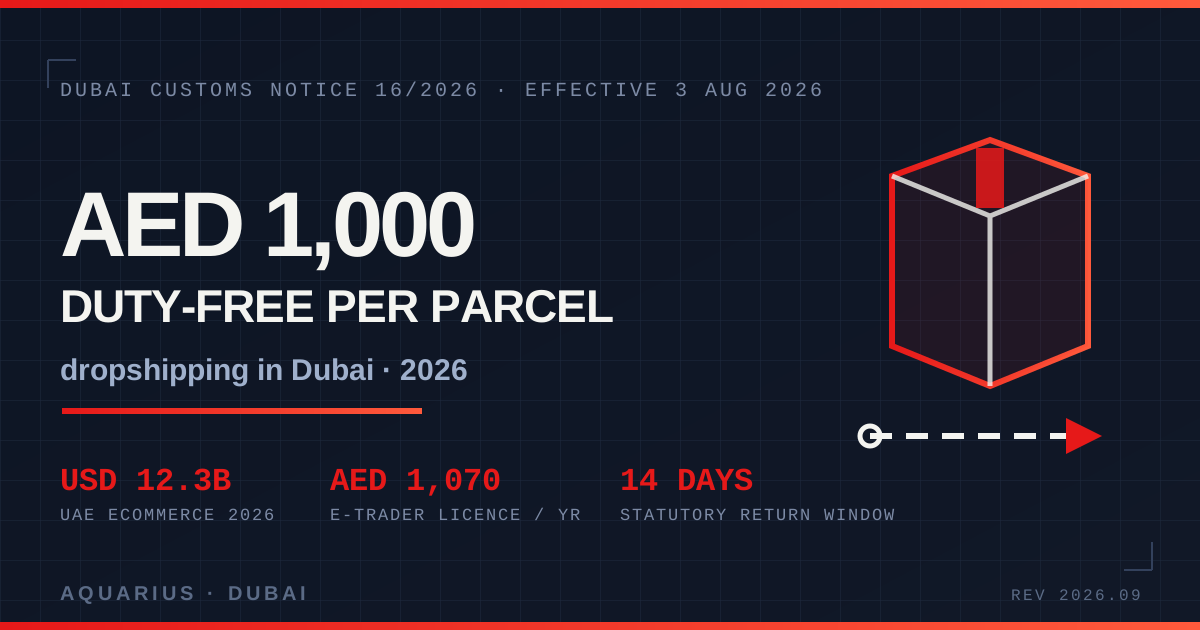
Short answer: Dropshipping is legal in Dubai, but there is no such thing as a “dropshipping licence” — you need an e-commerce trade licence, which costs AED 1,070 a year on Dubai’s E-Trader route (UAE and GCC nationals only), roughly AED 5,750–12,500 in a free zone, or AED 12,000–25,000 all-in on the mainland once office, visa and PRO costs are counted. Approval typically takes 7–14 days. The bigger 2026 change is at the border: Dubai Customs Notice No. 16 of 2026, effective 3 August 2026, raised the cross-border e-commerce duty-free threshold from AED 300 to AED 1,000 per parcel.
That single notice quietly rewrote the margin maths for every Dubai store that ships from abroad. An AED 800 parcel that used to attract 5% customs duty now clears duty-free — about AED 44 saved per parcel. But the exemption has edges most “start dropshipping in Dubai” articles never mention, and getting them wrong is how a store ends up paying duty it budgeted away.
Key takeaways
- UAE e-commerce is worth USD 12.30 billion in 2026, heading to USD 21.01 billion by 2031 at an 11.29% CAGR — with 11 million+ online shoppers and 45,000+ active stores already competing.
- 58% of UAE online purchases are made from international vendors. That leakage is the dropshipper’s opening — and the reason local delivery speed wins.
- Notice 16/2026 (3 August 2026) lifted the duty-free threshold to AED 1,000 per shipment, per parcel not per item, with tobacco, vapes, nicotine liquids and alcohol excluded.
- Duty relief is not VAT relief: 5% import VAT still applies on dutiable imports, and bulk commercial consignments pay duty from the first dirham of CIF.
- VAT registration is mandatory at AED 375,000 of taxable supplies (voluntary from AED 187,500). Corporate tax is 0% to AED 375,000, then 9% — and Small Business Relief for revenue under AED 3 million was extended in August 2026 to tax periods ending on or before 31 December 2029.
- Your real cost per order is not the product: delivery runs AED 17–30 in Dubai, failed attempts and returns-to-origin add 15–25% to true per-parcel cost, and gateways take 2.49–2.9% + AED 0.50–1.00.
The market is big enough to be worth entering — and crowded enough to punish a bad store
Three numbers frame the opportunity. The UAE e-commerce market reached USD 12.30 billion in 2026 and is forecast to hit USD 21.01 billion by 2031, an 11.29% CAGR — roughly double the global average growth rate. There are 11 million+ online shoppers in a country of about 11.4 million people, served by 45,000+ active e-commerce stores. And 79% of all e-commerce transactions happen on a smartphone, which means a desktop-first store is not a store.
Now the number that matters most to a dropshipper: 58% of UAE online purchases are placed with international vendors. UAE shoppers are already buying from abroad and already waiting for shipping. A Dubai-registered store that sources the same catalogue but lands parcels faster, prices in dirhams, takes cash on delivery and answers a WhatsApp message in Arabic is not competing on product — it is competing on friction, and friction is where the incumbent loses.
That is also why the thin version of this business fails. Fashion alone takes a 22% share of the market and contributes 38.7% of total e-commerce revenue, so a generic AliExpress catalogue with a 30-day lead time is entering the most contested category in the country with the weakest possible offer.
Myth-bust: there is no “dropshipping licence” in Dubai
Most Dubai businesses get this wrong, and setup agents rarely correct it because the confusion sells packages. Dropshipping is a fulfilment model — you hold no stock and your supplier ships direct — not a licence category. What you actually need is an e-commerce or general trading licence issued by the Dubai Department of Economy and Tourism (DED) or a free zone authority, and your activity list has to cover the goods you sell.
Your four licence routes, priced
| Route | Annual cost (AED) | Who it suits | Catch |
|---|---|---|---|
| E-Trader (DED) | 1,070 | UAE and GCC nationals selling online with no storefront | Nationality-restricted; no visa; no staff |
| Free zone e-commerce package | 5,750–12,500 | Expat founders, remote-first, 0–2 visas | Mainland B2B sales may need a distributor or agent |
| Free zone trading licence (zero-visa, 1 yr) | from 11,900 incl. VAT | Founders who want a clean trading scope | Costs rise sharply once visas are added |
| Mainland DED trade licence | 10,000–20,000 + Ejari rent 15,000–40,000 | Selling to UAE government and corporates, physical retail later | Physical office with Ejari is mandatory |
Realistically, budget AED 12,000–25,000 all-in for a mainland dropshipping setup once trade licence, visa, PRO services, VAT registration and compliance setup are included, and 7–14 working days from application to approval if your documents are clean. Our guide to the trade licence for an online store in the UAE walks the paperwork in order.
Two legal conditions apply whichever route you take. First, keep a written supplier agreement on file covering pricing, delivery timescales, returns and quality standards — auditors ask for it. Second, do supplier due diligence: dropshipping structurally increases exposure to counterfeit and grey-market goods, and misrepresenting product origin draws fines up to AED 50,000 plus licence suspension.
The border rule that changed in August 2026
Dubai Customs Notice No. 16 of 2026, effective 3 August 2026, raised the duty-free threshold for cross-border B2C e-commerce shipments from AED 300 to AED 1,000. Dubai Customs framed it as a competitiveness measure: lower landed costs, fewer declarations, faster clearance through Mirsal 2. Four details decide whether you actually benefit:
- Per shipment, not per item. An AED 1,400 order split across two parcels is treated differently from the same order in one box. Cart structure is now a customs decision.
- Exclusions are absolute. Tobacco and tobacco products, electronic smoking devices and accessories, nicotine-containing liquids, and alcoholic beverages or food containing alcohol get no exemption at any value.
- Duty relief is not VAT relief. 5% import VAT still applies on dutiable imports, calculated on CIF value plus duty. Above the threshold you are back to 5% customs duty + 5% VAT on CIF.
- It is a courier/B2C relief, not a wholesale loophole. Consolidating stock into a bulk commercial consignment pays duty from the first dirham of CIF. If your plan was to import a pallet and call it a thousand AED 900 parcels, that plan does not work.
One more useful clause: previously duty-paid B2C goods get a 60-day duty-exemption window from the original exit date when they come back — which matters enormously in a market where returns are routine. And note the notice is a Dubai Customs instrument. If your carrier clears parcels through Abu Dhabi, Sharjah or a northern emirate, confirm the port of entry before you model the saving.
On an AED 800 parcel the relief is worth about AED 44, roughly 5.5% of sticker price. On a 12% net margin, that is a third of your profit per order appearing out of a customs notice most competitors have not read yet.
Unit economics: where a Dubai dropshipping order actually loses money
Product cost is the smallest problem. The UAE-specific costs are delivery, cash on delivery, and failure.
| Cost line | 2026 rate | Notes |
|---|---|---|
| Standard next-day delivery, Dubai | AED 17–30 per parcel | Northern Emirates AED 22–38 |
| Same-day delivery | AED 35–60 Dubai | AED 45–75 Northern Emirates |
| Failed attempts + return-to-origin | 15–25% of true per-parcel cost | The line that quietly kills COD-heavy stores |
| Card gateway | 2.49–2.9% + AED 0.50–1.00 | Telr 2.49–2.69%, PayTabs 2.85% + AED 1, Stripe 2.9% + AED 1 (3.9% international) |
| BNPL (Tabby / Tamara) | 2.99–3.99% + per-transaction | Approval 60–80% by segment |
| Marketplace referral fee | 5–15% of sale | Amazon.ae: 5% electronics to 15% fashion, plus AED 180/month Professional plan |
| Marketplace fulfilment (FBA) | AED 7–20+ per unit | Weight and size banded, plus storage |
Work a realistic order through those rates. Sell at AED 249 with a landed product cost of AED 90 and delivery at AED 24. A card payment takes about AED 8; a BNPL checkout takes closer to AED 10 — and BNPL is not optional at the margins any more, because BNPL now accounts for roughly 14% of UAE e-commerce checkout volume, up from under 5% in 2022, with UAE BNPL transaction volume growing over 40% year on year through 2025. You are left near AED 127 gross. Then apply the failure tax: at a 20% uplift for failed attempts and RTO on the fulfilment side, you shed another AED 5–25 per order depending on your COD mix. Advertising has to come out of what remains.
That is the whole game. Selling is easy in the UAE; netting is hard. Stores that survive fix three things early: they cut COD share by making card and BNPL the path of least resistance, they compress delivery to the point where customers stop cancelling, and they instrument returns instead of discovering them in a monthly reconciliation. Our breakdown of last-mile delivery and COD integration for Dubai e-commerce goes deeper on the logistics side, and adding Tabby and Tamara to a Dubai store covers the BNPL plumbing.
Tax: the two thresholds that decide your structure
VAT registration becomes mandatory at AED 375,000 of taxable supplies and imports over 12 months, with voluntary registration from AED 187,500. The standard rate is 5%. Non-resident suppliers get no threshold at all — they must register on their first taxable UAE sale. From 1 January 2026 the requirement to issue a self-invoice under the reverse charge mechanism was removed, but you must retain the supplier-issued invoice and import documentation, which for a dropshipper means your supplier paperwork is now the audit trail.
On corporate tax: 0% on the first AED 375,000 of taxable income, 9% above it. If revenue stays under AED 3 million, Small Business Relief can elect you out of corporate tax entirely — and in August 2026 the Ministry of Finance extended that relief from tax periods ending 31 December 2026 to periods ending on or before 31 December 2029. For a store in year one, that is a genuine runway extension rather than a technicality.
Consumer protection is where dropshipping gets expensive
Long supplier lead times collide directly with UAE consumer law. Online shoppers have a 14-day right to return most purchases without giving a reason, counted from delivery, and the seller must refund within 14 days of receiving the return. Article 28 of the Executive Regulation requires you to disclose merchant identity, total price including VAT and delivery, the return policy and a complaint channel before checkout. Delivery has a default deadline of 30 days unless the customer agreed otherwise — miss it and they can cancel for a full refund.
Enforcement is not theoretical. Federal Law No. 15 of 2020 carries fines up to AED 2,000,000 for consumer protection breaches, a single non-response to a DED complaint notice triggers an automatic AED 50,000 penalty, and the DED recorded over 45,000 consumer complaints across the UAE in 2026, led by misleading pricing and refund refusals. A dropshipping store whose refund depends on a supplier in another timezone has already lost that argument.
What it costs to build the store, and how Aquarius does it
The licence is the cheap part. The store is what converts. Realistic 2026 build budgets in Dubai:
| Build | AED | What you get |
|---|---|---|
| Shopify starter, dropship-ready | 6,000–18,000 | Theme, Arabic/English, Tabby and Tamara, COD flow, supplier feed |
| Custom headless store | 25,000–90,000 | Own checkout, supplier API sync, margin rules, RTO analytics |
| Marketplace + own store, dual channel | 35,000–120,000 | Amazon.ae and noon listings synced to one inventory and price engine |
We build the second and third rows. The parts that pay for themselves are unglamorous: a supplier feed that updates price and stock automatically so you never sell an out-of-stock SKU, landed-cost logic that applies the AED 1,000 threshold per shipment at checkout instead of surprising the customer at the door, a COD risk score that flags likely RTO before dispatch, and an Arabic-first product page because the market is bilingual and the conversion difference is measurable. If you are still deciding channel, our comparison of selling on noon and Amazon versus your own store is the right starting point, and our pricing shows what each tier includes.
FAQ
Is dropshipping legal in Dubai in 2026?
Yes. Dropshipping is fully legal in the UAE provided you hold a valid e-commerce licence from the DED or a free zone authority, your licence activities cover the goods you sell, and you keep supplier agreements on file. There is no separate dropshipping licence.
What is the cheapest way to get an e-commerce licence in Dubai?
The DED E-Trader licence at AED 1,070 a year is the cheapest, but it is restricted to UAE and GCC nationals and comes with no visa. For expat founders the realistic floor is a free zone e-commerce package from around AED 5,750, with zero-visa trading packages from about AED 11,900 including VAT.
Do I pay customs duty on dropshipped orders under AED 1,000?
Under Dubai Customs Notice 16/2026, effective 3 August 2026, cross-border B2C e-commerce shipments valued up to AED 1,000 per parcel are exempt from customs duty — excluding tobacco, electronic smoking devices, nicotine liquids and alcohol. The 5% import VAT still applies on dutiable imports, and bulk commercial consignments pay duty from the first dirham of CIF value.
Do I need to register for VAT as a Dubai dropshipper?
Registration is mandatory once taxable supplies and imports pass AED 375,000 in 12 months, and voluntary from AED 187,500. Non-residents have no threshold and must register on their first taxable UAE sale. Keep supplier invoices and import documents: since 1 January 2026 self-invoicing under the reverse charge mechanism was removed, so that paperwork is your evidence.
Can customers return dropshipped products in the UAE?
Yes, and this is the model’s biggest operational risk. UAE consumers have a 14-day right to return most online purchases from delivery, and you must refund within 14 days of receiving the goods back — regardless of your supplier’s policy. Build a local returns address or a 3PL reverse-logistics flow before you launch, not after the first complaint.
How long does it take to launch a Dubai dropshipping store?
Licence approval typically runs 7–14 working days. A Shopify build with Arabic, BNPL and COD is a 2–4 week job; a custom store with supplier API sync and margin rules is 6–12 weeks. Payment gateway approval is usually the critical path, so start it the day the licence is issued.
Dropshipping in Dubai in 2026 is not a licence problem, it is a margin problem — and margin is decided by your store, your checkout and your returns flow, not your supplier list. Tell us what you plan to sell and we will model the per-order economics with your real landed costs, then build the store that survives them. See our services for scope.