
How Long Does It Take to Build a Website or App in Dubai? (2026 Timelines)
Real 2026 build timelines for Dubai websites and apps, week by week, plus the UAE approval gates (payment gateways, UAE Pass, store review) that quietly add a month.
- PUBLISHED
- 20 SEPT 2026
- READ TIME
- 10 MIN
- AUTHOR
- AQUARIUS · DUBAI
- UNIT
- REV 2026.09
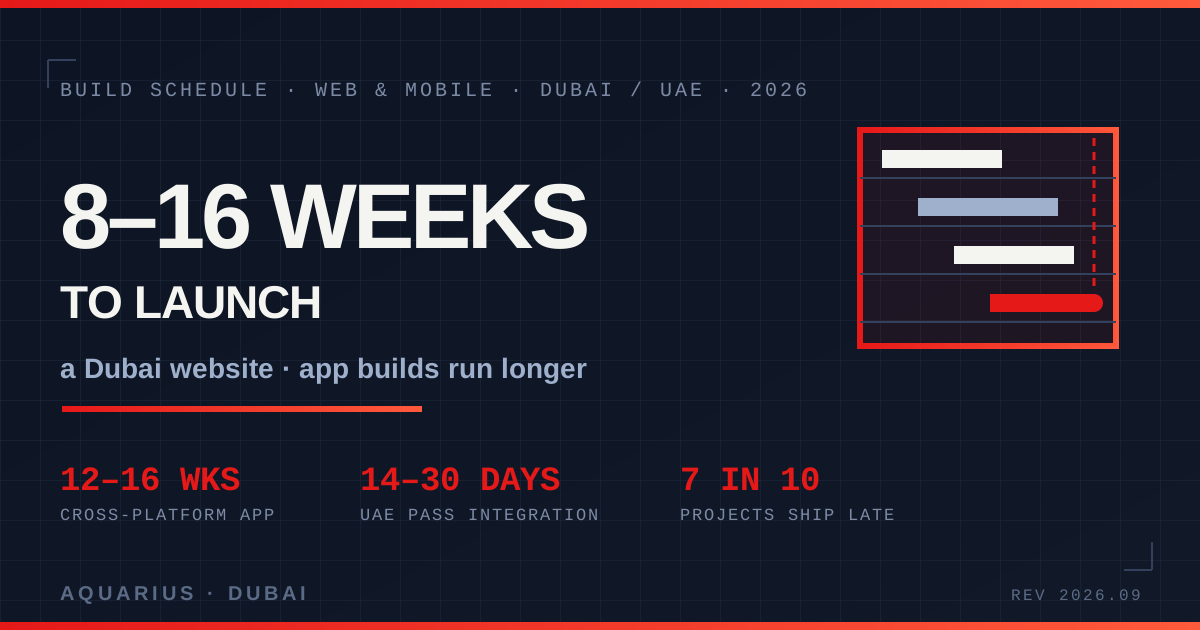
Short answer: In 2026 a Dubai business website takes 2–6 weeks for a basic build, 8–16 weeks for a typical corporate or bilingual site, and 8–14 weeks for ecommerce. A mobile app takes 10–16 weeks for an MVP and 5–10 months for a complex product — 12–16 weeks cross-platform versus 20–28 weeks per platform native. The part that wrecks Dubai schedules is not code: it is the UAE approval queue — payment gateway onboarding, UAE Pass, store review — which adds two to six weeks if you start it late. Updated September 2026.
Here is what most Dubai businesses get wrong. They negotiate hard on the build estimate, sign, and then discover in week nine that the merchant account is still inside a bank approval cycle, the UAE Pass use-case questionnaire has not been submitted, and the Google Play account cannot publish to production for another fortnight. The developers finished on time. The launch did not.
Key takeaways
- Typical Dubai web project: 8–16 weeks from discovery to launch. Simple sites land in 2–6 weeks; custom platforms run 4–6 months.
- Typical app: 10–16 weeks for an MVP, 2–5 months for a standard product, 5–10 months for an advanced backend or enterprise build.
- Cross-platform buys time, not just budget. Flutter or React Native covers both stores in 12–16 weeks against 20–28 weeks per platform native — a 30–45% cut in build time.
- UAE approvals are the hidden critical path. Network International merchant onboarding runs 2–4 weeks, UAE Pass integration 14–30 days, and a brand-new Google Play account must run a 14-day closed test with 12 testers before it can even apply for production access.
- Late is the norm, not the exception. Seven in ten software projects are delivered late, and Standish Group CHAOS data puts 66% of projects over time or budget, with one in five cancelled outright.
Why the Dubai market punishes a slow launch
The demand side is not the problem. UAE internet penetration hit 99.1% in January 2026, smartphone penetration 96.4% (up from 94.8% a year earlier), and digital payments now account for 89% of transactions, against 74% in 2024. Dubai’s ecommerce market is projected at USD 9.8 billion in 2026, up from USD 8.1 billion in 2025, and the emirate’s D33 agenda targets roughly USD 27 billion a year in economic value from digital transformation. The audience is online, paying by card, and growing.
The supply side is where it breaks. Across more than 5,400 large IT projects studied by McKinsey and the University of Oxford, the average project ran 45% over budget and 7% over time and delivered 56% less value than predicted. PMI data shows 43% of projects miss their deadline by more than 25%, and Wellingtone’s 2026 figures put the share of organisations finishing projects on time at just 36%. In a market adding roughly AED 6 billion of new ecommerce spend in a single year, a quarter of slippage is not an inconvenience — it is a quarter of that growth you were not in the market to take.
Website build timelines in Dubai (2026)
These are realistic calendar durations from kickoff to public launch, assuming one decision-maker, content supplied on schedule and two rounds of review. Every one of them stretches when content arrives late — the single most common cause of delay on Dubai projects.
| Project type | Typical duration | What drives the clock |
|---|---|---|
| Landing page / campaign one-pager | 1–2 weeks | Copy sign-off, tracking setup |
| Basic business site (5–10 pages) | 2–6 weeks | Content, photography, one design round |
| Corporate site, bilingual EN/AR | 8–12 weeks | Arabic translation and RTL layout QA |
| Ecommerce store | 8–14 weeks | Catalogue structuring, checkout UX, gateway onboarding |
| Custom platform, portal or booking system | 4–6 months | Integrations, roles and permissions, load testing |
Where the weeks actually go
On a typical 12-week Dubai corporate build the split is roughly: discovery and information architecture 1–2 weeks, UI design 2–4 weeks including review cycles, development 4–6 weeks, content population and the Arabic RTL pass 1–2 weeks, and QA, performance and launch 1–2 weeks. Bilingual work is the phase most often under-planned: Arabic is not a translation bolted on at the end, it is a layout, typography and testing pass across every template, which is why we treat it as its own workstream in our guide to Arabic website localisation and RTL in Dubai.
Mobile app build timelines in Dubai (2026)
| Scope | Typical duration | Notes |
|---|---|---|
| Tightly focused MVP | 10–16 weeks | One user role, one payment path, no admin extras |
| Standard business app | 2–5 months | 15–25 screens, auth, payments, admin panel |
| Complex / enterprise product | 5–10 months | Advanced backend, integrations, compliance review |
| Native, per platform | 20–28 weeks | iOS and Android built and tested separately |
| Cross-platform, both stores | 12–16 weeks | Flutter or React Native, one codebase |
Native versus cross-platform is a schedule decision before it is a budget decision. The same customer-facing MVP that needs 14–18 weeks of native development can be delivered in 8–12 weeks in Flutter, and cross-platform cuts total build time by 30–45% against shipping two separate native apps. For most Dubai SME products that trade is worth making; where it is not is covered in our Flutter vs React Native comparison for Dubai teams.
The Dubai approval gates nobody puts on the Gantt chart
This is what separates a Dubai timeline from a generic one. None of these are development tasks, all of them are blocking, and every one can be opened in week one instead of week nine.
| Gate | Realistic wait | Start it |
|---|---|---|
| .ae domain (second level) | Live within minutes of payment | Week 1 |
| Restricted .co.ae / .net.ae | About 5–7 days | Week 1 — needs a trade licence or UAE trademark |
| Stripe (clean foreign entity) | 24–48 hours | Before checkout build starts |
| PayTabs / Tap / Mamo | 3–5 business days | Week 1–2 |
| Telr | 5–10 business days | Week 1–2 |
| Network International | 2–4 weeks (bank approval cycle) | Week 1, without exception |
| UAE Pass integration | 14–30 days | Week 1–2, before the auth screens are built |
| Apple App Store review | 90% inside 48 hours; 1.5 days average | Submit 1–2 weeks before launch date |
| Google Play, new developer account | 14-day closed test with 12 testers, then 3–7 days review | Week 1 — a hard three-week floor |
Payment gateways. Document completeness is the single biggest variable in approval speed. Every UAE acquirer wants a valid trade licence, UBO documentation (Emirates ID and passport) and an official merchant IBAN letter. A missing IBAN letter costs a week. Picking Network International and starting in week nine costs a month. Fees and integration costs are broken down in our Dubai payment gateway integration cost guide.
UAE Pass. Integration typically takes 14 to 30 days including API configuration, security testing and staff training. Before any of that, a private entity needs a valid UAE trade licence, a completed authentication questionnaire, use-case guidelines and a workflow diagram of the user journey, then a sandbox and staging pass before production credentials are issued. Teams that treat it as a two-day OAuth task lose a month; the full sequence is in our UAE Pass integration guide.
Store review. Apple stated in June 2026 that 90% of submissions clear within 48 hours, averaging 1.5 days, though a first submission from a new developer account runs 3–7 days. Google Play pushes updates to established apps through in 1–3 hours, but a new developer account must first run a closed test with at least 12 testers for 14 continuous days before it can apply for production access. If your launch is six weeks out and the Play account does not exist yet, the date is already wrong.
What a slipped schedule costs in AED
Time and money are the same line item. McKinsey’s analysis found each additional year of schedule adds roughly 15% to cost overruns, and Deloitte’s digital project data showed a median delay of six months, with 30% of projects delayed by more than a year. On a Dubai build quoted at AED 120,000, a six-month slip is not just a later launch — it is six months of paid media pointing at a page that does not exist, a support retainer paid on a product nobody is using, and a season of demand handed to whoever did ship.
How we schedule it at Aquarius: approval gates open in week one, in parallel with discovery, so the merchant account and the UAE Pass request are already in flight while design is still in review. Content deadlines are dated in the plan, not implied. Two review rounds per phase are budgeted; a third is a scope conversation, not a silent two-week hole. And you get a clickable build every week, so slippage shows up in week three rather than week eleven. Indicative AED ranges by scope sit on our pricing page, and the full cost picture is in our Dubai website and app cost breakdown.
Frequently asked questions
How long does it take to build a website in Dubai in 2026?
A basic business website takes 2–6 weeks. A typical corporate or bilingual site takes 8–16 weeks from discovery to launch, and ecommerce stores run 8–14 weeks. Custom platforms and portals take 4–6 months.
How long does it take to build an app in Dubai?
A focused MVP takes 10–16 weeks, a standard business app 2–5 months, and a complex or enterprise product 5–10 months. Cross-platform builds cover both iOS and Android in 12–16 weeks, against 20–28 weeks per platform for native.
What is the fastest way to launch a website in Dubai?
Cut the page count, supply final content before design starts, limit reviews to one decision-maker, and open every approval gate — domain, payment gateway, store accounts — in week one. A tightly scoped launch site in 2–3 weeks, expanded after go-live, beats a 14-week build that misses the season.
Why do Dubai projects take longer than the quoted build time?
Because the quote prices development, not approvals. Merchant onboarding at a bank-backed acquirer takes 2–4 weeks, UAE Pass takes 14–30 days, and a new Google Play account faces a mandatory 14-day closed test. Run sequentially after the build instead of alongside it, those add a month or more.
Does an Arabic version add to the timeline?
Yes — budget 1–2 extra weeks on a standard corporate site. Arabic is a full RTL layout and typography pass across every template plus translation review, not a text swap, and it needs its own QA cycle on mobile.
How much of a delay is the client’s side?
Most of it, honestly. Timelines are driven by how fast content, feedback and sign-off arrive, not by how fast the team builds. Projects that land on the original date are the ones where content was ready at kickoff and one person had authority to approve.
Planning a launch around a season, an event or a funding milestone? Send us the date you need to be live and the scope you have in mind, and we will send back a backward-planned schedule with the approval gates marked — before you commit to anything. Talk to Aquarius or see what we build on our services page.