
WooCommerce vs Shopify for a Dubai Store (2026): The 2% Fee Most Merchants Never Budget For
Shopify adds 2% on Basic to every order via a UAE gateway: AED 20,000 a year at AED 1m GMV. Real 2026 AED cost model for WooCommerce vs Shopify in Dubai.
- PUBLISHED
- 16 OCT 2026
- READ TIME
- 13 MIN
- AUTHOR
- AQUARIUS · DUBAI
- UNIT
- REV 2026.09
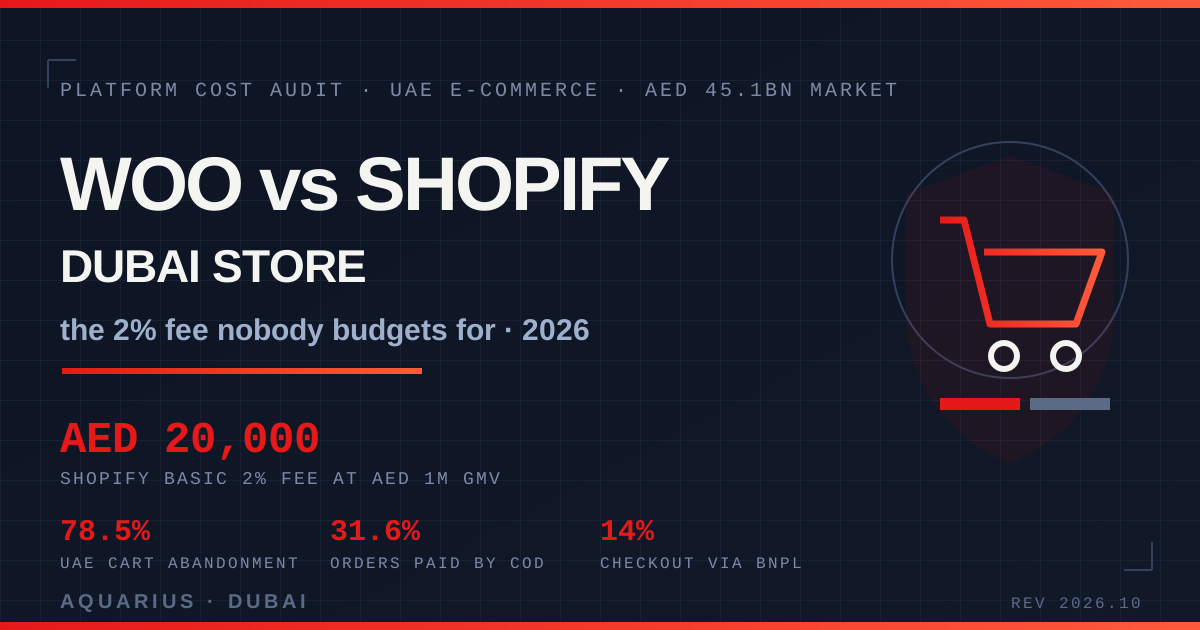
Short answer: for most Dubai stores in 2026 the honest comparison is not features, it is fees. Shopify costs USD 39–399 a month (Basic to Advanced, or USD 29–299 paid annually) plus an extra platform fee of 2% on Basic, 1% on Grow and 0.6% on Advanced on every order taken through a third-party gateway — which is still how most UAE merchants charge cards, because Shopify Payments in the UAE is only in a gated early-access rollout. WooCommerce has no per-order platform fee at all, but shifts that money into hosting, plugins and maintenance of roughly AED 18,000–55,000 a year once the store is doing real volume. Below AED 1 million GMV a well-run Shopify build is usually cheaper; above it, WooCommerce or a headless build usually wins.
Here is what most Dubai businesses get wrong: they compare the monthly plan price, sign up on Basic, connect PayTabs or Telr, and never notice the second fee. At AED 1,000,000 of annual sales that unnoticed 2% is AED 20,000 a year — on top of the gateway’s own 2.49–2.85%. It is the most expensive line item nobody put in the budget.
Key takeaways
- UAE e-commerce is worth about USD 12.3 billion (roughly AED 45.1 billion) in 2026 and is forecast to reach AED 67.2 billion by 2030 at a 9.9% CAGR, per the EZDubai and Euromonitor International report.
- Shopify’s third-party gateway fee is 2% / 1% / 0.6% / 0.2% on Basic / Grow / Advanced / Plus. It disappears only on Shopify Payments, which in the UAE is still an invite-based rollout.
- WooCommerce charges nothing per order, but a moderate store spends USD 2,500–6,000 a year on premium plugins alone, plus hosting and patching.
- UAE checkout reality: 31.6% of orders are cash on delivery (only 7–10% of value, 70–80% success) and BNPL is about 14% of checkout volume on major UAE stores, up from under 5% in 2022.
- The deadline that decides your 2027 architecture: FTA e-invoicing pilots from 1 July 2026, mandatory for large taxpayers 1 January 2027 and for SMEs 1 July 2027.
The Dubai numbers that frame the decision
This is not a hobby market any more. UAE e-commerce revenue reached roughly AED 42.2 billion in 2025 and about USD 12.3 billion in 2026, with online sales already 15.7% of total UAE retail and expected to pass 20% by 2030. Apparel and footwear alone was AED 11.4 billion in 2025.
Two local behaviours should shape the platform choice more than any feature list. First, cart abandonment in the UAE ran 78.0–78.5% in 2025, with mobile 2–3 percentage points worse than desktop — in a market where the large majority of discovery happens on a phone. Second, language: around 60% of UAE online shoppers prefer to browse in Arabic, and localising properly is repeatedly measured as a 25–40% conversion lift. A platform that makes bilingual Arabic and English with true right-to-left layout painful is costing you more than its licence fee.
Globally the two platforms are closer than the marketing suggests. WooCommerce is detected on 6.64% of measurable web origins versus Shopify’s 4.76% — a 1.40x lead — and Store Leads counts 4.34 million live WooCommerce stores against 2.84 million Shopify stores. Among the top one million sites the order flips: Shopify 6.08% to WooCommerce 3.12%. Translated: WooCommerce wins on raw footprint, Shopify wins among stores built specifically to transact at scale.
The 2% fee most Dubai merchants miss
Shopify’s own payment rails, Shopify Payments, remove the platform’s extra per-order fee. In the UAE that product has been rolling out in waves rather than switching on for everyone: it started with selected and Plus-level stores and was reported to extend to the Advanced plan on 26 August 2026, with no public UAE rate card published at the time of writing. Eligibility is visible only inside your own admin, under Settings and Payments.
So the practical position for a Dubai SME on Basic or Grow in 2026 is this: you charge cards through a UAE gateway — Telr at about 2.49% on local cards, PayTabs at 2.85% + AED 1, Tap at 2.75% + USD 0.30 — and Shopify adds its platform fee on top. WooCommerce never adds that second layer; you pay the gateway and nothing else per order.
| Cost line at AED 1m annual GMV | Shopify Basic + UAE gateway | Shopify Advanced + Shopify Payments* | WooCommerce + UAE gateway |
|---|---|---|---|
| Platform or licence | AED 1,290 (USD 29/mo annual) | AED 13,180 (USD 299/mo annual) | AED 0 (open source) |
| Hosting, plugins, patching | Included | Included | 18,000–55,000 |
| Gateway fee | 24,900–28,500 | Shopify Payments rate (UAE card rate not published) | 24,900–28,500 |
| Extra platform fee | 20,000 (2%) | 0 on Shopify Payments, or 6,000 (0.6%) if third-party | 0 |
| Indicative all-in | 46,000–50,000 | 38,000–48,000 | 43,000–84,000 |
*Shopify Payments availability in the UAE is granted store by store; treat the zero platform fee as conditional until you see it enabled in your own admin. Figures exclude VAT at 5%, apps, and your build cost.
Read the table the way a CFO would. On Basic, the platform fee is the swing factor, and it scales linearly with success — AED 20,000 at one million, AED 60,000 at three. On WooCommerce, the swing factor is operational: if nobody owns updates, backups and performance, the saving evaporates into downtime during a Ramadan or White Friday peak.
Where each platform actually wins in the UAE
Shopify wins when
- You are launching or relaunching fast and want a checkout that already converts on mobile without tuning.
- Your catalogue is straightforward — a few hundred to a few thousand SKUs, simple variants.
- You have no in-house technical owner. PCI scope, uptime and patching are Shopify’s problem, not yours.
- You are already at a volume where Advanced or Plus, plus Shopify Payments eligibility, kills the platform fee.
WooCommerce wins when
- Your margin cannot absorb a percentage-of-revenue platform fee — electronics, gold and jewellery, high-ticket furniture.
- You need odd commercial logic: B2B tiered pricing with TRN capture, quote-to-order, deposits on made-to-order items, trade accounts, multi-branch stock.
- Content and SEO drive your traffic and the store needs to live inside a large bilingual WordPress site.
- You want the data on infrastructure you choose, including UAE-region hosting for data-residency reasons.
One myth worth busting: “WooCommerce is free”. The plugin is free; the store is not. Managed hosting that survives UAE traffic spikes runs from roughly USD 25–300 a month on Cloudways-class infrastructure to USD 50–500 on WP Engine, and a moderate store spends USD 2,500–6,000 a year on premium plugins — security, backups, caching, SEO, payment and shipping extensions. Published 2026 benchmarks put annual maintenance at USD 5,000–15,000 for a store doing USD 50,000–500,000 GMV. Budget it, or it arrives as an emergency invoice.
Payments, BNPL and cash on delivery: the UAE checkout stack
Neither platform ships a UAE-ready checkout out of the box. Both need the same three local pieces, and getting the mix right moves revenue more than any theme choice.
Cards. Telr, PayTabs, Tap, Network International and Checkout.com all support AED and integrate with both platforms. Rates cluster at 2.49–2.85% plus a small fixed fee; renegotiate once you have three months of processing history.
BNPL. Tabby and Tamara are now roughly 14% of checkout volume on major UAE stores, up from under 5% in 2022, at merchant fees of about 2.99–3.99%. They convert: BNPL carries 8–12% of order share but 15–18% of value share, with a 92% success rate. From July 2026, Al Etihad Credit Bureau began including Tabby and Tamara data in UAE credit reports, which makes BNPL a mainstream credit product rather than a novelty. Both need their own app or plugin on either platform — see our guide to Tabby and Tamara integration for Dubai stores.
Cash on delivery. Still 31.6% of orders but only 7–10% of value, with a 70–80% success rate. COD is where margin dies quietly: failed deliveries, cash handling, returns. Both platforms can cap COD by order value or emirate — WooCommerce natively, Shopify through an app or checkout rules. Do it on day one.
VAT, TRN and the e-invoicing deadline that changes the maths
Your store has to issue a VAT-compliant tax invoice at 5%, display prices inclusive of VAT, and capture the buyer’s TRN on B2B orders. That is table stakes on both platforms.
What is not table stakes is what comes next. The UAE Federal Tax Authority e-invoicing programme runs pilots from 1 July 2026, requires businesses above AED 50 million revenue to have appointed an Accredited Service Provider by 30 October 2026, goes mandatory for large taxpayers on 1 January 2027 and reaches SMEs on 1 July 2027. Invoices must be issued in the PINT AE structured format through a five-corner Peppol model, with 51 mandatory fields on an electronic tax invoice and 49 on a commercial one, and more than 30 service providers accredited so far.
Practically, your store cannot be the end of the invoice chain — it has to hand clean, structured order data to an accounting system or service provider. WooCommerce gives you direct database and API access to build that integration. Shopify routes you through the Admin API and an app. Neither is a blocker; both are cheaper to design now than to retrofit under a deadline. Our UAE e-invoicing and ERP integration guide covers the data model in detail.
What a Dubai store actually costs to build in 2026
Platform fees are the running cost. Here is the build cost, in the AED ranges we quote in Dubai:
| Build | What is included | AED | Timeline |
|---|---|---|---|
| Shopify store, UAE-configured | Theme customisation, bilingual Arabic and English with RTL, UAE gateway, Tabby or Tamara, COD rules, VAT invoicing, analytics | 28,000–75,000 | 4–7 weeks |
| WooCommerce store, UAE-configured | Same scope on your own hosting, plus a performance budget, security hardening, staging and backup pipeline | 32,000–85,000 | 5–8 weeks |
| Headless build (Next.js front end) | Custom storefront with Shopify or Woo as the commerce engine, B2B pricing logic, ERP or accounting sync, e-invoicing-ready order payloads | 120,000–260,000 | 10–16 weeks |
| Annual run cost | Hosting or plan, plugins or apps, patching, monitoring, CRO iterations | 14,000–60,000 | ongoing |
The decision rule we give clients is deliberately unromantic. Under roughly AED 1 million of annual GMV with a simple catalogue, take Shopify, accept the fee, and spend the saved engineering budget on traffic and conversion. Above that, or with any non-standard commercial logic, model the platform fee over three years — it is usually the number that justifies WooCommerce or a headless build outright.
And do the abandonment maths before anything else. At a 78% abandonment rate, recovering four percentage points on a store doing AED 1 million is roughly AED 180,000 of additional revenue — which dwarfs the entire platform argument. Checkout speed, Arabic copy, visible COD and BNPL options and honest delivery dates are where that comes from.
How Aquarius approaches it
We have no house platform to defend. We start with your numbers — GMV, average order value, payment mix, catalogue complexity, who owns the store after launch — and run the three-year cost model in front of you before a line of code is written. Then we build on whichever platform wins, with a UAE checkout stack, bilingual Arabic and English, VAT and TRN handling, and order data structured for the e-invoicing mandate from day one. See our development services and transparent pricing, or send us your current store and we will tell you in one call what it is costing you in platform fees.
FAQ
Is Shopify Payments available in the UAE in 2026?
Partially. It launched for UAE merchants in a gated early-access rollout, starting with selected and Plus-level stores and reported to extend to the Advanced plan on 26 August 2026, with no public UAE rate card yet. Check Settings and Payments in your own Shopify admin — eligibility is granted store by store. Until it is enabled, you pay a third-party gateway plus Shopify’s platform fee.
How much is Shopify’s extra transaction fee?
2% on Basic, 1% on Grow, 0.6% on Advanced and 0.2% on Plus, charged on orders processed through any payment provider other than Shopify Payments. It is in addition to the gateway’s own 2.49–2.85% merchant rate.
Is WooCommerce really free for a Dubai business?
The plugin is. The store is not. Expect managed hosting from about USD 25–300 a month, USD 2,500–6,000 a year in premium plugins for a moderate store, and USD 5,000–15,000 a year in maintenance at USD 50,000–500,000 GMV. The trade is a fixed, predictable cost instead of a percentage of every order.
Which platform handles Arabic and RTL better?
Both can do it well; neither does it for free. Around 60% of UAE shoppers prefer browsing in Arabic and localisation is measured at a 25–40% conversion lift, so treat it as a build requirement, not a plugin. WooCommerce usually wins when the store sits inside a large bilingual content site; Shopify wins when you want a clean two-market setup with minimal engineering.
Will my store need to comply with UAE e-invoicing?
Yes, on a phased timeline: pilots from 1 July 2026, mandatory for large taxpayers on 1 January 2027, and for SMEs on 1 July 2027, in the PINT AE format through an Accredited Service Provider. Your store does not file the invoice itself, but it must pass complete, structured order and TRN data to whatever system does.
Can I move from Shopify to WooCommerce later without losing SEO?
Yes, with a proper redirect map, preserved URL structure and a staged cutover. Above AED 1 million GMV the platform-fee saving often funds the migration in its first year. Our guide to migrating a website without losing SEO covers the sequence.
Sources: EZDubai and Euromonitor International UAE e-commerce report; Mordor Intelligence UAE e-commerce market 2026; UAE Ministry of Finance and Federal Tax Authority e-invoicing guidance (version 1.1, June 2026); Al Etihad Credit Bureau BNPL reporting announcement; Shopify published plan pricing and transaction-fee schedule; BuiltWith and Store Leads platform share data; published 2026 WooCommerce cost benchmarks.