
Corporate Gifting & Web-to-Print Portals in Dubai (2026): The AED 500 VAT Rule
What a corporate gifting or web-to-print portal costs in Dubai in 2026 — AED build bands — plus the AED 500 VAT deemed-supply rule and the 50% corporate tax cap on client gifts.
- PUBLISHED
- 19 SEPT 2026
- READ TIME
- 11 MIN
- AUTHOR
- AQUARIUS · DUBAI
- UNIT
- REV 2026.09
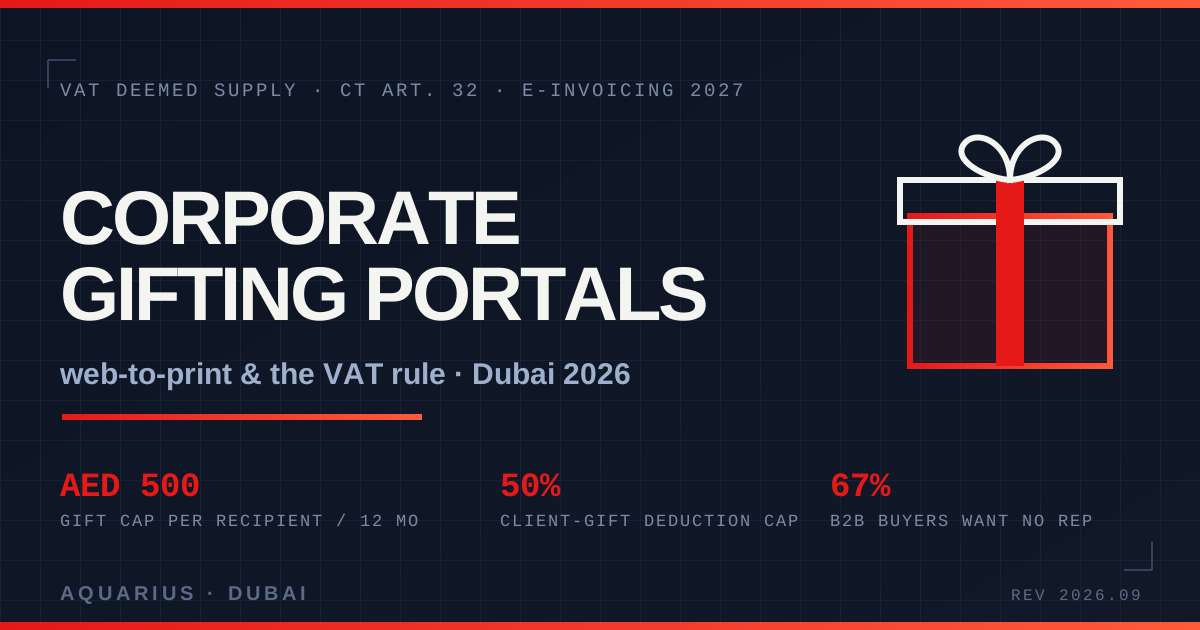
Short answer: A corporate gifting or web-to-print portal lets Dubai clients configure, brand-check and reorder gifts and printed items themselves, with approvals, budgets and VAT handled at checkout. Build cost in the UAE runs roughly AED 45,000–90,000 for a branded ordering storefront, AED 110,000–240,000 for a full web-to-print configurator with artwork proofing, and AED 260,000–500,000+ for a multi-brand procurement platform.
Here is the part almost nobody prices in: under UAE VAT, a business gift can stop being a gift and become a deemed supply you owe output tax on. The line sits at AED 500 per recipient per 12 months. Most Dubai gifting programmes cross it at Ramadan and never record it.
Key takeaways
- AED 500 is the number to build into your portal. Samples and commercial gifts to one recipient inside a 12-month period are excluded from deemed supply only up to AED 500 in value.
- AED 2,000 is the second escape hatch. If total output tax on all your deemed supplies across 12 months stays under AED 2,000, no VAT is due — a threshold you cannot evidence without per-recipient records.
- Client gifts are only 50% deductible under Article 32 of the UAE Corporate Tax Law, and gifts with no business connection are disallowed entirely.
- 67% of B2B buyers now prefer a rep-free buying experience (Gartner, March 2026) — up from 61% a year earlier. Your WhatsApp-and-PDF gifting process is the friction.
- E-invoicing is coming for the paperwork: mandatory from 1 January 2027 for businesses at AED 50 million or more in revenue, 1 July 2027 for the rest.
Why Dubai corporate gifting moved online in 2026
The category is enormous and still compounding. The Business Research Company sizes the global gifting market at about USD 956.9 billion in 2026, up from USD 886.6 billion in 2025, and on track for roughly USD 1.31 trillion by 2030 at around an 8% CAGR. Corporate gifting is the part of that spend that recurs on a calendar — Ramadan and Eid, UAE National Day on 2 December, year-end client packs, onboarding kits, conference giveaways at GITEX and Gulfood.
Buying behaviour moved faster than most UAE suppliers did. Gartner's March 2026 sales survey of 646 B2B buyers found 67% prefer a rep-free buying experience, up from 61% the year before, 70% want a completely digital, self-service purchase, and 45% used AI during a recent purchase. A marketing manager sourcing 400 branded notebooks at 11pm does not want to wait for a quotation email in the morning.
The commerce infrastructure caught up too. UAE e-commerce is worth roughly USD 12.3 billion in 2026 and is forecast to reach about USD 21 billion by 2031, with B2B the fastest-growing slice at around a 17.4% CAGR. On the supply side, the global web-to-print software market sits at roughly USD 1.7–2.0 billion in 2026 depending on whose definition you take, growing 7–8% a year, while UAE digital printing revenue is projected to climb from USD 655.5 million in 2023 to USD 917 million by 2030.
Translation for a Dubai supplier: the demand is there, the buyers want to self-serve, and the software to let them is now commodity-priced compared with the margin it protects.
Myth-bust: “gifts are just a marketing expense”
This is where Dubai gifting budgets quietly leak money. Two separate tax rules apply to the same box of dates, and most companies apply neither.
1. VAT: the deemed supply trap
When you give away goods on which you recovered input VAT, the Federal Tax Authority can treat that give-away as a deemed supply — a sale you must account for output VAT on, even though no money changed hands. Two exceptions save most small gifting, and both are thresholds you have to be able to prove:
| Threshold | Measured over | What it means in practice |
|---|---|---|
| AED 500 of goods per recipient | Rolling 12 months | Samples and commercial gifts to one person stay outside deemed supply up to this value. The 400th mug is fine; the AED 900 leather set to the same client twice in a year is not. |
| AED 2,000 of total output tax | Rolling 12 months | If output tax on all deemed supplies combined stays under this, no VAT is due. At 5%, that is roughly AED 40,000 of give-away value across the business. |
Notice what both thresholds require: per-recipient, date-stamped records across a rolling year. A spreadsheet rebuilt every December cannot produce that. A portal that records who ordered what, for whom, at what value, produces it automatically.
2. Corporate tax: the 50% haircut
Under Article 32 of Federal Decree-Law No. 47 of 2022, only 50% of entertainment expenditure incurred on customers, shareholders, suppliers and other business partners is deductible — and client gifts fall inside that definition. Gifts with no genuine business connection are disallowed outright under Article 28. The FTA expects you to keep the recipient, the occasion and the business reason on file. Purely internal staff gifting is treated differently and is generally fully deductible as staff welfare, which is exactly why your system needs to separate client orders from employee orders at the point of checkout rather than at audit.
Get those two rules wrong and a AED 300,000 gifting year can cost materially more than budgeted, with the difference showing up as unrecoverable VAT and disallowed deductions months later. Our guide to corporate tax and accounting software for Dubai SMEs covers the wider record-keeping picture.
What a corporate gifting and web-to-print portal actually does
“Put the catalogue online” is not the product. The portal earns its cost by removing three specific jobs from your team: quoting, artwork chasing, and reordering. A serious build covers:
- Live configurator and instant pricing — quantity breaks, branding method (pad print, embroidery, laser, UV), number of print positions and setup fees priced in the browser, not in an emailed quotation.
- Artwork upload with preflight — resolution, bleed, colour mode and safe-area checks at upload, plus a rendered 3D or mock-up proof the client approves online. This is the single largest source of production delay in Dubai print jobs.
- Brand lock — approved logos, fonts and Pantone values stored per client, so a regional office cannot order a stretched logo in the wrong red.
- Corporate accounts with roles and budgets — requester, approver, finance. Spend limits per department, approval thresholds, and a purchase-order field on the cart.
- Per-recipient gifting records — the AED 500 and AED 2,000 tracking above, plus a client/employee flag for the Article 32 split.
- Arabic and English, RTL-correct — bilingual product data and invoices, since a Dubai gifting portal serves both procurement teams and government clients. See our Arabic and RTL localisation guide.
- Reorder in one click — last year's artwork, sizes and delivery list saved. Reorder is where portal margin actually lives.
- Multi-address split delivery — 60 boxes to Business Bay, 12 to Abu Dhabi, 8 couriered to Riyadh, one manifest.
- Payments and TRN-compliant tax invoices — card, bank transfer and credit terms, with correct VAT treatment per line.
The 2027 deadline that changes your invoicing
If you are building a portal in 2026, build it knowing what lands next. The UAE's e-invoicing framework, set out in Ministerial Decision No. 243 of 2025, uses a Peppol-based five-corner model on the UAE PINT AE standard. The timeline:
| Date | What happens |
|---|---|
| 1 July 2026 | Voluntary e-invoicing opens |
| 30 October 2026 | Businesses with AED 50m+ annual revenue must have appointed an Accredited Service Provider |
| 1 January 2027 | Mandatory for businesses at AED 50m+ revenue |
| 31 March 2027 | All remaining businesses must have appointed an ASP |
| 1 July 2027 | Mandatory for the rest |
| 1 October 2027 | Government entities |
B2B and B2G transactions are in scope; B2C is not. For a gifting portal that is almost entirely B2B, the practical instruction is simple: capture the buyer's TRN, legal entity name and address as structured fields from day one, and keep invoice data machine-readable rather than only rendering a PDF. Retrofitting that later costs more than building it now. We covered the mechanics in VAT-compliant e-commerce invoicing and UAE e-invoicing.
What it costs in Dubai, and what comes back
Bands below reflect what these builds go for in the Dubai market in 2026. Scope, not vendor, is what moves you inside a range.
| Build tier | Typical 2026 cost | What you get |
|---|---|---|
| Branded gifting storefront | AED 45,000–90,000 | Catalogue, quantity-break pricing, logo upload, corporate accounts, VAT-correct checkout |
| Web-to-print configurator | AED 110,000–240,000 | Live product personalisation, preflight and online proofing, brand lock, approval workflow, split delivery |
| Multi-brand procurement platform | AED 260,000–500,000+ | Multiple client portals, budgets and cost centres, ERP/stock integration, redemption points, API ordering |
| Licensed web-to-print SaaS instead | AED 1,800–9,000 / month | Faster start, recurring fee, limited control over pricing logic and local tax rules |
| Annual maintenance and hosting | 15–20% of build / year | Security patching, catalogue updates, UAE-region hosting, support |
The return is measurable, and worth measuring properly — because most companies do not. In one 2026 survey of 85 UK HR professionals, 65.9% believed gifting improved retention, but only 2.1% had actually measured an improvement and 1.6% formally tracked gifting ROI. Meanwhile over 80% of C-suite executives say corporate gifts deliver a measurable return, and 43% of companies name improved customer retention as their main reason for gifting. The classic retention economics still apply: a 5% lift in retention is associated with profit increases of 25% to 95%.
For a supplier, the arithmetic is more direct. If your team spends 12 hours a week producing quotations and chasing artwork, that is roughly 600 hours a year. At a conservative loaded cost, a mid-tier portal pays for itself on recovered hours alone before you count the orders you currently lose to whoever replied first. Add reorders — where a saved artwork file turns a two-week cycle into a two-minute one — and the payback window shortens again.
Build, licence, or bolt onto Shopify?
Three honest options, in rising order of control:
- Shopify or WooCommerce plus a personalisation app. Fastest and cheapest. Fine for fixed SKUs with a logo drop. It falls over on quantity-break pricing with setup fees, multi-position branding, approval chains and per-recipient gift records. See our Shopify build costs for Dubai.
- Licensed web-to-print SaaS. Mature configurators and preflight out of the box, monthly fee forever, and you adapt your pricing model to theirs. UAE tax fields and Arabic RTL usually need custom work anyway.
- Custom build. Right when your pricing logic is your competitive advantage, when you serve named corporate accounts with contract catalogues, or when procurement integration is part of the pitch. Compare the wider trade-off in our B2B wholesale portal guide.
How Aquarius builds gifting and print portals
Aquarius sits on both sides of this job: we run corporate gifting, large-format printing, signage and packaging production in Dubai, and we build the web and app platforms that sell them. That combination shows up in the details:
- Pricing engines that match real production — setup charges, plate and screen costs, quantity breaks and rush fees modelled the way your factory actually quotes.
- Preflight that rejects bad artwork before it reaches the press, not after.
- UAE tax handled in the data model — per-recipient gift values, client-versus-staff flags, TRN capture and e-invoice-ready invoice records.
- Bilingual by default, with Arabic RTL treated as a first-class layout rather than a translation pass.
- UAE-region hosting and PDPL-aware handling of recipient data — gifting lists are personal data. See our PDPL compliance checklist.
If you are scoping this quarter, our pricing page shows how we band projects and what we build covers the full stack.
Frequently asked questions
Do I have to pay VAT on corporate gifts in the UAE?
Sometimes. Giving away goods you recovered input VAT on can be treated as a deemed supply with output VAT due. Two exceptions apply over a rolling 12-month period: gifts and samples to a single recipient up to AED 500 in value, and total output tax on all deemed supplies staying below AED 2,000. Both require per-recipient records to evidence, which is why gifting spend should be tracked in a system rather than a spreadsheet.
Are client gifts tax deductible under UAE corporate tax?
Only half. Article 32 of Federal Decree-Law No. 47 of 2022 allows a 50% deduction on entertainment expenditure incurred on customers, shareholders, suppliers and other business partners, and client gifts sit inside that category. Gifts with no genuine business connection are disallowed entirely. Keep the recipient, occasion and business reason recorded for each gift.
How much does a web-to-print portal cost in Dubai?
A branded gifting storefront runs about AED 45,000 to 90,000. A full web-to-print configurator with artwork preflight, online proofing and approval workflows runs about AED 110,000 to 240,000. A multi-brand procurement platform with ERP integration starts around AED 260,000. Licensed SaaS alternatives typically cost AED 1,800 to 9,000 per month.
What is web-to-print software?
Web-to-print software lets customers configure and personalise a printed or branded product online — choosing size, material, branding method and artwork — then see live pricing, approve a digital proof and order without a salesperson. For corporate gifting it adds brand control, approval chains and reordering from saved artwork.
Will UAE e-invoicing affect my gifting portal?
Yes, on a known schedule. E-invoicing under Ministerial Decision No. 243 of 2025 becomes mandatory from 1 January 2027 for businesses with AED 50 million or more in annual revenue and from 1 July 2027 for the rest, with ASP appointment deadlines of 30 October 2026 and 31 March 2027 respectively. B2B and B2G invoices are in scope, so capture buyer TRN and legal entity data as structured fields now.
Should a gifting supplier build custom or use Shopify?
Use Shopify with a personalisation app if you sell fixed SKUs with a simple logo drop and want to launch quickly. Build custom when your quantity-break and setup-fee pricing is your competitive advantage, when named corporate accounts need contract catalogues and approval chains, or when you must track per-recipient gift values for UAE tax purposes.
Selling gifts or print to Dubai corporates? Talk to Aquarius about a portal that quotes for you at 11pm — and keeps the FTA records while it does it.