
E-commerce Returns in Dubai (2026): What Reverse Logistics Really Costs in AED
COD orders in the UAE come back 28-35% of the time versus 4-8% prepaid. Real 2026 AED costs to process a return in Dubai, what UAE law actually requires, and the returns portal that stops the leak.
- PUBLISHED
- 07 OCT 2026
- READ TIME
- 12 MIN
- AUTHOR
- AQUARIUS · DUBAI
- UNIT
- REV 2026.09
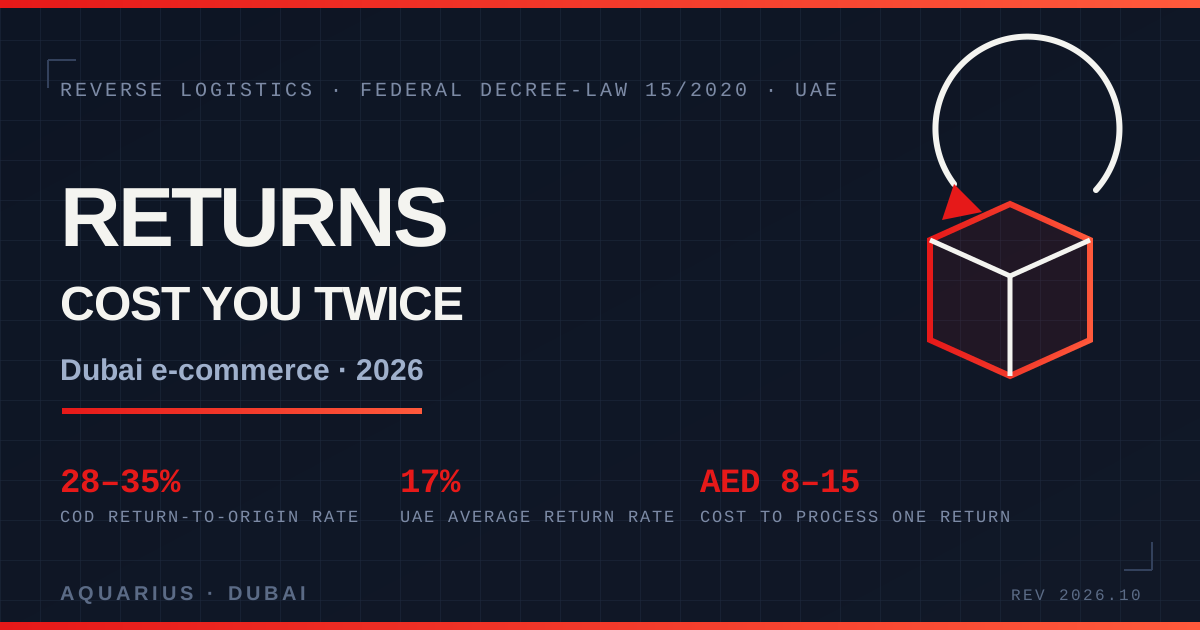
Short answer: processing a single e-commerce return in the UAE costs roughly AED 8 to AED 15 in handling alone, before you add the return leg of shipping, the lost forward freight and the margin written off on anything you cannot resell at full price. The UAE average return rate sits near 17% of orders and apparel near 26% — but the number that actually decides whether a Dubai store is profitable is the payment method: cash-on-delivery orders come back at a 28% to 35% return-to-origin rate against just 4% to 8% for prepaid.
That gap is the whole story. The UAE e-commerce market reached USD 12.3 billion (about AED 45.1 billion) in 2026, and 71.2% of UAE online retailers still offer cash on delivery, which accounts for roughly 30% of orders. Meanwhile the UAE reverse logistics solutions market is forecast to reach USD 5.2 billion by 2030 at a 12.5% CAGR — an entire industry growing on the back of parcels that went out and came straight back.
Key takeaways
- Returns are a payments problem before they are a logistics problem. A store at 30% COD with a 30% RTO rate on those orders is quietly failing roughly 9% of all orders before a customer has even opened the box.
- Most Dubai businesses get this wrong: they assume UAE law hands every online shopper a 14-day cooling-off right. It does not. There is no universal statutory change-of-mind window for UAE e-commerce — your published return policy is the contract you will be held to, and failing to honour it is what triggers enforcement.
- Manual return handling runs about USD 10 to 15 per return in labour; automated intake drops that to under USD 2. At 300 returns a month that is roughly AED 14,000 a month of avoidable labour.
- 90% of shoppers read the return policy before they buy and 76% will not buy again after a bad return experience (Narvar, 2025 State of Post-Purchase). Returns are an acquisition channel disguised as a cost centre.
- Penalties under the UAE Consumer Protection framework reach AED 1 million in administrative fines, plus suspension of activity for up to 90 days or licence revocation.
Why the Dubai returns problem is really a payments problem
Every market has returns. What makes the UAE distinctive is how many of them never reach the return stage at all, because the order fails on the doorstep. Cash on delivery remains normal here: 71.2% of UAE retailers offer it and it still carries around 30% of orders, even as digital wallets passed 53% of all transactions in early 2026 and roughly 80% of UAE payments went digital.
The economics of a COD failure are brutal, and they are different from a normal return. On a return-to-origin you pay the forward delivery, you pay the return leg, you pay the warehouse to receive and re-grade the item, and you collect nothing. With published RTO rates of 28% to 35% on COD against 4% to 8% prepaid, a Dubai store running a third of its volume on cash is losing double-digit percentages of its logistics budget to parcels that were never going to convert.
Run the arithmetic on a store doing 2,000 orders a month at an AED 250 average basket. If 30% are COD and a third of those come back untouched, that is about 200 dead orders a month — roughly AED 50,000 of gross merchandise value that evaporates, plus two shipping legs on each one. Then the genuine returns arrive on top, at the market-average 17%, or 26% if you sell apparel. This is why the fix starts at checkout, not at the warehouse door: partial prepayment, COD caps by basket value, address verification and order confirmation before dispatch. We cover the checkout side of that in our guide to last-mile delivery and COD integration for Dubai e-commerce.
What UAE law actually requires — and the myth to retire
The popular belief in Dubai e-commerce circles is that Federal Decree-Law No. 15 of 2020 on Consumer Protection, with its Executive Regulations under Cabinet Decision No. 66 of 2023 (in force since October 2023), grants every online shopper an automatic 14-day right to change their mind. That is not what the framework does.
Unlike the EU, UAE law does not impose a universal cooling-off period for change-of-mind returns on e-commerce. What it does impose is heavier than most merchants realise:
- Your published policy binds you. If you advertise a 14-day or 30-day return window, that is an enforceable commitment. Many UAE platforms publish 14 days voluntarily and are then held to it — including the refund turnaround they promise.
- Defective, unsafe or misdescribed goods are a statutory right, not a courtesy. Repair, replacement or refund must be available, and your policy cannot contract that away.
- Unfair contract terms are void. A no-returns-under-any-circumstances clause, or one letting you cancel unilaterally without compensation, is unenforceable and counts against you in a complaint.
- Refunds go back to the original payment method. You cannot quietly convert a card refund into store credit without consent — which is a real engineering requirement when the original tender was cash.
- Disclosure timing matters. The Executive Regulations even require notifying a consumer of a promotion falling within one week of their purchase, and delivering agency-covered spare parts within 30 days of request.
- Enforcement has teeth: administrative fines up to AED 1 million, suspension of activity up to 90 days, and in serious cases licence revocation.
The practical consequence for a Dubai store is counter-intuitive. Because the law leaves the change-of-mind window to you, your competitive advantage is in designing a window you can actually operate — and then honouring it mechanically, every time, with an audit trail. A generous policy you cannot execute is a bigger legal and reputational risk than a tighter one you always meet.
One cross-border wrinkle Dubai merchants miss: for returns of imported goods, dutiable items generally need to be re-declared before you refund the customer, while courier shipments under the AED 1,000 threshold move through a simplified path. Our breakdown of the AED 1,000 Dubai Customs e-commerce duty exemption explains where that line sits.
The real AED cost of one return in Dubai (2026)
Most merchants only count the return shipping label. Here is the full stack for a single returned item in the UAE, using published 2026 handling figures plus typical Dubai operating costs. Treat these as planning bands, not a quote: your freight rates, warehouse model and category drive the range.
| Cost line | Typical 2026 cost (AED) | Unit | Notes |
|---|---|---|---|
| Return handling and processing | 8 – 15 | per return | Published UAE average: receive, inspect, grade, restock |
| Manual labour overhead (no automation) | 37 – 55 | per return | USD 10–15 per return in labour alone; automation cuts it to under USD 2 |
| Reverse pickup leg (intra-Dubai) | 12 – 25 | per parcel | Higher for scheduled or same-day pickup windows |
| Reverse pickup leg (other emirates) | 20 – 40 | per parcel | Northern Emirates and Al Ain add distance cost |
| Lost forward freight on an RTO | 12 – 30 | per failed order | You paid to deliver an order that was never accepted |
| COD collection fee (unrecovered) | 5 – 15 | per failed order | Charged on attempt by several UAE carriers |
| Payment-gateway refund cost | 0 – 12 | per refund | Many UAE gateways do not return the original MDR on a refund |
| Repack / refurbish to resale grade | 10 – 60 | per item | Apparel is cheap to re-grade; electronics are not |
| Markdown on B-grade resale | 15 – 40% of item value | per item | Usually the single biggest line, and the least tracked |
| Write-off / disposal | 100% of cost | per item | Opened consumables, cosmetics, perishables, damaged goods |
Two things fall out of that table. First, the shipping label is rarely the expensive part — labour and markdown are. Second, the lines you can automate away (intake, grading decisions, refund execution, carrier booking) are exactly the lines that scale linearly with order volume, which is why a mid-size Dubai store feels returns pain abruptly rather than gradually.
What a returns portal actually has to do
A returns portal is not a form. It is a decision engine that sits between your storefront, your warehouse, your carrier and your payment gateway, and its job is to make the cheap outcome the default one. The build has five parts.
1. Self-serve intake with eligibility logic
The customer enters order number plus phone or email, sees only the items still inside your published window, picks a reason from a structured list, and gets an instant decision. Eligibility rules live in code — window length by category, non-returnable SKUs, hygiene and final-sale flags, condition declarations. No human reads an email. This single step is what moves you from USD 10–15 of labour per return to under USD 2.
2. A reason taxonomy you can act on
"Changed my mind" is a dead end. "Smaller than expected", "colour differs from photo", "two sizes ordered, keeping one", "arrived damaged" each point at a fixable upstream cause. Tag reasons per SKU, surface the top offenders weekly, and the top five reasons will usually name three product pages that need better photography, a size chart, or an Arabic description. That is the loop that reduces the 17% base rate instead of just processing it faster.
3. Exchange and credit offered before refund
Present the cheapest resolution first: same item different size, store credit at a small bonus, then cash refund. Exchanges keep the revenue and often ship from stock you already hold. This is the highest-ROI screen in the whole portal, and it is a UI decision, not a logistics one.
4. Carrier pickup booking and bilingual tracking
Book the reverse leg from inside the portal, generate the label, and send Arabic and English status updates over WhatsApp or SMS. Dubai customers do not check email for parcel status. Full RTL support is not optional here — a returns flow that breaks into English is where trust is lost on an already negative interaction.
5. Refund execution with an audit trail
The hardest engineering in the stack. Card refunds go back to the original card via the gateway API. COD refunds need a bank-transfer or wallet path with IBAN capture and verification, because there is no card to credit. Every state change — requested, approved, picked up, received, graded, refunded — needs a timestamp and an actor, so that when a consumer complaint arrives you can show the policy was met. That audit trail is also your defence on disputes; see our guide to chargeback and fraud prevention for Dubai e-commerce.
If your warehouse side is still spreadsheets, the grading and restock half belongs in a proper system rather than the portal — our Dubai warehouse management system guide covers that layer. And every refund has a tax leg: credit notes have to reconcile against the original invoice, which matters increasingly as UAE e-invoicing comes into force.
What it costs to build in Dubai in 2026
These are our build bands for the returns layer specifically, assuming an existing storefront on Shopify, WooCommerce, Magento or a custom Next.js stack. Prices are indicative scopes, not a quote.
| Scope | Build cost (AED) | Timeline | What you get |
|---|---|---|---|
| Policy and flow design only | 6,000 – 12,000 | 1 – 2 weeks | UAE-compliant policy copy (AR/EN), eligibility matrix, cost-per-return model |
| Self-serve returns portal (MVP) | 22,000 – 45,000 | 3 – 5 weeks | Intake, eligibility engine, reason taxonomy, admin queue, email/WhatsApp notifications |
| Carrier integration (reverse pickup) | 12,000 – 28,000 | 2 – 3 weeks | Pickup booking, label generation, status webhooks, one or two UAE carriers |
| Automated refund execution | 15,000 – 35,000 | 2 – 4 weeks | Gateway refund API, COD bank-transfer path with IBAN capture, full audit log |
| Exchange and store-credit engine | 14,000 – 30,000 | 2 – 3 weeks | Size/variant swap, credit issuance, stock reservation, bonus-credit rules |
| Returns analytics dashboard | 10,000 – 24,000 | 1 – 3 weeks | Rate by SKU, category and reason, cost-per-return, RTO by payment method and emirate |
| Full integrated build (all of the above) | 75,000 – 150,000 | 8 – 14 weeks | End-to-end portal, carrier + gateway integration, WMS hooks, AR/EN, dashboard |
| Ongoing support and iteration | 2,500 – 8,000 / month | — | Carrier/gateway API changes, policy updates, reason-code tuning |
Now the payback, which is unusually easy to compute for this kind of build. A store processing 300 returns a month at manual labour of USD 10–15 each is spending roughly AED 11,000 to 16,500 a month on handling labour. Automated intake at under USD 2 per return takes that to about AED 2,200. That is a saving near AED 9,000 to 14,000 a month, which pays back a AED 35,000 MVP portal in roughly three to four months — before counting a single recovered sale from an exchange instead of a refund, or a single avoided COD failure.
And the revenue side is the larger half. With 90% of shoppers reading the return policy before buying and 76% refusing to buy again after a bad return experience, the returns flow is doing conversion work on every product page whether you have invested in it or not. In a market where AED 45.1 billion moves online and acquisition costs keep climbing, losing three-quarters of a customer base you already paid for is the most expensive line in this entire article.
How Aquarius builds it
We start with your numbers, not a product demo. First we model your actual cost per return and your RTO rate split by payment method and emirate — most Dubai merchants have never seen that split, and it usually reframes the project. Then we write the policy you can genuinely operate, in Arabic and English, and only then do we build the portal that enforces it automatically.
Delivery is phased so you bank savings before the full scope is done: intake and eligibility first, because that is where the labour sits; then refund automation; then exchanges and the analytics loop that drives the base return rate down. Risk reversal: fixed scope and fixed price per phase, a working staging environment you test against your own order data before launch, and you own the code and the repository. See our pricing for how the phases are packaged, or read how we approach e-commerce builds and UAE payment gateways more broadly.
If returns are eating your margin and nobody in the business can tell you what one costs, that is the first thing worth fixing. Tell us your order volume and payment mix and we will come back with your cost-per-return model and a phased build plan.
FAQ
Does UAE law give online shoppers a 14-day return right?
No — not as a universal statutory right. UAE law does not impose a general cooling-off period for change-of-mind returns in e-commerce. Federal Decree-Law No. 15 of 2020 and its Executive Regulations under Cabinet Decision No. 66 of 2023 require you to publish a clear return policy, prohibit unfair terms, and guarantee remedies for defective, unsafe or misdescribed goods. Many UAE platforms publish a 14-day window voluntarily, and once published it binds them. Non-compliance can draw administrative fines up to AED 1 million and suspension of activity for up to 90 days.
What does it cost to process one return in the UAE?
Handling alone averages AED 8 to AED 15 per return. On top of that sit the reverse pickup leg (roughly AED 12 to 40 depending on emirate), any unrecovered forward freight and COD collection fees on a failed delivery, gateway refund costs, repack or refurbishment, and the markdown on B-grade resale, which is typically 15% to 40% of item value and the largest hidden line. Manual labour adds a further USD 10 to 15 per return unless intake is automated.
Why are cash-on-delivery returns so much worse in Dubai?
Because COD lets a customer commit to nothing. Published UAE figures put return-to-origin on COD orders at 28% to 35%, against 4% to 8% for prepaid. With 71.2% of UAE retailers offering COD and about 30% of orders using it, a typical store is failing a meaningful share of volume at the doorstep. The fixes are commercial before they are technical: partial prepayment, COD caps above a basket threshold, address and phone verification, and a confirmation step before dispatch.
Should a Dubai store build a returns portal or buy an off-the-shelf app?
If you are on Shopify with a single currency, one carrier and card-only checkout, an app will often do. Build becomes the right answer when you have COD refunds (no card to credit, so you need an IBAN and bank-transfer path), Arabic and RTL requirements, multiple UAE carriers, cross-border returns needing customs re-declaration, or an ERP and warehouse system that has to stay in sync. Those four conditions describe most serious Dubai retailers, and they are exactly where generic apps stop.
How long does a returns portal take to build?
A self-serve MVP covering intake, eligibility and an admin queue is typically 3 to 5 weeks. Adding carrier pickup booking and automated refund execution brings it to roughly 7 to 10 weeks. A full integrated build with exchanges, WMS hooks, bilingual notifications and an analytics dashboard runs 8 to 14 weeks, usually phased so the labour savings start landing after the first release.