
Health Supplement E-commerce in Dubai (2026): EDE Registration Costs, AED 7,000 Per Product, and the Claims That Get You Delisted
You cannot sell supplements online in the UAE until the product is registered, and since 29 December 2025 the regulator is the EDE, not MOHAP. Real 2026 AED fees, build costs and the claim rules behind delistings.
- PUBLISHED
- 08 OCT 2026
- READ TIME
- 12 MIN
- AUTHOR
- AQUARIUS · DUBAI
- UNIT
- REV 2026.09
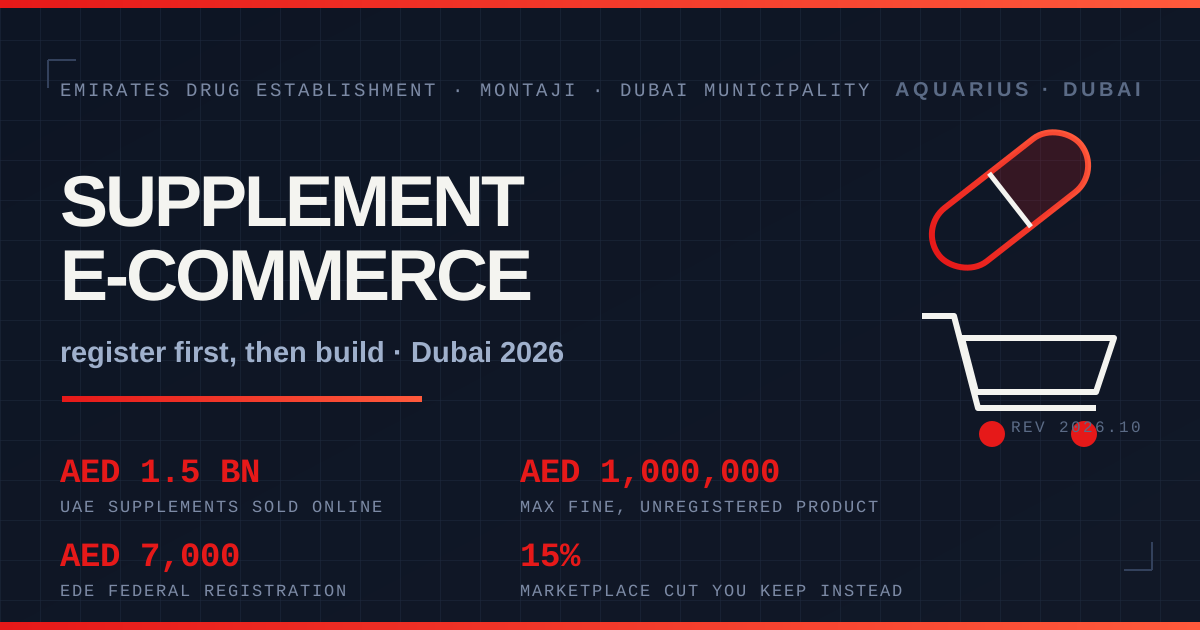
Short answer: You cannot legally sell a health supplement online in the UAE until the product itself is registered — and since 29 December 2025 the federal registration authority is no longer MOHAP but the new Emirates Drug Establishment (EDE). Budget AED 7,000 per product plus roughly AED 4,100 in analysis and certificate fees for the federal EDE route, or roughly AED 230–600 per product plus AED 200 per label for the Dubai Municipality Montaji route if you are selling within Dubai. The store itself costs AED 28,000–75,000 for a compliance-aware Shopify build or AED 95,000–260,000 custom with subscriptions, batch tracking and Arabic labelling built in. The expensive mistake is never the website. It is listing an unregistered SKU: exposure runs to AED 1 million federally, with customs seizure and marketplace account suspension on top.
Key takeaways
- The market is real and growing fast: the UAE dietary supplements market is worth about USD 687.98 million in 2026 and is compounding at 11.30% a year toward USD 1.80 billion by 2035. Online supplement sales have already reached roughly AED 1.5 billion.
- Buyers are already online: around 85% of UAE consumers prefer to buy health products online, against 99% internet penetration. 55% say they buy supplements specifically for immunity and general health.
- Your regulator changed in December 2025: under Federal Decree-Law No. 38 of 2024, health-product registration moved from MOHAP to the EDE (ede.gov.ae) effective 29 December 2025. Guides and consultants still pointing you at the MOHAP portal are out of date.
- Two routes, a 20x cost difference: EDE federal registration is AED 100 application + AED 7,000 registration + AED 3,500 analysis + AED 500 pricing certificate, in 30–60 working days. Dubai Municipality Montaji is roughly AED 230–600 per product in 4–8 weeks. Both authorisations last 5 years.
- Marketplaces now gate on it: both Amazon.ae and noon require proof of lawful registration before they will activate a supplement listing — and Amazon takes a 15% referral fee on health and personal care items priced above AED 50, plus AED 7.20–17.50 per unit fulfilment and AED 184 a month.
An AED 1.5 billion online category that half its sellers are not licensed to touch
Three numbers explain why supplement e-commerce is one of the better retail bets in the UAE right now, and why it is also one of the riskiest to launch sloppily.
- The category is scaling. The UAE dietary supplements market sits at roughly USD 687.98 million in 2026, growing at an 11.30% CAGR through 2035 to about USD 1,803.15 million. The wider UAE consumer health market is around USD 0.90 billion in 2026.
- It has already moved online. E-commerce supplement sales in the UAE have climbed to roughly AED 1.5 billion, with about 85% of consumers saying they prefer buying health products online. UAE healthcare e-commerce generated around USD 151 million in 2025 and is growing 10–15% year on year. All of this sits inside a UAE e-commerce market worth USD 12.30 billion in 2026, heading to USD 21.01 billion by 2031.
- Demand is health-led, not fad-led. About 55% of UAE consumers report buying supplements to support immunity and general health, and the Ministry of Health and Prevention has recorded a 20% rise in vitamin and mineral sales. That is the profile of a repeat-purchase category, which is exactly why subscription mechanics matter more here than in fashion or electronics.
Here is what most Dubai businesses get wrong. They treat a supplement store as a normal store. They pick a theme, wire up a payment gateway, import a spreadsheet of SKUs from a supplier in Europe or India, and go live in three weeks. Then the first container is held at customs, or noon freezes the listing, or an inspector reads the product page copy. Registration is not paperwork you catch up on after launch — importing, selling, manufacturing or advertising an unregistered supplement is prohibited outright, and selling one containing a banned ingredient is a criminal offence, not a fine.
The registration change most sellers missed: MOHAP is not your regulator any more
This is the single most important compliance fact of 2026 for this category. Under Federal Decree-Law No. 38 of 2024, pharmaceutical and health-product registration transferred from the Ministry of Health and Prevention to the newly created Emirates Drug Establishment, effective 29 December 2025. Submissions now go through ede.gov.ae.
The practical consequences are immediate:
- Half the guidance online is stale. Any consultant, checklist or blog post routing you to the old MOHAP supplement portal is describing a workflow that closed at the end of 2025. Verify the authority before you pay anyone a registration fee.
- The federal route is for federal ambitions. EDE is the correct path for supplements carrying therapeutic-adjacent claims, containing pharmaceutical-grade actives, or intended for distribution across multiple emirates at once.
- Dubai-only sellers have a cheaper option. Dubai Municipality still runs emirate-level registration through the Montaji platform, with Abu Dhabi handled by ADAFSA. If your sales are Dubai-centric, Montaji is dramatically cheaper and faster.
- Penalties are tiered and serious. Dubai Municipality fines run AED 10,000 to AED 50,000 per violation. EDE exposure reaches AED 1 million, with criminal prosecution available in serious cases, plus customs seizure, warehouse stock freezes and marketplace account suspension.
Two registration routes, two very different bills
Pick the route that matches your distribution plan, not the one a forwarder recommends. Published fee structures for 2026:
| Item | EDE (federal) | Dubai Municipality (Montaji) |
|---|---|---|
| Application fee | AED 100 | AED 10 processing |
| Registration per product | AED 7,000 | Approx. AED 230–600 |
| Product analysis / re-analysis | AED 3,500 | AED 100–250 per test if requested |
| Pricing certificate | AED 500 | AED 220 for a printed certificate |
| Label assessment | Part of dossier review | AED 200 per label design (2–4 working days) |
| Timeline | 30–60 working days; 3–6 months for novel ingredients | 4–8 weeks |
| Validity | 5 years | 5 years |
| Indicative cost, 20 SKUs | Approx. AED 222,000 | Approx. AED 12,000–20,000 |
That last row is the decision. A 20-SKU catalogue registered federally is a six-figure commitment before a single bottle ships; the same catalogue registered in Dubai is a rounding error against your build budget. Most first-time brands should launch Dubai-only on Montaji, prove sell-through, then fund the EDE dossiers for the five SKUs that actually earn national distribution.
Either route needs the same dossier spine: a UAE trade licence carrying the health supplement activity code, a bilingual Arabic and English compliant label, a Certificate of Free Sale legalised by the UAE Embassy in the country of origin, a GMP certificate, an ISO-accredited Certificate of Analysis, a stability study with at least 12 months of shelf life remaining, and a Halal certificate where any ingredient is animal-derived. The most common rejection causes are mundane and avoidable: incomplete Arabic translations, stability data that does not match the submitted label, and lab reports from non-accredited laboratories.
What a compliant supplement store needs that a normal store does not
This is where the build diverges from a generic e-commerce project. Eight things belong in scope from day one:
- A registration field on every product record. Authority (EDE or Montaji), registration number, issue date, five-year expiry, and a rule that unpublishes the SKU automatically when the authorisation lapses. If the platform will not let you add the field, you cannot enforce the rule.
- Batch and expiry tracking at unit level. Supplements are dated goods. You need FEFO picking, a minimum-remaining-shelf-life rule at dispatch, and batch traceability for a recall — the same discipline a pharmacy delivery platform needs.
- Bilingual product data as a schema requirement, not a translation afterthought. Arabic ingredient lists, dosage, warnings and storage conditions are label obligations; your product page should render the approved label text, not marketing paraphrase.
- Claim guardrails in the CMS. A banned-phrase linter on product descriptions, blog copy and ad feeds. More on this below — it is the failure mode that costs the most and is the cheapest to engineer out.
- Subscription and auto-replenishment. A 30-day consumable is the ideal subscription product, and health is one of the fastest-growing segments of UAE subscription commerce. See our guide to recurring payments and subscription billing in the UAE for the gateway-level mechanics.
- Local payment and BNPL coverage. Tap, PayTabs, Network International and Telr for cards, plus Tabby or Tamara on baskets above AED 200 where stacking a three-month supply is the obvious upsell. Our Dubai e-commerce payment gateway comparison covers rates and settlement.
- VAT-correct invoicing. Supplements are standard-rated at 5%, and VAT registration becomes mandatory at AED 375,000 of annual turnover. Subscriptions complicate this, because each renewal is its own tax point.
- Quantity sanity limits. Per-order caps on high-dose SKUs reduce both resale risk and chargeback exposure.
What it costs to build in Dubai in 2026
| Build tier | Typical AED | Timeline | What you get |
|---|---|---|---|
| Shopify / Woo, compliance-aware | 28,000–75,000 | 4–7 weeks | Bilingual storefront, registration metafields, local gateways, app-based subscriptions |
| Headless commerce build | 95,000–180,000 | 8–14 weeks | Next.js front end, Arabic RTL, native subscriptions, batch and expiry logic, claim linter, ERP feed |
| Custom platform plus operations | 180,000–260,000 | 14–22 weeks | Above plus WMS integration, FEFO picking, recall tooling, B2B pricing tiers, practitioner portal |
| Annual run cost | 14,000–60,000 | Ongoing | Hosting, gateway fees, subscription tooling, maintenance, registration renewals |
Add registration to whichever tier you pick. A realistic Dubai-only launch with 15 SKUs lands around AED 40,000–90,000 all-in for store plus Montaji registrations. A national launch with federal EDE dossiers on 15 SKUs starts near AED 260,000 before marketing — which is precisely why the SKU-by-SKU route decision deserves an afternoon rather than a guess.
Own store or marketplace? The 15% maths
Amazon.ae and noon are not a shortcut past registration — both now require proof of lawful registration before they will activate a supplement listing. So the choice is purely economic, and the economics are unusually clear in this category.
Amazon.ae charges a 15% referral fee on health and personal care items priced above AED 50 (8% at AED 50 or below), AED 7.20 to AED 17.50 per unit for standard-size FBA fulfilment depending on weight, and AED 184 a month for a Professional seller plan, plus seasonal storage. On a 2,000-order month at an AED 180 average basket, that is roughly AED 648,000 a year in referral fees on AED 4.32 million of annual revenue — before fulfilment.
A supplement buyer is a repeat buyer. Marketplace fees are charged on every repeat order forever, while a store build is paid once. That is the structural argument for owning the channel: the marketplace is a customer-acquisition surface, your own store is where the second, fifth and twentieth purchase should happen. We walk through the full trade-off in selling on noon and Amazon versus your own store. Practically, run both — marketplace for discovery, own store with subscription pricing for retention.
The claim that gets you delisted
Here is the myth worth busting. Founders assume compliance risk lives in the product. In practice, most enforcement in this category starts with the copy. Under Dubai’s framework — Legislative Order No. 30/2008 and Local Order No. 11/2003 — a health supplement must not be presented as treating, diagnosing, preventing or curing any disease. The restriction explicitly extends beyond the label to brochures, leaflets, advertisements and any other presentation, which in 2026 means your product page, your email flows, your TikTok script and your affiliate partners’ captions.
The regulatory direction is tightening, not loosening: in October 2026 the Dubai Health Authority moved against absolute and unverifiable health advertising claims such as “the best” and “100%”, including when published by influencers and content creators rather than by the licensed entity itself. If your growth plan leans on creators, read our note on DHA advertising permits and health marketing in Dubai before briefing anyone.
The engineering answer is a banned-phrase linter wired into the publish step: block “cures”, “treats”, “prevents”, “heals”, named diseases, “clinically proven” without a cited study, and absolutes like “the best” or “100% effective”. It costs a day to build and it prevents the one category of mistake that can take your whole storefront offline.
How Aquarius builds supplement stores in Dubai
We start with the registration map, not the design. In week one we classify every SKU as EDE-federal or Montaji-Dubai, model the fee total both ways, and tell you which SKUs are not worth registering at all — that conversation alone has saved clients more than the build cost. Then we ship a bilingual storefront with registration metadata, batch and expiry logic, native subscription pricing, local gateways and BNPL, VAT-correct invoicing, and a claim linter in the publish pipeline. Fixed scope, fixed AED price, milestone payments, and your domain and repository in your name from day one.
The cost of inaction is quantifiable. In a category compounding at 11.30% a year with 85% of buyers already shopping health products online, a year spent on an unregistered or non-subscribing store is a year of handing repeat revenue to a marketplace at 15% a time.
Launching or fixing a supplement store in the UAE? Send us your SKU list and we will come back with the registration route per product and a fixed AED quote for the build. See pricing, browse our services, or reach us via contact, WhatsApp +971 56 351 3436, or hello@aquarius-advt.me. Aquarius is an AI-native web and app development studio in Dubai.
FAQ
Do I need to register a supplement before selling it online in the UAE?
Yes, without exception. Importing, selling, manufacturing or advertising an unregistered health supplement is prohibited, and both Amazon.ae and noon require proof of lawful registration before activating a listing. Since 29 December 2025 federal registration runs through the Emirates Drug Establishment at ede.gov.ae rather than MOHAP, while Dubai-only distribution can use Dubai Municipality’s Montaji platform.
How much does supplement registration cost in Dubai in 2026?
The federal EDE route costs AED 100 for the application, AED 7,000 for product registration, AED 3,500 for analysis and AED 500 for a pricing certificate, taking 30 to 60 working days. The Dubai Municipality Montaji route is roughly AED 230 to 600 per product plus AED 200 per label design, in 4 to 8 weeks. Both authorisations are valid for five years.
What does a supplement e-commerce website cost to build in Dubai?
A compliance-aware Shopify or WooCommerce build runs AED 28,000 to 75,000 in 4 to 7 weeks. A headless build with Arabic RTL, native subscriptions, batch and expiry logic and a claim linter runs AED 95,000 to 180,000. A custom platform with warehouse integration, FEFO picking and B2B tiers runs AED 180,000 to 260,000. Budget AED 14,000 to 60,000 a year to run it.
Can I advertise health benefits for my supplements in the UAE?
Only within strict limits. A health supplement must not be presented as treating, diagnosing, preventing or curing any disease, and the restriction covers labels, brochures, leaflets, advertisements and any other presentation — including product pages, emails and creator content. Dubai moved further in October 2026 against absolute claims such as “the best” and “100%” in health advertising. Build a banned-phrase check into your publishing workflow.
Is it better to sell supplements on noon and Amazon or on my own store?
Both, in sequence. Marketplaces give discovery but charge a 15% referral fee on health and personal care items above AED 50, plus AED 7.20 to 17.50 per unit fulfilment and AED 184 a month. Because supplements are a repeat-purchase category, those fees recur on every reorder while a store build is paid once. Use the marketplace to acquire and your own store with subscription pricing to retain.
What happens if I sell an unregistered supplement in the UAE?
Dubai Municipality fines run AED 10,000 to AED 50,000 per violation. Federal exposure through the EDE reaches AED 1 million with criminal prosecution possible in serious cases, and selling a product containing a banned ingredient is itself a criminal offence. Practical consequences arrive faster than fines: customs seizure, warehouse stock freezes and marketplace account suspension.