
Print-on-Demand in Dubai (2026): Real AED Margin Maths, Licence Costs and Why Global POD Fails Here
A Printful tee lands in Dubai at ~AED 90 in 7-25 business days. A Dubai printer does it for AED 40-67, next day. The margin maths, licence costs and routing fix.
- PUBLISHED
- 27 OCT 2026
- READ TIME
- 12 MIN
- AUTHOR
- AQUARIUS · DUBAI
- UNIT
- REV 2026.09
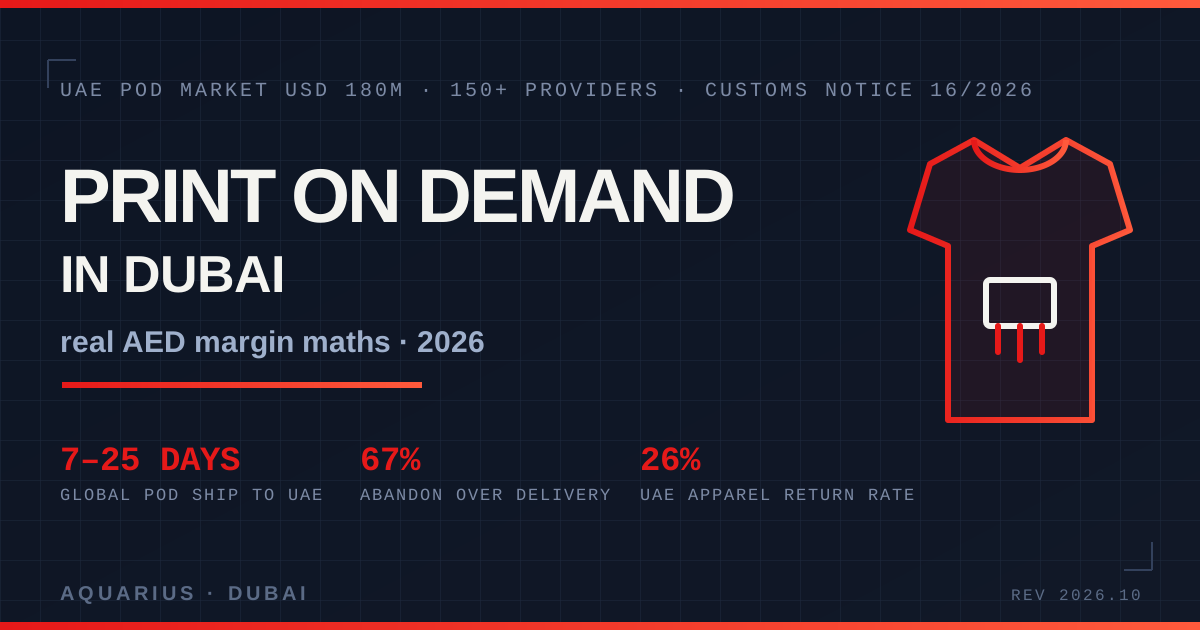
Print-on-demand works in Dubai, but the global platform model does not. A Bella+Canvas 3001 tee printed on Printful lands in Dubai at roughly AED 90 all-in and takes 7 to 25 business days to arrive; the same printed tee sourced from a Dubai DTF supplier costs AED 40 to AED 67 delivered and arrives next day. The licence is cheap — AED 1,070 in government fees on Dubai’s e-Trader route, or AED 5,750 to 12,500 in a free zone. The expensive mistake is plugging a US print network into a market where same-day delivery is the baseline expectation.
That is the whole article in two paragraphs, and it is the opposite of what most “start print-on-demand in Dubai” guides tell you. They walk you through signing up for Printify and connecting Shopify, then stop — right before the part where the maths decides whether you have a business.
Key takeaways
- Global print-on-demand is worth USD 15.19 billion in 2026, heading to USD 46.43 billion by 2031 at a 25.05% CAGR. The UAE slice is about USD 180 million, with 150+ active POD providers already operating locally.
- 70% of UAE consumers say they prefer personalised products — the demand is real and under-served.
- 67% of online shoppers abandoned a purchase over delivery options (DHL 2026 E-Commerce Trends Report). Printful quotes 7–25 business days internationally; Printify 15–30 business days to rest-of-world. That is the entire problem.
- Dubai Customs Notice No. 16 of 2026 (effective 3 August 2026) raised the duty-free parcel threshold to AED 1,000. Duty relief is not VAT relief — 5% import VAT still applies.
- UAE apparel return rates run 26% (footwear 31%). On print-to-order stock a return is near-total loss — only 48% of returned items resell at full price industry-wide, and a one-off custom print resells at none.
Three numbers that make Dubai an unusually good POD market
Start with demand, because the fundamentals here are genuinely strong.
- UAE e-commerce is USD 12.30 billion in 2026, forecast to reach USD 21.01 billion by 2031 at an 11.29% CAGR. Roughly 85% of UAE consumers shop online monthly, against near-total internet penetration and about 9.83 million social media users — the exact audience that buys creator merch, event tees and branded corporate kit.
- 70% of UAE consumers prefer personalised products. That is a personalisation preference well above most markets, in a country where a young, heavily expatriate population buys identity-signalling goods: football shirts, gym merch, nationality-themed apparel, corporate gifting.
- The UAE POD market is still only about USD 180 million against a USD 15.19 billion global market. Dubai and Abu Dhabi dominate local activity, and apparel — T-shirts, hoodies, activewear — leads the product mix. Demand outruns the supply of operators who have solved fulfilment properly.
So the market exists. The failure mode is almost never demand. It is the supply chain you pick on day one.
The mistake almost every Dubai POD store makes
“I’ll run Printify or Printful and sell to UAE customers. No inventory, no risk.”
No inventory, yes. No risk, no. Here is what that decision actually commits you to.
Delivery time. Printful’s own policy quotes roughly 7 to 25 business days for most international destinations, and specifically flags customs delays into the Middle East. Printify quotes 15 to 30 business days for rest-of-world. Add 2–5 business days of production before anything ships. Meanwhile UAE delivery expectations have moved in three years from 2–3 days (2022), to next-day standard (2024), to same-day in Dubai as the competitive baseline in 2026 for fashion, beauty and tech. You are not slightly behind the market. You are an order of magnitude behind it.
Conversion. 67% of online shoppers abandoned a purchase because of the delivery offering. A checkout that says “delivery in 15–30 business days” to a Dubai Marina customer who had groceries delivered in 20 minutes this morning does not convert at the rate your ad spend assumed. Every dirham of paid traffic you send to that page is discounted by the same factor.
Returns. UAE apparel returns run about 26%; overall e-commerce returns sit at 18–20% across categories. A faulty or poor-quality item is the top stated reason (57%), with wrong size next at 54%. Each return costs USD 10–65 to process, and only 48% of returned items resell at full price. On print-on-demand that last number collapses to zero: a custom-printed tee in the wrong size is not restockable. If your supplier is in the US and your customer is in Jumeirah, you are also paying international reverse logistics on a garment you cannot resell. This is where POD margins quietly die — see our breakdown of e-commerce returns and reverse logistics in Dubai.
Customs. Notice No. 16 of 2026, effective 3 August 2026, lifted the duty-free threshold to AED 1,000 per parcel — genuinely good news, and it covers essentially every single-tee order. But the exemption is per parcel, not per item, and duty relief is not VAT relief: 5% import VAT still applies on dutiable imports. Our full read of the AED 1,000 duty exemption covers the edges.
The margin maths, side by side
Here is a single black tee with one front print, sold to a customer in Dubai at AED 149 — a realistic market price. USD converted at AED 3.6725.
| Line | Global POD (Printful / Printify) | Dubai local print + local courier |
|---|---|---|
| Base garment + print | USD 10.98 (Bella+Canvas 3001, free plan, cheapest provider, one front print) ≈ AED 40; USD 8.77 on Printify Premium ≈ AED 32 | AED 22–35 per printed piece at 12–99 units; AED 12 at 100–499; AED 35–50 for a true one-off |
| Shipping to the customer | USD 12.49 first apparel item worldwide, +USD 6.00 each additional (Printful) ≈ AED 46; Printify rest-of-world apparel USD 8.99–18.99 ≈ AED 33–70 | AED 12–22 intra-Dubai last mile |
| Import VAT / duty | Duty-free under AED 1,000, but 5% import VAT ≈ AED 4 | Nil at import (domestic supply; 5% output VAT once registered) |
| Landed cost | ≈ AED 90 | AED 40–67 |
| Gross margin at AED 149 | ≈ AED 59 (40%) | AED 82–109 (55–73%) |
| Delivery promise | 7–25 business days (Printful) / 15–30 (Printify), plus production | Next day, same-day achievable |
| Return handling | International reverse logistics on an unresellable item | Local pickup, reprint, same-week resolution |
Read the last three rows together. The local route is cheaper, faster and recoverable. There is no trade-off to agonise over. Printify’s own benchmarks put top-selling product margins at 40–50%, with apparel at 40% and new sellers starting at 5–10%. The global-platform column lands you exactly at the apparel benchmark. The local column puts you 15–30 points above it — which is the difference between a store that can afford paid acquisition in Dubai and one that cannot.
The honest caveat: global platforms win on two things. Catalogue breadth — hundreds of SKUs you will never stock locally — and international orders, where a US buyer should be printed in the US. The right architecture is not “local instead of global”. It is routing: UAE and GCC orders to a Dubai printer, everything else to the global network, decided automatically at checkout.
Licence, VAT and the boring compliance layer
Nobody needs a “print-on-demand licence” because no such thing exists. You need a trade licence that covers e-commerce activity.
- Dubai e-Trader: AED 1,070 in government fees (licence, knowledge and innovation fees), plus AED 300 Dubai Chamber membership — AED 1,370 all-in at issuance. Restricted to UAE and GCC nationals, and it does not permit a physical shopfront.
- Free zone: roughly AED 5,750–12,500 a year, open to all nationalities, visa-eligible.
- Mainland: roughly AED 12,000–25,000 all-in once office, visa and PRO costs are counted.
Approval typically runs 7–14 days. The licence creates no tax exemption: VAT registration is mandatory above AED 375,000 of taxable supplies and imports in the preceding 12 months, or where you expect to cross it within 30 days, with voluntary registration available from AED 187,500. If you sell printed goods to UAE customers you are making domestic supplies at 5% once registered. The same ground is covered in more depth in our Dubai dropshipping licence and margin guide and the e-commerce licence cost breakdown.
What actually drives sales once the plumbing works
Printify’s seller data is unusually specific, and it contradicts the “upload 1,000 designs” advice that dominates POD content.
- Products with 1–2 design elements convert about 70% better than busier designs. Single-element designs account for 56% of eligible sales, two-element for 24%.
- 1–5 colour options outperform wider variant sets by a similar margin. More variants is not more revenue; it is more dead SKUs.
- Median time to the first USD 1,000 in revenue is 165 days; sellers who get there faster do it in under 118 days, with about 67 designs published and a cadence of 10 new listings a week.
Translated: this is a volume-of-attempts game with simple designs, which means your store has to make publishing cheap. A storefront where adding a product means a manual mockup, a manual variant matrix and a manual price calculation caps you at a fraction of ten listings a week. That is a software problem, not a design problem.
What it costs to build the store properly, and how Aquarius does it
The platform is the cheap part. The order-routing and automation layer is where the money goes — and where the 15–30 margin points live.
| Scope | What you get | Typical AED | Timeline |
|---|---|---|---|
| Launch store | Shopify or WooCommerce storefront, bilingual EN/AR, mockup-driven product templates, Apple Pay / Google Pay / Tabby, AED pricing, VAT configured | AED 14,000 – 28,000 | 2 – 4 weeks |
| Local fulfilment routing | Geo rules sending UAE and GCC orders to your Dubai printer and the rest to the global network, with per-route cost and SLA tracking | AED 18,000 – 42,000 | 3 – 5 weeks |
| Printer integration | Automated job tickets to the print supplier (print-ready file, size, placement, courier label) with status webhooks back to the order | AED 22,000 – 55,000 | 4 – 7 weeks |
| Design-to-SKU pipeline | Upload-once publishing: auto mockups, variant matrix, margin-based pricing, bulk listing to the store and marketplaces | AED 26,000 – 60,000 | 4 – 8 weeks |
| Returns and reprint workflow | Customer-facing return request, size-exchange reprint logic, cost-per-return reporting | AED 12,000 – 26,000 | 2 – 3 weeks |
Now the cost of not doing it. Take a store doing 400 orders a month at AED 149. On the global-platform model at 40% gross margin that is AED 23,840 of gross profit a month. On the local-routing model at 60% it is AED 35,760 — AED 11,920 more per month, AED 143,040 a year, on identical revenue. The routing layer pays for itself in roughly two to four months, before you count the conversion lift from replacing “15–30 business days” with “tomorrow” against that 67% delivery-driven abandonment figure.
We build the store and the routing, not the prints — you keep your own supplier relationships and we integrate whoever gives you the best AED per piece. If you want the printing handled too, our Dubai t-shirt and uniform printing rates are published openly. Every build ships with the cost model wired into the admin, so you can see landed cost and true margin per order rather than guessing at month end. See transparent pricing, review our engineering and e-commerce services, or book a 30-minute scoping call — bring your current supplier quotes and we will run your numbers through the table above on the call.
Frequently asked questions
Is print-on-demand profitable in Dubai in 2026?
Yes, if you fulfil locally. The maths: a tee landed from a global POD network costs about AED 90 delivered to a Dubai address, against AED 40–67 from a Dubai printer with local courier. At an AED 149 retail price that is a 40% gross margin versus 55–73%. Printify’s own benchmarks put apparel at 40% and new sellers at 5–10%, so the local route is the difference between benchmark and genuinely good.
Can I use Printful or Printify in the UAE?
You can, and for international orders you should. For UAE customers the problem is delivery: Printful quotes 7–25 business days for most international destinations and flags Middle East customs delays, while Printify quotes 15–30 business days to rest-of-world. In a market where same-day Dubai delivery is the 2026 baseline and 67% of shoppers abandon over delivery options, that becomes a conversion tax on every order.
What licence do I need for a print-on-demand business in Dubai?
An e-commerce trade licence. Dubai’s e-Trader route costs AED 1,070 in government fees plus AED 300 Dubai Chamber membership but is limited to UAE and GCC nationals. A free zone licence runs roughly AED 5,750–12,500 a year and is open to all nationalities; mainland is roughly AED 12,000–25,000 all-in. Approval usually takes 7–14 days.
Do I pay customs duty on print-on-demand items shipped into the UAE?
Under Dubai Customs Notice No. 16 of 2026, effective 3 August 2026, parcels valued up to AED 1,000 clear duty-free — which covers virtually every single-garment POD order. The threshold is per parcel, not per item, and duty relief is not VAT relief: 5% import VAT still applies on dutiable imports, and bulk commercial consignments pay duty from the first dirham.
Do I need to register for VAT?
Mandatory once taxable supplies and imports exceed AED 375,000 over the preceding 12 months, or where you expect to cross that within the next 30 days. Voluntary registration is available from AED 187,500. The e-Trader licence creates no VAT or corporate tax exemption.
How do returns work on custom-printed products?
This is the biggest hidden cost. UAE apparel returns run about 26% and footwear 31%, with poor quality (57%) and wrong size (54%) the top reasons. Each return costs USD 10–65 to process and only 48% of returned items resell at full price industry-wide — for a custom print, effectively none do. Mitigate it with accurate size charts, mandatory size confirmation at checkout, and a local reprint-and-exchange workflow instead of a refund-and-ship-back loop.
How many designs do I need before this starts working?
Printify’s seller data puts the median time to USD 1,000 in revenue at 165 days, with faster sellers getting there in under 118 days having published around 67 designs at about 10 new listings a week. Keep designs simple: 1–2 design elements convert roughly 70% better than busier artwork, and 1–5 colour options outperform wider variant sets.
Sources: Mordor Intelligence print-on-demand market size and CAGR (2026–2031), via Printify print-on-demand statistics 2026; Printify seller benchmarks (margins, time-to-revenue, design-element conversion); Ken Research, UAE Print on Demand Market (USD 180 million, 150+ providers, 70% personalisation preference); Mordor Intelligence UAE e-commerce market size 2026–2031; Printful shipping policy and rate card; Printify shipping rates and delivery estimates; DHL 2026 E-Commerce Trends Report (67% delivery-driven cart abandonment); UAE e-commerce return-rate benchmarks 2026; Dubai Customs Notice No. 16 of 2026 (effective 3 August 2026); Dubai Economy e-Trader fee schedule; UAE Federal Tax Authority VAT registration thresholds; published 2026 Dubai DTF and DTG supplier price lists. AED conversions at USD 1 = AED 3.6725. Pricing and licence costs are indicative — confirm current fees with DET and your tax advisor.